Logistics & Mobility
Logistics Software Development
Fleet, delivery and EV-logistics platforms built to survive real operations.
Planning your budget? Cost out a logistics platform.
Logistics & Mobility sub-services
ExploreFleet Management
Vehicle tracking, dispatch, maintenance and driver management, fleet software built for real operations.
ExploreLast-Mile Delivery
Live tracking, route optimization and proof of delivery, paired customer and driver apps built end to end.
ExploreWarehouse Management (WMS)
Receiving, putaway, picking, packing and stock control, warehouse systems built for throughput.
ExploreSupply Chain Management
Procurement, inventory, orders and visibility across the chain, supply chain platforms built to scale.
ExploreWe build the software that moves vehicles, orders and people, and keeps working when the fleet triples.
We build the software that moves vehicles, orders and people: real-time fleet and shipment tracking, route optimization, dispatch consoles, driver apps and the integrations that tie them to the TMS, WMS and ERP you already run. We're a small senior studio in Surat, India, and we've shipped last-mile delivery platforms, an EV-logistics fleet system and a shipper-carrier marketplace: work where the demo looks easy and the third month decides the project.
Most logistics software pages are a list of nouns. This one is mostly about the parts that go wrong, because that's the only useful thing an agency can tell you before you've signed anything. If you want the number first: our Scoping Sprint is $2,300, fixed, two weeks, ending with a clickable prototype, a technical plan and a fixed quote, credited in full if you build with us.
The systems, and how they fit together
Logistics software isn't one product. It's usually four or five systems that have to agree with each other about where a vehicle is and what it's carrying.
Real-time fleet and shipment tracking. Live vehicle positions, geofences that fire on entry and exit, ETA prediction, trip history and playback. The interesting part is never the map, it's the ingestion pipeline behind it, and whether it still works when the fleet triples.
Route optimization and dispatch. Assigning stops to vehicles under real constraints: capacity, time windows, driver shifts, multiple depots, pickup-and-delivery pairs. In practice that's a Vehicle Routing Problem, and we build it with proper solvers rather than a "nearest stop next" loop that looks fine on ten stops and falls apart at two hundred.
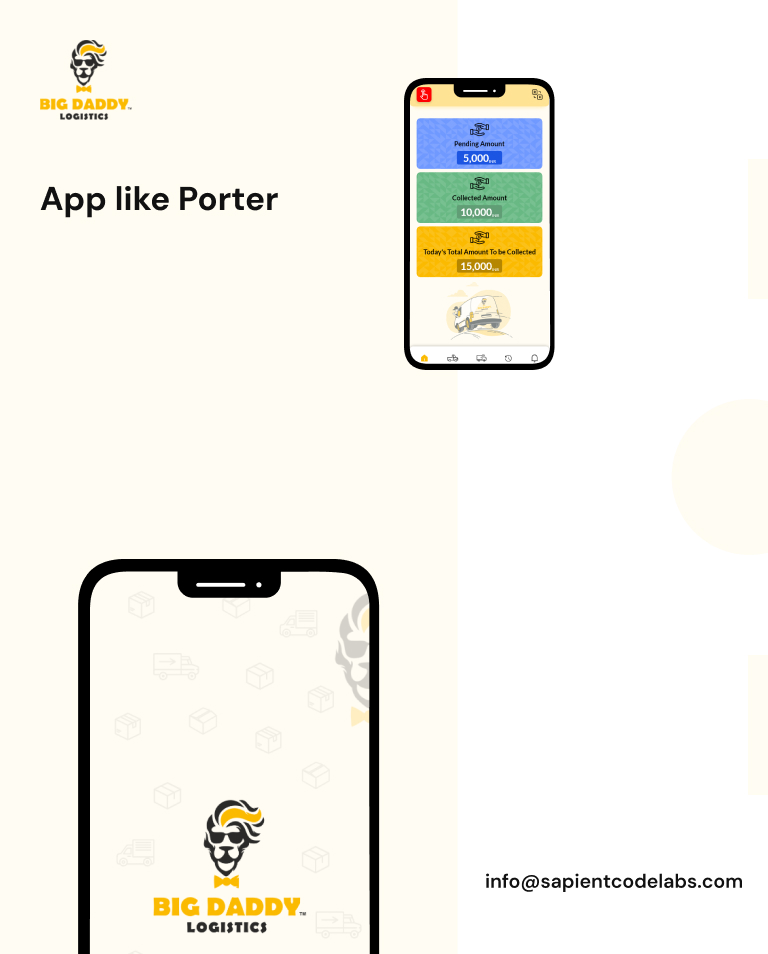
Last-mile delivery platforms. The full triangle: a customer app or web flow for booking and tracking, a driver app for the job, and an admin panel for the people who fix things when a driver goes dark. Proof of delivery with photo and signature capture, status transitions, ratings, and the reconciliation reporting finance actually asks for. Roughly what we built for Bigdaddy Logistics.
Driver and delivery-partner apps. OTP login because drivers lose passwords, big tap targets because they're wearing gloves, offline queuing because coverage dies in basements, and attendance flows that survive a manager who doesn't trust GPS alone.
TMS, WMS and ERP integrations. Order feeds, shipment status writebacks, inventory sync, invoicing and settlement, usually against a SOAP endpoint, a nightly flat-file drop, or a database someone will let you read but not write. We treat integration as a first-class workstream with its own risk budget.
Ops dashboards, reconciliation and reporting. The screen a dispatcher lives in for eight hours: exceptions first, live map second, everything else on demand. Plus the load-bearing boring stuff: trip reconciliation, driver payouts, client invoicing, GST-compliant documentation.
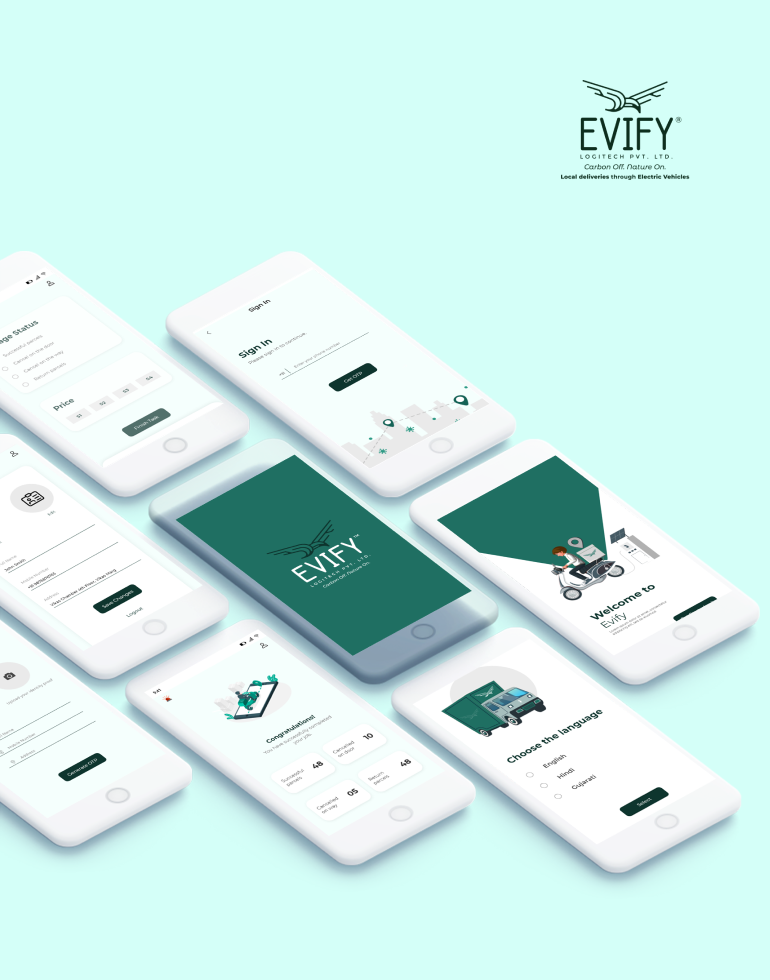
EV-logistics and charging operations. A different shape: state of charge instead of fuel level, range as a routing constraint, charging-slot scheduling as a dispatch input, and compliance documents (PUC, RC, insurance) with expiry dates someone must be reminded about. We built exactly this for Evify.
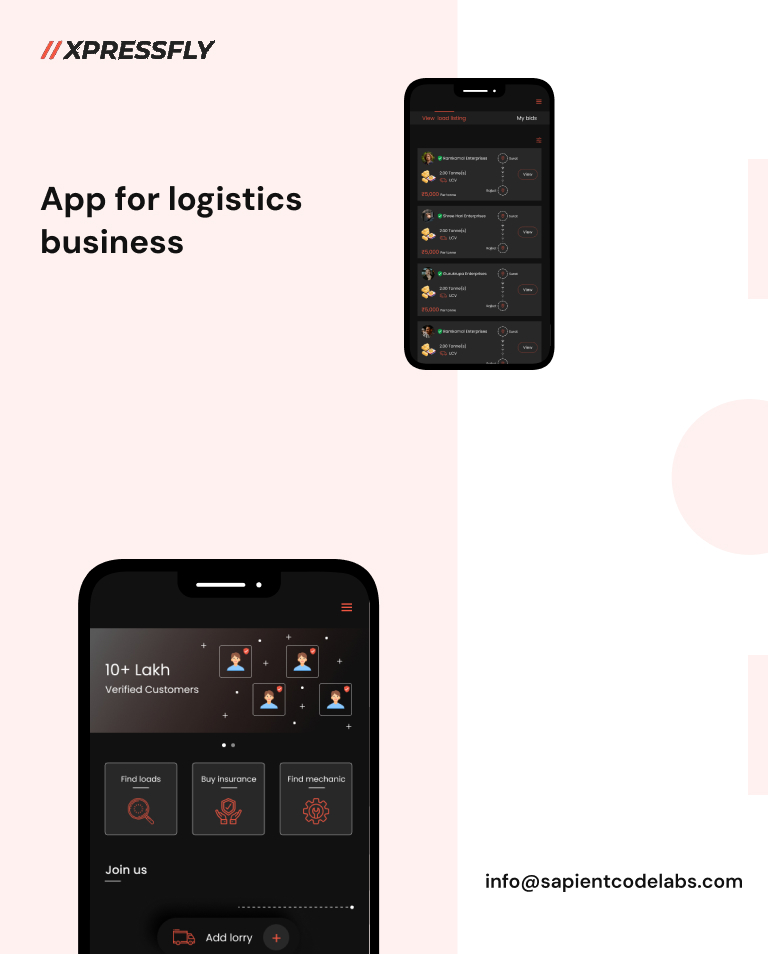
Marketplace and brokerage models. Shipper posts a load, carriers bid, platform takes a cut, where the hard parts are verification, bidding and payouts. Built for Xpressfly.
If your need is narrower, we have dedicated pages for fleet management, last-mile delivery apps, warehouse management, inventory management and supply chain platforms.
The hard parts nobody scopes properly
Every logistics proposal you receive will price the screens. Screens are the cheap part. Here's what actually consumes the budget, and what we do about each. If a vendor can't talk about these four things unprompted, they haven't shipped logistics software.
1. Real-time tracking doesn't scale the way the demo suggests
A live map with fifty vehicles is a weekend project. A live map with five thousand vehicles reporting every few seconds is a distributed systems problem, and the failure mode is nasty: everything works, then a growth month arrives and the tracking service starts dropping connections at 3pm every day. The trap is architectural. Naive WebSockets pin every connection to one server process, so your ceiling is a per-node memory limit, a deploy drops every vehicle at once, and adding a second server means a dashboard on node A never hears about a vehicle on node B.
What we build instead, detailed in our MQTT and Redis optimization guide:
- MQTT for the vehicle leg, WebSockets for the browser leg. MQTT was designed for exactly this: constrained devices, flaky cellular links, tiny payloads. Brokers like Mosquitto, EMQX or HiveMQ cluster natively, so capacity means adding broker nodes rather than rewriting ingestion.
- QoS tiering, deliberately. Routine location pings ride QoS 0, because a lost ping is replaced two seconds later. Geofence breaches, emergency alerts and delivery confirmations get QoS 1, because losing one is a support ticket. QoS 2's four-part handshake is reserved for commands that must execute exactly once. Teams that put everything on QoS 2 "to be safe" pay in throughput.
- Redis as the state layer, not just a cache. Vehicle state in hashes for O(1) reads; geospatial indexes so "which vehicles are in this zone" and "nearest available driver" are single commands rather than table scans; pub/sub to fan updates out to every dashboard process, which is what makes horizontal scaling possible at all.
- Payload discipline and sticky sessions. Binary encoding instead of JSON, delta updates instead of full state objects, adaptive reporting intervals, and reconnecting vehicles routed back to the same node. On cellular fleets that's a line item on the SIM bill, not a performance nicety.
The dashboard side needs the same discipline: JWT auth at socket connect, WSS not WS, viewport culling, clustering at low zoom, and a time-series database for history, the architecture in our Socket.io and Mapbox GL write-up.
2. Route optimization is NP-hard, and pretending otherwise is expensive
"Add route optimization" is one sentence in a brief and an entire research field in reality. The Vehicle Routing Problem is NP-hard: no algorithm finds the provably optimal answer for a real fleet in a time anyone will wait, and capacity limits, time windows, shift rules, multiple depots and pickup-delivery pairing make it harder. So the honest goal is never "optimal", it's a very good solution, inside a time budget, respecting every hard constraint. The practical route there:
- Use a real solver. We build on Google OR-Tools, which handles the standard variants directly: capacitated VRP, VRP with time windows, pickup-and-delivery, multi-depot and periodic routing, using constraint programming with local search. It reaches strong solutions in seconds where a hand-rolled greedy heuristic produces routes a dispatcher quietly overrides. Detail in our OR-Tools routing guide.
- Budget the solve time explicitly. The solver improves for as long as you let it run. Ten seconds versus two minutes is a product decision, because overnight batch planning and live re-dispatch are different products, and it needs deciding in discovery, not in production.
- The distance matrix is the real cost centre. Quality is capped by travel-time accuracy, which means live traffic data from a mapping provider. Those calls are billed, and an n-stop problem needs n² of them. Caching and geocoding hygiene are architecture decisions with a monthly invoice attached.
- Time windows create waiting, and waiting is real. Arrive early and the vehicle idles until the window opens; model that or your plan is fiction. Service time per stop, unloading, signature, a locked gate, matters as much as drive time, and it's the number operators most often haven't measured.
- Re-optimize incrementally. Full mid-shift replanning produces churn drivers hate. We re-solve within bounds: reassign what needs it, hold the rest.
Where AI helps, it helps at the edges: predicting service times and traffic from your historical data, and orchestrating exception handling around the solver rather than replacing it. See our three AI approaches to last-mile routing and a multi-agent dispatch agent built with CrewAI and Google Maps. An LLM is not a routing engine and we won't sell you one as if it were.
3. Driver apps have to work with no signal and a dying battery
The driver app is where most logistics projects actually fail, for unglamorous reasons. Drivers work in loading bays, basement car parks, industrial estates and rural gaps. If the app needs connectivity to record a delivery, the delivery doesn't get recorded and your data is wrong by the end of week one.
Offline-first isn't a feature you add later; it changes the data model. Every state change queues locally and syncs when a connection returns, so every write needs an idempotency key and a conflict rule. What happens when a driver marks a stop delivered offline and dispatch cancels it centrally in the same window? That should be decided by you in discovery, not by an engineer at 11pm.
Then there's the phone. Continuous high-accuracy GPS flattens a battery before a shift ends, and a dead phone is a vehicle that has vanished from your map. The fix is adaptive sampling: high accuracy while moving and near a stop, coarse while parked, using distance filters rather than time intervals. Background location and battery-optimization behaviour is the most platform-specific part of the build on both Android and iOS, needs real-device testing across handsets, and is routinely missing from cheap quotes.
GPS accuracy deserves honesty too: urban canyons produce drift of tens of metres, so naive geofences fire spuriously and proof-of-delivery-by-location alone is not evidence. We smooth traces, require dwell time before a geofence event, and pair location with something harder: a scan, a photo, an OTP. That's why the Evify driver app uses selfie and QR check-in rather than trusting coordinates alone.
4. The legacy TMS/ERP integration is the schedule risk
The system of record is rarely modern and never yours. Expect SOAP, EDI, nightly CSV drops on SFTP, a read-only database replica, or an API with an undocumented rate limit you discover by hitting it, and expect the vendor to charge for access and take weeks to grant credentials.
Three rules we work by. Sandbox access before the estimate: we won't give a confident integration number without seeing the interface, and a vendor who does is guessing. An anti-corruption layer, always: a clean internal model with one adapter per external system, so when the TMS changes the blast radius is one module. Assume the sync is eventually consistent and design the ops UI for it: show operators when data was last confirmed, give them a manual reconciliation path, because the alternative is a dispatcher who stops trusting the screen. For temperature-controlled operations, add sensor telemetry to the same picture, as in our cold-chain IoT article.
One consequence: there is no maintenance window in logistics. The vehicles move tomorrow whether or not your cutover went well, so we ship in slices that run alongside the incumbent system: one depot, corridor or vehicle class at a time, with a rollback that's a config change rather than a restore.
Proof
Three logistics platforms we've taken to production, described exactly as they are. We don't publish outcome metrics we haven't had approved by the client, and you should be sceptical of agencies that do.
Evify Logitech, EV-logistics fleet and driver platform. Eveeto, the logistics arm of Evify®, runs intra-city delivery using only electric two- and three-wheelers, and needed to track drivers and deliveries and manage the fleet properly. We built an admin panel and a deliberately simple driver app: vehicle records with generated QR codes, expiry reminders for PUC, RC and insurance, role-based access control, driver login approval, location checks, payroll based on work completed, and customer invoicing from that same record. The driver app is OTP login, a selfie to confirm presence on location, QR scan to check in a vehicle, photo capture of worksheets, and pickup/drop status. Kotlin, Node.js, MongoDB and AWS, with Google Maps and an SMS gateway. Evify raised USD 100k in seed funding, their milestone rather than ours. See the project →
Bigdaddy Logistics (Shakti Logistix), last-mile parcel delivery platform. Connecting users with drivers for parcel delivery across four surfaces: customer mobile app, driver mobile app, customer web app, and an admin panel running the whole delivery process. Booking, real-time parcel tracking, status updates, payments and ratings on the customer side; real-time order assignment, route optimization, navigation assistance and status updates on the driver side. The admin panel covers order, user, driver and payment management plus analytics and reporting. Vue.js, Java and Swift on the front ends, Laravel (PHP) and MySQL behind them, Razorpay, AWS, and Google Maps plus SMS, email and GST APIs. See the project →
Xpressfly, shipper-carrier marketplace. A Porter-style marketplace connecting shipping needs to carriers ready to deliver. Customers post shipment details in a few taps and receive competitive bids from a network of verified carriers; the admin panel handles manual customer verification, accounting and payouts to truckers, and reporting. Flutter, Node.js, MongoDB and AWS, with Google Maps, Firebase Cloud Storage, an SMS gateway and Aadhaar API verification. See the project →
Across all three, the same pattern: a driver-facing app that works in the field, an admin surface where the operation is actually run, and payouts that have to reconcile. The rest is on the portfolio page.
What it costs
Most agencies won't put numbers on an industry page. We publish ours, because "it depends" wastes everyone's time:
- A production-ready MVP, one fleet, one corridor, tracking plus a driver app, typically runs $5,000–$25,000. Tier breakdown in our MVP cost guide.
- A custom web application such as a dispatch console runs $5,000–$50,000+ depending on scope. See the web app cost guide.
- A mobile app across iOS and Android, driver, customer, or both, typically lands at $10,000–$50,000 for a funded v1. The mobile cost guide has the feature-level arithmetic.
- A SaaS logistics platform spans $5,000–$150,000+ from single-tenant pilot to scaled multi-tenant product, priced out in the SaaS cost guide.
Our blended rate is about $20/hour for a senior team; the same scope from a US or Western European agency runs $120–$250/hour. That spread is cost of living, not skill, with the honest caveat that offshore goes wrong when a body shop puts five juniors under a distant architect. What predicts a good outcome is that you talk to the engineers directly, the team is small and senior, and you see working software every sprint.
Two logistics-specific budget lines belong in your plan from day one: mapping and traffic API spend, which scales with stops and re-optimization frequency rather than users, and cellular data across the fleet.
Those are honest general ranges, not quotes. To get a real number for your operation, start with the Scoping Sprint: $2,300, fixed, two weeks. You get a clickable prototype, a technical plan and a fixed quote for the build, credited in full if we build it together. It's the only figure on this site that's a firm offer. How it works →
Where we're not the right fit
Worth saying plainly, because finding out in month two is expensive for both of us.
You need telematics hardware built. We integrate with OBD dongles, trackers, sensors and gateways; we don't design, certify or manufacture them. If your product needs a device engineered and put through regulatory approval, you need a hardware partner. We'll build the software half alongside them.
You need a 40-person squad next month, or people on site. We're a small senior studio by choice, not by growth stage, working remotely from India with overlap hours committed in writing. If your programme genuinely needs six parallel squads, or your process requires people in your building or a vendor already on an approved list, a large systems integrator is the right shape. If you were merely told you need forty people, it's worth a second opinion: a lot of logistics programmes are three good engineers and a decision-maker who answers questions.
You want optimization guaranteed as a percentage. Nobody can honestly promise "cut fuel costs 30%" before seeing your route data. The gain depends on how good your current planning is, and some operations are already near their practical floor. We'll model expected improvement against your real historical routes during the Scoping Sprint and tell you if the number is unexciting.
You want the cheapest possible build. Offline sync, connection scaling and integration hardening cost real hours. A quote that skips them isn't cheaper, it's incomplete.
Related reading
The engineering write-ups behind the sections above, all by our team, all with working code or concrete architecture:
- 5 Ways to Optimize Logistics Fleet Tracking WebSocket Connections with MQTT and Redis
- How to Optimize Last-Mile Delivery Routes with OR-Tools and Python
- Building Real-Time Freight Tracking Dashboards with Socket.io and Mapbox GL
- How to Build an AI Logistics Dispatch Agent Using CrewAI and Google Maps
- 3 Ways to Solve Last-Mile Delivery Routing Problems with AI
- Revolutionizing Cold Chain Logistics with IoT Technologies
What we build
Capabilities- Real-time fleet & shipment tracking
- Route optimization & dispatch
- Last-mile delivery platforms
- Driver & delivery-partner apps
- TMS, WMS & ERP integrations
- Ops dashboards, reconciliation & reporting
- EV-logistics & charging operations
- Marketplace & brokerage models
How we work
Process- 01
Discovery & ops mapping
We map the operation, not the wishlist: routes, roles, shift patterns, exception handling, and what your dispatchers currently do in spreadsheets and WhatsApp at 6am, because the real workflow is never the documented one. You leave with a prioritised roadmap to a first release, a technical approach, and an explicit list of what we are not building yet.
- 02
Design & architecture
Dispatcher and driver interfaces built for speed and glanceability rather than for a portfolio shot, plus the decisions expensive to reverse: ingestion and broker topology, the routing engine and its time budget, the offline sync model, the integration boundary, and where state lives.
- 03
Build & integrate
Two-week sprints with demoable software at the end of every one. You see the board, you join the demos, you always know what's next. Integrations start early rather than at the end, because that's the workstream most likely to slip and you want to find out in week three, not week fifteen. Typically React and Node on the web, Flutter for driver and customer apps, Python where the optimization lives, AWS underneath.
- 04
Launch & scale
Phased rollout by depot or corridor, load testing against realistic connection counts before you need it, and monitoring from day one. Most clients keep us on for iteration and scaling.
Frequently asked
Do you build real-time vehicle and shipment tracking?
Yes: live GPS tracking, geofencing, ETA prediction and trip history, powering both customer-facing tracking and internal dispatch. We build the ingestion layer for scale from the start, typically MQTT for the vehicle leg, WebSockets to the browser, and Redis holding live state.
How many vehicles can the platform handle?
That's an architecture question, not a product limit. Clustered MQTT brokers with Redis-backed state and stateless app nodes scale by adding nodes. The real ceiling is set by reporting frequency, payload size and history retention, decisions we make in discovery and load-test before you need the headroom.
Can you integrate with our existing TMS, WMS or ERP?
Yes, and that's most logistics projects. REST and GraphQL, but also SOAP, EDI, flat-file drops and read-only database replicas. We ask for sandbox access before giving a confident estimate, and build an adapter layer so a future change to that system doesn't ripple through your platform.
How do you handle route optimization?
With a real solver, usually Google OR-Tools, covering capacity, time windows, multiple depots, pickup-and-delivery pairs and shift rules. The Vehicle Routing Problem is NP-hard, so the goal is a strong solution inside an agreed time budget, not a provably optimal one.
Will the driver app work without signal?
It has to, so yes. Actions queue locally and sync when connectivity returns, with idempotent writes and defined conflict rules so an offline delivery and a central cancellation can't corrupt each other. We also tune location sampling so a shift doesn't end with a dead battery.
Have you built EV-logistics platforms?
Yes, the fleet and driver platform for Evify's logistics arm, which runs intra-city delivery entirely on electric two- and three-wheelers: vehicle records with QR codes, compliance-document expiry reminders, role management, driver attendance, payroll and invoicing.
How much does logistics software development cost?
An MVP typically runs $5,000–$25,000; a dispatch or ops web app $5,000–$50,000+; driver and customer mobile apps $10,000–$50,000; a multi-tenant SaaS platform $5,000–$150,000+. Our cost guides break each down by tier and feature, and the $2,300 Scoping Sprint ends with a fixed quote. Budget separately for mapping API and cellular data, both of which scale with your fleet rather than your build.
How long before something is live?
Two-week sprints with demoable software at the end of each, and rollout by depot or corridor rather than a single switch, so a first depot can be live well before the full platform is finished. A realistic first launch is a few months depending on scope and how quickly integration credentials arrive.
Related insights
All posts →How to Build an App Like Porter: Dispatch, Drivers and Payouts
Fleet Management Software Development: Modules, Cost, On-Premise
How to Build Real-Time Freight Tracking with WebSockets and AI Agents
IoT in Cold Chain Logistics: An Adoption and Build Guide
Solving Last-Mile Delivery Route Optimization with Python, Google OR-Tools, and Real-Time Traffic APIs
Building Real-Time Freight Tracking Dashboards with Socket.io and Mapbox GL
Revolutionizing Fleet Management: How to Build an AI Logistics Dispatch Agent Using CrewAI and the Google Maps Platform
5 Ways to Optimize Logistics Fleet Tracking WebSocket Connections with MQTT and Redis
Building a product for this sector?
Start with a 2-week Scoping Sprint. We pin down exactly what to build and what it costs before you commit. Fixed price, credited against the build.