MVP Development
MVP Development
A production-ready MVP in weeks, the smallest real product that proves your idea with users. Built in India, priced in public.
Planning your budget? See what an MVP costs to build.
We help you ship the core, not the kitchen sink, fast enough to learn before the runway runs out.
We build the smallest real version of your product, the one actual users can sign up for, use and pay for, and we ship it in 4–8 weeks for a lean build ($2,500–$3,500) or 8–16 weeks for a funded one ($5,000–$25,000). Not a prototype, not a demo, not a stripped-down draft you throw away in six months: a working product with real auth, real data, real payments where you need them, and analytics wired in from the first sprint so it can answer the question you built it to answer.
Those prices are published, not teased. The tier-by-tier and feature-by-feature arithmetic is in our MVP cost guide, and the one figure on this site that's a firm offer rather than guidance is the Scoping Sprint: $2,300, two weeks, credited in full against the build if you go ahead with us.
What an MVP is, and what it isn't
This is where most of the money gets wasted, so we'll be blunt.
An MVP is the smallest version of your product that a real stranger can use to get a real outcome, and that you can learn something true from. "Minimum" describes the scope. "Viable" describes the quality. Founders who get burned almost always lost one of those two words.
An MVP is not a cheap version of the full product. Write the full spec, then ask for it at a third of the price, and you get the full spec at a third of the quality: every flow half-finished, nothing solid enough to charge for. That's a discount, not an MVP, and it's the most common way a first build fails. The way to spend less is to build fewer things properly, never the same things worse.
An MVP is not a prototype either. A prototype, a Figma flow, a clickable mock, a technical spike, proves something can look right or can technically work. It has no users, no data and no truth in it. That work is useful and cheap, and if it's what you need you should buy it instead: a proof of concept runs $500–$2,500 over 2–4 weeks. But a prototype can't tell you whether people come back on Tuesday, and that's usually the question deciding whether the company exists.
An MVP is not throwaway code. We build the core on a foundation the full product can grow from. There are shortcuts we take gladly, such as manual back-office steps, off-the-shelf auth, one platform instead of three, and shortcuts we won't, like skipping code review on a payments flow or shipping without event tracking. The first kind saves you money; the second quietly charges you double six months later, when you can least afford a rebuild.
So the honest test isn't "is it small enough?" It's this: can a real user complete the core journey end to end, and can you see what they did? Everything else is negotiable.
What you get
An MVP engagement produces a product and the means to learn from it, both, or the engagement was pointless:
- A live, working product in production, on your infrastructure, with real accounts and real data.
- One or two core user journeys built properly, not five built partially. Choosing which is the first thing we do together, and the hardest.
- Product design and a clickable prototype of those flows, signed off before a line of production code exists.
- Real authentication, real data model, real permissions: the unglamorous parts that decide whether v2 is an extension or a rewrite.
- Payments where the model needs them: Stripe one-off, subscriptions, or Connect split payments for marketplaces.
- An admin panel, so you can operate the thing without asking an engineer for a database query.
- Analytics and event tracking from day one, instrumented against the specific question the MVP exists to answer.
- Cloud hosting, CI/CD, environments and monitoring: staging and production, deploys that are boring on purpose.
- QA and a security pass: code review on every change, automated tests on critical paths, dependency scanning, environment isolation. (How we work has the detail.)
- Full handover: source code, infrastructure, IP and documentation in your name. No lock-in, nothing that needs us to keep running.
- A prioritised list of what to build, fix or kill next, written from what users actually did rather than what we all assumed.
Investor-ready in weeks, not months
"Investor-ready" usually gets used as a mood. Here's what we mean by it concretely: four things, all checkable, none aspirational.
1. A working product a real user can use unaccompanied. Not a video, not a click-through, not a staging link that survives only the happy path. An investor who asks "can I try it?" gets a URL, signs up as a stranger, and reaches the value without you in the room. The number of pitches that fall apart at that exact request is why this is item one.
2. Metrics instrumented from the first sprint. Analytics goes in at the start, not bolted on before a raise. Asked what your activation rate is, how many of last month's signups came back, or where people drop out of onboarding, you answer from a dashboard rather than a feeling. An MVP without event tracking can't answer the only question it was built to answer.
3. A demo that doesn't need excuses. No "ignore that", no "that bit's coming", no reload before the payment step. That's a design and QA outcome, not luck: the flows in the demo are the flows we hardened, and the polish budget goes on the journey you'll show rather than spread thin across features nobody asked about.
4. A technical story that survives diligence. Eventually a partner's technical advisor asks about the data model, what happens at 100x load, how auth and permissions work, what's custom versus bought, and what the rebuild risk is. That call goes well when the architecture was written down and defensible before the build started, which is exactly what the Scoping Sprint's technical plan is for.
What "in weeks" honestly means: a lean MVP typically takes 4–8 weeks; a funded MVP 8–16. We don't promise a two-week app, because two-week apps are demos. What we commit to is working software in a shared environment every cycle, so you're never waiting until week ten to find out whether the build is real.
One caveat worth more than the rest: an investor-ready product is not a fundable company. What raises money is evidence, users doing the thing repeatedly. The MVP's job is to generate that evidence fast and cheap enough that you still have runway when it arrives. Anyone telling you the software itself is the pitch is selling software.
Start here: the Scoping Sprint
Most builds start with a two-week Product Scoping Sprint, $2,300, fixed price. It exists because hiring a dev team cold is a leap of faith: quotes vary wildly because everyone is guessing at scope, and you can't tell who actually understood your product until you're months in.
You get four things: a clickable prototype of your core journey, ready to put in front of users, advisors or investors; a technical plan covering architecture, data model and stack choices, written so a technical advisor can audit them; a ruthless scope, the version-one feature list, what we cut and why each cut makes you faster; and a fixed quote and timeline. A number, not a range.
The terms: $2,300 fixed, credited 100% against the build, no lock-in, and every artifact is yours and usable with any team. It costs you 4–6 hours across the two weeks, we sign an NDA before the first workshop as standard, and we run two sprints a month, so slots are limited. If the idea is still looking for a problem, we'll say so on the intro call.
What it costs
Most agencies won't put a number on a services page. We publish ours, because "it depends" is a tax on founders' time:
| Tier | What it is | Price | Timeline |
|---|---|---|---|
| Proof of Concept | A single-flow prototype or technical spike to prove one risky assumption. Not production-grade. | $500–$2,500 | 2–4 weeks |
| Lean MVP | One core use case, clean UX, real auth and data. Enough to onboard first users and charge them. | $2,500–$3,500 | 4–8 weeks |
| Funded MVP | Several connected flows, payments, admin tooling and analytics, built to scale into v2. | $5,000–$25,000 | 8–16 weeks |
Three things make those numbers real rather than marketing:
They assume a senior team at offshore rates. We are an MVP development agency in India, based in Surat, Gujarat, and ours blend to about $20/hour. A US or Western European agency charges $120–$250/hour for the same seniority and quotes $40,000–$150,000+ for the same scope. That spread is cost of living, not skill. The risks of offshore development are real too; what predicts a good outcome is talking directly to the engineers building your product, a small senior team, overlap hours guaranteed in writing, and working software every week instead of slide decks.
What working with an Indian MVP development agency actually looks like. India runs four and a half to five and a half hours ahead of the UK and the same distance behind eastern Australia, depending on daylight saving at your end, so there is a real overlap window with both rather than a handover email. Most of our clients are in the UK, Australia and Canada. You own all the intellectual property and you have repository access from day one rather than at handover, which means you can read the commit history as it happens or take a working codebase away at any point. We have shipped over a hundred products in seven years to sixty-plus clients, and ninety-five percent of them stay with us after the first build.
They assume one platform first, usually responsive web, or one cross-platform mobile codebase. Add native mobile alongside a web product and a typical build moves from roughly $5,000–$15,000 to roughly $10,000–$30,000.
The biggest variable isn't on the table. It's scope discipline. The same idea specced by two founders lands in two different tiers, and the number of core flows is the largest driver, because every flow adds design, build and test. Founders add "oh, and a seller dashboard" in one sentence; that sentence is a second application.
Budget two things beyond the build: infrastructure and third-party services at typically $60–$400/month early on, and 15–20% of the build cost per year for maintenance and iteration. The entire output of an MVP is a list of changes, and an MVP you can't afford to change was pointless.
The MVP cost guide has the full breakdown: cost per feature at real hourly rates, the seven variables that move a quote, a worked marketplace example, and how to cut cost without invalidating the MVP. If your build is more SaaS than MVP, or mobile-first, the SaaS, mobile app and web app guides run the same arithmetic.
None of the above is a quote. They're honest general ranges. The way to get a real number for your product is the Scoping Sprint: $2,300, two weeks, ending in a fixed price we commit to, because it's an engineering estimate against a prototype and a written plan rather than a guess against a paragraph.
Proof
We've shipped 100+ products, many of them somebody's first version. A few that are public:
- FeastQuest, a marketplace for culinary experiences across host, guest and admin sides: listing and pricing tools, booking with payments, reviews, moderation and analytics. Flutter and React front end, Node and MongoDB on AWS, with Google Maps, AWS SES and a payment gateway.
- FitConnect, a fitness platform across four surfaces (client app, trainer app, gym panel, admin): custom workout and nutrition plans, progress logging, in-app messaging, membership and scheduling. Flutter, Node, MongoDB, AWS, Firebase for chat and storage.
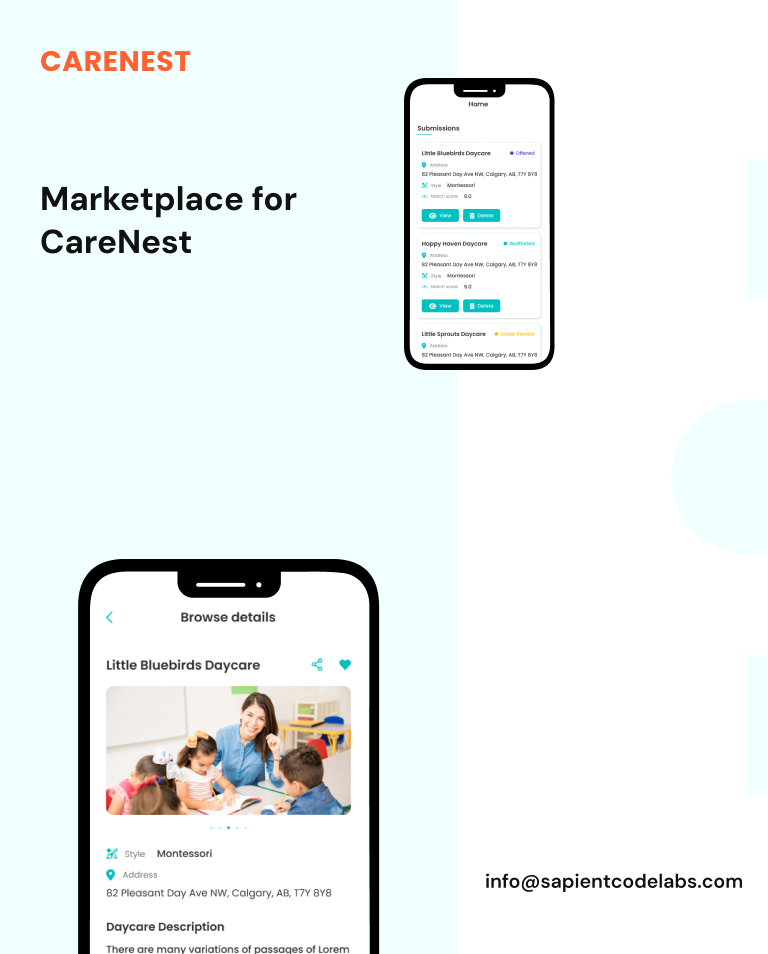
- CareNest, a two-sided marketplace connecting parents with daycare providers: child profiles, applications to multiple centres with real-time status, enrolment management, Stripe payments. React, Node, MongoDB on AWS.
- VBites, a video testimonial product: a customer-facing collection portal, video review and editing, embeddable players with per-video metrics, admin dashboard with revenue tracking. React, Node, MongoDB, AWS, Stripe, MUX.
Those four cover the shapes most MVPs take: two-sided marketplace, multi-role platform, subscription SaaS. The portfolio has the rest, including healthcare, logistics and social products. We also build and run our own products, which keeps us honest: we live with our architectural decisions for years after launch, the same way you will.
What you won't find here: invented growth numbers, funding announcements or "3x conversion" claims. We don't publish client outcomes we haven't been given permission to publish, and a services page full of unattributed percentages should make you suspicious of every other number on it, including the prices.
When you should NOT build an MVP yet
We turn away builds that fail these checks, because they'd fail anyway and we'd rather lose the deal than the reference:
You haven't talked to 20 potential users. Not friends, not people who said "great idea", but twenty conversations with people who have the problem. A landing page, a Figma prototype and twenty conversations cost a few hundred dollars and kill more bad ideas than any MVP will. Skip it and the MVP becomes a very expensive way to have those conversations anyway.
A landing page and a Figma prototype would answer the question. If what you need to know is "will anyone click sign up?" or "does this flow make sense to a stranger?", buy that instead: a fraction of the cost, and faster. Spend real build money on questions only a working product can answer: do people come back, will they pay, does the loop close.
You could fake it with no-code first. If Airtable plus Zapier plus a simple front end can serve 50 users, do that. When it creaks you'll write a far better spec; we regularly inherit no-code graduates, and their specs are excellent because they're written in observed behaviour rather than guesses.
You want enterprise compliance before you have a customer. SOC 2, HIPAA readiness and a full security programme are real work at real cost ($1,500–$6,000+), and they're right when a specific deal requires them. Buying them speculatively spends validation budget on procurement theatre. We build to a compliance-ready architecture from the start, with sensible data handling, isolation and encryption, so the path stays open; you buy the certification when a buyer's name is attached to it.
The idea's only real test is scale. If it only works with ten thousand concurrent users, such as social networks and liquidity-dependent marketplaces, an MVP proves nothing, and you need a different validation strategy.
The budget only covers the build. If $10,000 is everything you have, don't spend $10,000 on version one. Spend less and hold the rest for the changes real users will demand: there will be changes, and they matter more than anything in the initial scope.
If two or three of those land, the next step is a conversation, not a contract. We'd rather tell you to build less; it's why clients believe the quote when we tell them what something should cost.
Where we're the wrong fit
Every studio is wrong for someone. Here's who we're wrong for, so you can disqualify us in two minutes instead of two calls:
We're a small senior team, not a 40-person vendor. That's the trade. You get engineers who've shipped this shape of product before and who you talk to directly; you don't get twelve people starting on Monday. If your build genuinely needs three parallel squads from week one, we're not the shop, and we'll say so on the intro call rather than staffing up around your budget.
We're not staff augmentation on an MVP engagement. An MVP is a scoped outcome we're accountable for, not bodies on your sprint board. If what you need is engineering capacity inside your existing process, your PM, your backlog, your standups, that's a reasonable need, and it's dedicated developers, not this page.
We're not the cheapest quote you'll get. Freelancers and body shops sit well below our rate, and sometimes that's the right call for a small, well-specced scope you can supervise yourself. What you're paying for here is senior judgement about what not to build: worth nothing on a scope that's already certain, worth a great deal on one that isn't.
We won't ship a fixed price against a paragraph. If you need a binding number this week with no scoping phase, we're not it. A fixed price against a description is a guess that becomes a change-order machine; against a prototype and a written plan it's an engineering estimate.
If you need a broader engagement than a first version, with design, engineering, DevOps and everything after launch under one team, that's end-to-end product development. If it's clearly a multi-tenant subscription product from day one, SaaS development fits better. Same team either way; only the scope changes.
What's included
Capabilities- + A live product in production
- + One or two core journeys, built properly
- + Product design & clickable prototype
- + Real auth, data model & permissions
- + Payments where the model needs them
- + An admin panel
- + Analytics & event tracking from day one
- + Cloud hosting, CI/CD & monitoring
- + QA & a security pass
- + Full handover: code, infra & IP
- + What to build, fix or kill next
How we work
Process- 01
Shape the scope
We pin down the core journey worth testing and cut everything that isn't essential to the first release. This phase saves the most money, and it's mostly subtraction. You leave knowing what we're building and what we're explicitly not building yet, written down, so "while you're in there, can we also…" in week six is a decision with a price rather than a slow leak.
- 02
Design & prototype
A clickable prototype of the core flows, so we agree on the experience before building it. The data model is designed alongside the interface, not after: the shape of your data decides what v2 costs, and that's cheapest to get right on day three.
- 03
Build the core
Senior engineers, two-week cycles, working software in a shared staging environment at the end of every one plus a short demo. You steer as it takes shape instead of approving a big reveal, and analytics goes in with the features rather than after them. Our default stack is React and Node on the web, Flutter for iOS and Android from one codebase, MongoDB or Postgres, on AWS. The engineers you meet are the engineers who build.
- 04
Launch & learn
We ship to production, wire up monitoring, and hand over the keys: repositories, infrastructure and documentation, all in your name. Then we watch what real users do and help you read the signals to decide what to build, fix or kill next. Most of our MVPs become version one of a long-lived product the same team keeps building. Some tell us to change direction, which is also the MVP working correctly.
Frequently asked
How long does it take to build an MVP?
A lean MVP typically takes 4–8 weeks; a funded MVP with several connected flows, payments and admin tooling takes 8–16. A proof of concept is 2–4 weeks. Timelines slip for the same reason budgets do, scope added mid-build rather than slow engineering, and you see working software every two weeks throughout.
How much does an MVP cost?
A proof of concept is $500–$2,500, a lean MVP $2,500–$3,500, a funded MVP $5,000–$25,000. Those assume a senior team at our blended rate of about $20/hour; a US or EU agency at $120–$250/hour quotes $40,000–$150,000+ for equivalent scope. The MVP cost guide breaks it down feature by feature, and the $2,300 Scoping Sprint ends in a fixed quote for your specific build, credited in full.
Are you an MVP development agency in India?
Yes. We are a product engineering studio in Surat, Gujarat, founded in 2019, with just over twenty people. Most of our MVP clients are in the UK, Australia and Canada. Over a hundred products shipped, sixty-plus clients, and ninety-five percent client retention.
How does working with an MVP development team in India work day to day?
Two-week cycles with working software in a shared staging environment at the end of each, a board you can see at any time, and direct access to the engineers rather than an account manager. India runs four and a half to five and a half hours ahead of the UK and the same behind eastern Australia, so overlap is real. We put the overlap hours in writing rather than leaving them to goodwill.
Why is MVP development in India cheaper than a US or UK agency?
Cost of living, not skill. Our blended rate is about $20 per hour for a senior team; a US or Western European agency charges $120 to $250 per hour for the same seniority. That is why a lean MVP here runs $2,500 to $3,500 rather than $40,000. The published tiers on this page are the same numbers we quote from.
Do we own the code and the IP?
Yes, entirely, and from day one rather than at handover. You own all the intellectual property, and you have repository access from the first commit, so you can read the history as it happens, put your own reviewer on it, or take a working codebase away at any point. Source code, infrastructure and documentation end up in your name. No lock-in, no proprietary black boxes. Same for the Scoping Sprint: even if you never build with us, the prototype, plan and scope are yours and usable by any competent team.
What happens after launch?
We ship to production, wire up monitoring and hand over the keys, then it's your call. Most clients keep us on to read the early signals and build the next round of features; some hand off cleanly to an in-house team, which we document for. Either way budget 15–20% of build cost per year for maintenance and iteration, plus $60–$400/month for infrastructure and services.
Can you work with our existing team?
On an MVP we take accountability for the outcome, which works best when we own the build end to end, with your product people in the workshops, demos and decisions. Working alongside your designer, PM or a couple of your engineers is normal. If what you want is capacity slotted into your own backlog and process, that's dedicated developers, a different and cheaper engagement.
What if we need to pivot mid-build?
That's the MVP doing its job, not a failure. We work in two-week cycles precisely so a change of direction costs two weeks rather than a quarter. When a pivot changes scope we re-scope and tell you the new cost before building it. What we won't do is absorb a redirect quietly and hand you a surprise at the end.
Will the MVP be throwaway code?
No. We build the core on a foundation the full product can grow from: real data model, real auth, real permissions, code review on every change, tests on critical paths. Any good MVP has deliberate shortcuts (manual back-office steps, bought-not-built auth and payments, one platform first) and we'll walk you through them. Cutting quality on the parts carrying your data isn't one.
How do we start?
A 15-minute call to hear what you're building and confirm an MVP is the right next step, with no sales process. If it is, most builds begin with the two-week Scoping Sprint, and we run two a month, so slots are limited. If the honest answer is that you should talk to twenty users first, we'll say so.

Industries we serve
All industries →Related insights
All posts →MVP Development Cost in India: What an 8-Week Build Buys
Scaling an MVP to a Full Product: What Actually Changes
Building Denti360: What a Dental Practice SaaS Actually Costs
End-to-End Product Development: What It Includes, Stage by Stage
Not ready to commit to a full build?
Start with a 2-week Product Scoping Sprint: clickable prototype, technical plan and a fixed build quote, credited in full if we build together.