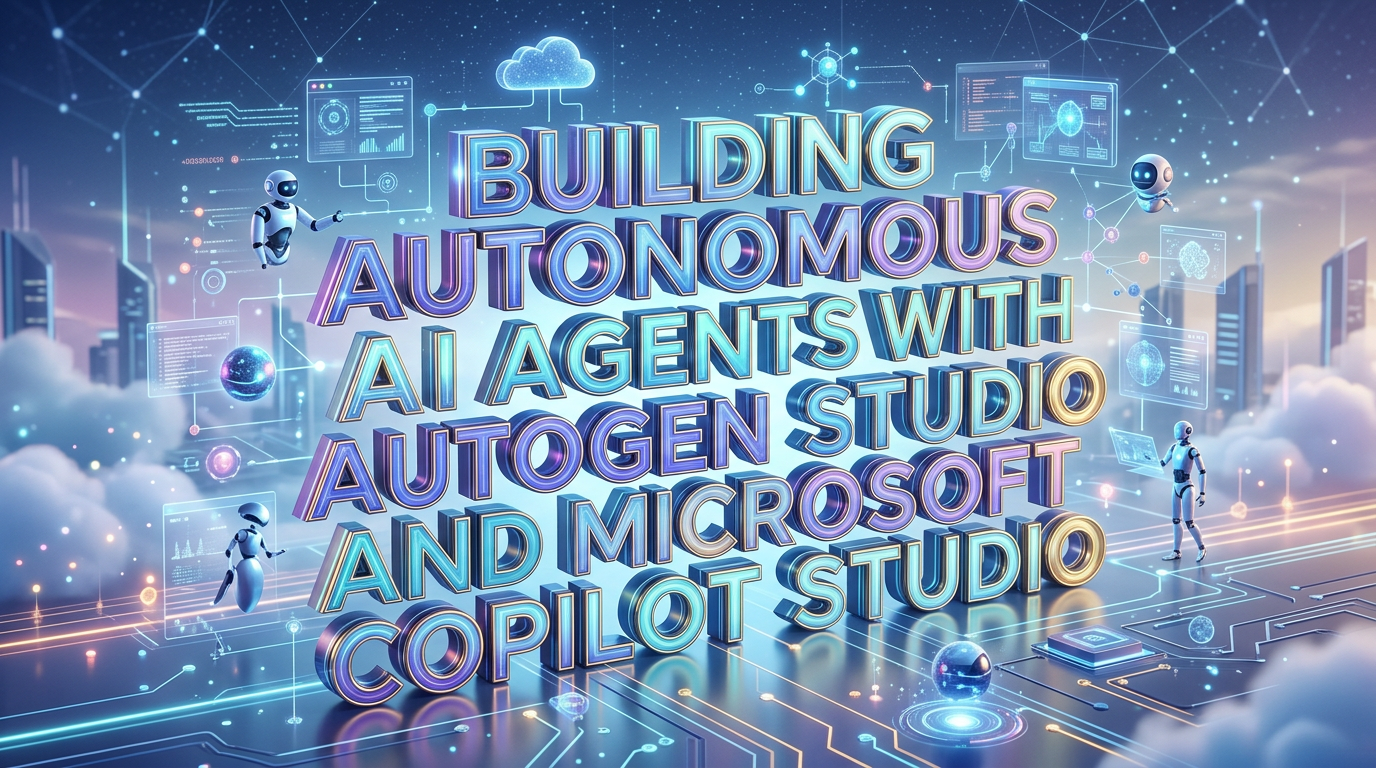
Introduction to Autonomous AI Agents
The landscape of artificial intelligence has undergone a transformative shift with the emergence of autonomous AI agents. Unlike traditional AI assistants that respond only to direct prompts, autonomous agents can reason, plan, and execute complex tasks with minimal human intervention. These intelligent systems represent the next frontier in AI development, enabling businesses to automate sophisticated workflows, enhance decision-making processes, and drive unprecedented operational efficiency.
For organizations seeking to harness the power of autonomous AI, two prominent platforms have emerged as leaders in the field: AutoGen Studio and Microsoft Copilot Studio. Each offers unique capabilities and approaches to building and deploying AI agents, catering to different use cases and technical requirements. In this comprehensive guide, we will explore both platforms in detail, providing you with the knowledge needed to make informed decisions about implementing autonomous AI agents in your organization.
Production agents need auth, audit, evaluation and integration — that's AI agentic development.
Understanding AutoGen Studio
AutoGen Studio represents Microsoft's open-source framework designed to simplify the creation of multi-agent applications. Built on the foundation of large language models (LLMs), AutoGen Studio enables developers to orchestrate multiple AI agents that can collaborate, communicate, and complete complex tasks autonomously. The platform abstracts much of the complexity involved in agent development, making it accessible to developers with varying levels of AI expertise.
At its core, AutoGen Studio operates on a conversation-driven paradigm where agents interact through structured dialogues to solve problems. Each agent can be assigned specific roles and responsibilities, enabling the creation of sophisticated agent ecosystems. The framework supports various agent architectures, including single-agent setups, paired agent configurations, and hierarchical multi-agent systems. This flexibility allows developers to tailor agent behaviors to match their specific application requirements.
One of AutoGen Studio's distinguishing features is its emphasis on code generation and execution. Agents can write, test, and refine code autonomously, making the platform particularly valuable for software development tasks, data analysis, and technical problem-solving. The Studio provides an intuitive interface for defining agent behaviors, managing conversations, and monitoring agent interactions, significantly reducing the learning curve for new users.
Microsoft Copilot Studio Overview
Microsoft Copilot Studio takes a different approach to AI agent development, focusing on the creation of copilots that enhance user productivity across Microsoft 365 applications. As part of the broader Microsoft Copilot ecosystem, Copilot Studio enables organizations to build custom AI assistants that can be integrated with existing business applications, databases, and workflows. The platform leverages Microsoft's extensive AI infrastructure, including Azure OpenAI Service, to deliver powerful conversational capabilities.
Copilot Studio distinguishes itself through its low-code development environment, which empowers business users and citizen developers to create AI agents without extensive programming knowledge. The platform offers a visual conversation designer, pre-built connectors to Microsoft services, and robust analytics tools that simplify the development lifecycle. This accessibility makes it particularly attractive for organizations looking to deploy AI agents quickly and iterate on their implementations.
The platform's deep integration with the Microsoft ecosystem provides significant advantages for organizations already invested in Microsoft technologies. Copilot Studio agents can seamlessly interact with data from SharePoint, OneDrive, Teams, Dynamics 365, and other Microsoft services. This integration enables the creation of powerful knowledge management assistants, customer service agents, and productivity enhancers that leverage existing data sources and business processes.
Key Features Comparison
When evaluating AutoGen Studio versus Copilot Studio, understanding their distinctive features is essential for making the right choice for your organization. AutoGen Studio excels in scenarios requiring complex reasoning, code generation, and multi-agent collaboration. Its strength lies in handling technical tasks that demand iterative problem-solving and autonomous decision-making. The platform supports custom agent configurations, allowing developers to define intricate agent behaviors and interaction patterns.
Copilot Studio, on the other hand, shines in its ease of use and Microsoft ecosystem integration. The low-code approach enables rapid development and deployment of AI assistants that work naturally within familiar Microsoft applications. The platform includes built-in security, compliance, and data governance features that align with enterprise requirements, making it suitable for organizations with strict regulatory obligations.
Both platforms support extensibility through plugins and APIs, enabling integration with external services and data sources. However, AutoGen Studio offers greater flexibility for custom implementations, while Copilot Studio provides more out-of-the-box functionality for common business scenarios. The choice between the two often depends on your organization's technical capabilities, existing infrastructure, and specific use case requirements.
We treat the surrounding product as end-to-end product development, not a separate science project.
Building Autonomous Agents with AutoGen Studio
Developing autonomous agents with AutoGen Studio involves several key steps that collectively establish a robust agent system. The process begins with defining the agent's purpose and capabilities, which includes identifying the specific tasks the agent will handle and the data sources it will access. This foundational planning ensures that the agent is designed to meet your organization's needs effectively.
Configuration of agent behaviors represents the next critical phase. Developers specify how agents should respond to different types of requests, define conversation flows, and establish error handling procedures. AutoGen Studio provides configuration files where developers can define agent prompts, set temperature parameters for response creativity, and specify model preferences. These configurations directly influence how agents process information and generate responses.
The multi-agent collaboration feature in AutoGen Studio enables the creation of sophisticated agent teams where different agents handle specific aspects of a complex task. For example, a software development workflow might involve separate agents for requirements analysis, code generation, testing, and documentation. These agents communicate through structured messages, sharing context and coordinating their efforts to achieve the overall objective.
Testing and optimization form an essential part of the development lifecycle. AutoGen Studio includes tools for monitoring agent conversations, analyzing performance metrics, and identifying areas for improvement. Developers can review conversation logs, evaluate response quality, and fine-tune agent configurations to enhance accuracy and efficiency. This iterative approach ensures that agents perform optimally in real-world scenarios.
Creating AI Agents with Microsoft Copilot Studio
Microsoft Copilot Studio offers a streamlined approach to AI agent creation that emphasizes accessibility and rapid deployment. The process begins with the copilot creation wizard, where users define the copilot's purpose and select from template options that address common business scenarios. This guided approach helps users quickly establish a functional AI assistant without extensive technical background.
The conversation designer in Copilot Studio provides a visual interface for building dialogue flows. Users can create topics that represent different conversation pathways, define trigger phrases that initiate specific flows, and construct response templates that guide interactions. The platform supports both generative and static response options, allowing developers to balance flexibility with controlled messaging.
Knowledge integration represents a cornerstone of Copilot Studio functionality. Organizations can connect their data sources through pre-built connectors or custom APIs, enabling copilots to access relevant information during conversations. The platform supports various knowledge formats, including documents, websites,databases, and Microsoft 365 content. This comprehensive knowledge access ensures that copilots provide accurate, contextually relevant responses.
Publishing and deployment in Copilot Studio involves configuring authentication settings, defining security policies, and selecting distribution channels. Copilots can be embedded in websites, integrated with Teams, or exposed through custom applications. The platform provides analytics dashboards that track usage patterns, conversation quality, and user satisfaction, enabling continuous improvement of the copilot experience.
Use our SaaS development cost guide to budget the product shell around the models.
Use Cases and Industry Applications
Autonomous AI agents built on these platforms find applications across diverse industries and business functions. In software development, AutoGen Studio-powered agents assist with code review, bug detection, and documentation generation. These agents can autonomously analyze codebase changes, identify potential issues, and suggest improvements, significantly accelerating development cycles while maintaining quality standards.
Customer service represents another high-impact application area where both platforms deliver substantial value. Organizations deploy AI agents to handle routine customer inquiries, provide product information, and resolve common issues. These agents operate continuously, delivering instant responses that reduce wait times and improve customer satisfaction. For more complex scenarios, agents can seamlessly escalate conversations to human agents while providing complete context.
Knowledge management and internal assistance represent growing use cases as organizations seek to democratize access to information. AI agents can search across document repositories, synthesize findings, and present relevant information in conversational formats. This capability transforms how employees access organizational knowledge, making information retrieval more intuitive and efficient.
Financial services, healthcare, and manufacturing industries leverage AI agents for specialized tasks such as compliance monitoring, patient triage, and production optimization. The ability to configure agents with domain-specific knowledge and workflows enables organizations to address unique operational requirements while maintaining the benefits of AI automation.
Best Practices for Implementation
Successful implementation of autonomous AI agents requires careful planning and adherence to established best practices. Begin with clearly defined use cases that offer measurable business value while remaining achievable with current AI capabilities. Starting with focused, well-scoped projects allows teams to build experience and demonstrate results before expanding to more complex implementations.
Invest in quality data and knowledge foundations. AI agents perform best when they have access to accurate, well-organized information. Take time to structure your data sources, establish data governance policies, and ensure that knowledge bases remain current. Regular reviews and updates prevent agents from providing outdated or incorrect information.
Establish clear human oversight mechanisms, particularly for high-stakes decisions. While autonomous agents can handle many tasks independently, appropriate human review ensures accountability and enables intervention when necessary. Define escalation paths and decision boundaries that specify when human involvement is required.
Monitor performance continuously and iterate on your implementations. Both AutoGen Studio and Copilot Studio provide analytics tools that reveal agent behavior patterns, user satisfaction metrics, and areas requiring improvement. Regular analysis of these insights enables ongoing optimization that enhances agent effectiveness over time.
Future Outlook and Considerations
The field of autonomous AI agents continues to evolve rapidly, with advances in reasoning capabilities, multimodal interactions, and agent collaboration promising even more powerful implementations. Organizations that develop expertise in these platforms now will be well-positioned to leverage future developments as they emerge. The integration of agents with emerging technologies such as augmented reality and advanced robotics will further expand the possibilities for autonomous AI in enterprise environments.
As AI agents become more capable, considerations around ethics, transparency, and responsible AI usage become increasingly important. Organizations should establish governance frameworks that address data privacy, algorithmic bias, and appropriate use cases. Building AI agents that align with organizational values and societal expectations will be essential for sustainable, trusted implementations.
Conclusion
Building autonomous AI agents with AutoGen Studio and Microsoft Copilot Studio represents a significant opportunity for organizations seeking to transform their operations through artificial intelligence. Each platform offers distinct advantages: AutoGen Studio provides powerful multi-agent orchestration and code generation capabilities ideal for technical applications, while Copilot Studio delivers accessible, Microsoft-integrated solutions for business users. Understanding your organization's specific requirements, technical capabilities, and strategic objectives will guide you toward the right choice.
The journey to autonomous AI adoption requires thoughtful planning, iterative development, and ongoing optimization. By starting with well-defined use cases, investing in quality knowledge foundations, and maintaining appropriate human oversight, organizations can successfully implement AI agents that deliver meaningful business value. As these technologies continue to mature, the potential for autonomous AI to drive innovation and efficiency will only grow, making now the ideal time to explore these platforms and build your organization's AI agent capabilities.
Ready to ship production AI agents? Run a Scoping Sprint ($2,300, two weeks) for a prototype, plan and fixed quote — or talk to us.