Choosing a product development company in India comes down to three things the sales call will not volunteer: what the firm actually owns (outcomes, or hours), what its size makes it good and bad at, and what its hourly rate is made of. Get those three straight and most of a shortlist sorts itself. This is the India-specific, product-specific version of that exercise, written from inside a 20-person studio in Surat that competes for the same searches.
The results for "product development company in India" mix firms that could not be more different. A five-person shop and a firm with thousands of seats both rank, both say "end-to-end", both quote in dollars per hour, and both have a page of logos. The pages are written to the same template, so they tell you almost nothing. The differences that matter are structural: who owns what, who you talk to, and what happens when the estimate is wrong.
The general agency-selection material is not repeated here. The guide to choosing a software development agency covers engagement models, proposals, red flags and paid trials, whatever country the firm is in. What follows is what that guide leaves out: how the Indian market is shaped, why two quotes for the same build can be $12 and $45 an hour without either firm lying, and which questions expose a firm that builds features but has never owned a product.
What "product development company" means, versus a staffing shop or a dev shop
Three kinds of firm answer to the phrase. The test of which one you have reached is what they sell you when you describe a product idea.
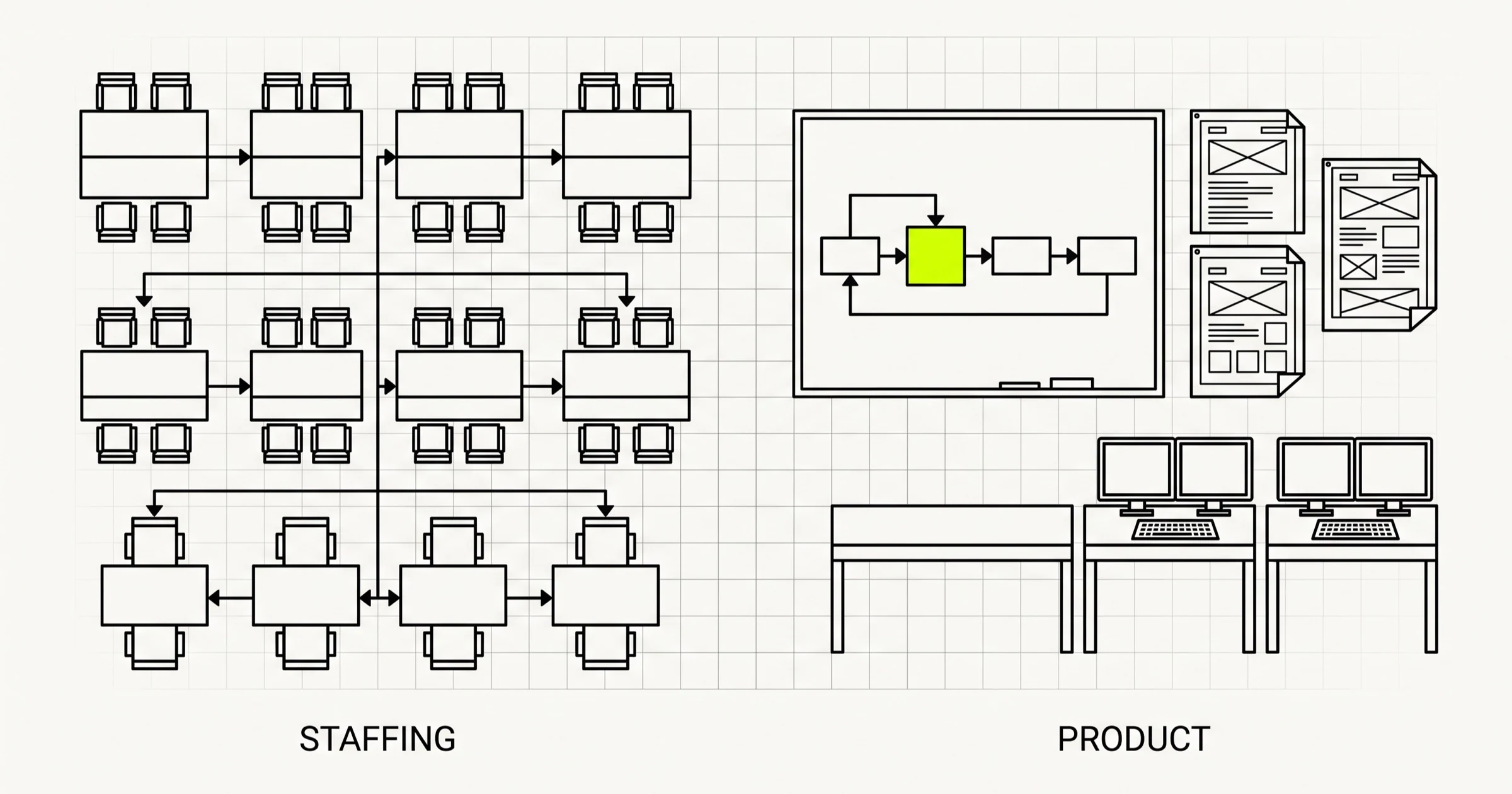
A staffing shop rents hours. You describe the product and they answer with people: two React developers and a QA at a monthly rate. The developers may be excellent, but you are the product manager, the architect and the acceptance tester whether or not you wanted those jobs, and the firm's obligation ends at "the developer did what you asked". If you have an engineering team and need capacity, this is the right buy, bought openly as dedicated developers under your process. If you have a product idea and no engineering lead, it is the wrong buy dressed in the right words.
A dev shop builds what you specify. You bring a specification or a design, they quote against it and build it. When the specification is silent on what happens when a payment fails halfway through, the shop guesses or asks, and either way the cost of the gap is yours. Dev shops are a fine choice when you have done the product thinking and have someone in-house to check the output against what was meant.
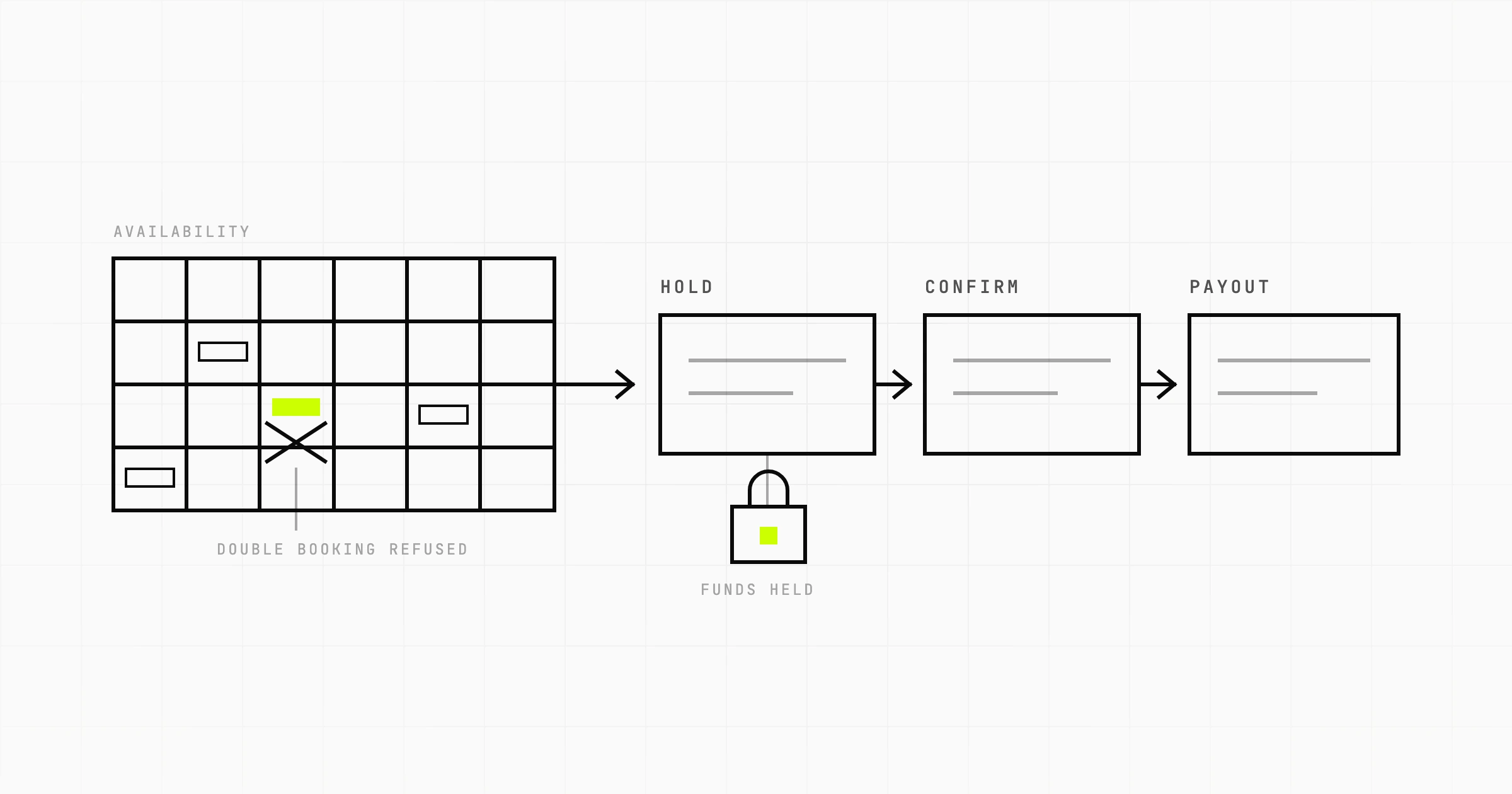
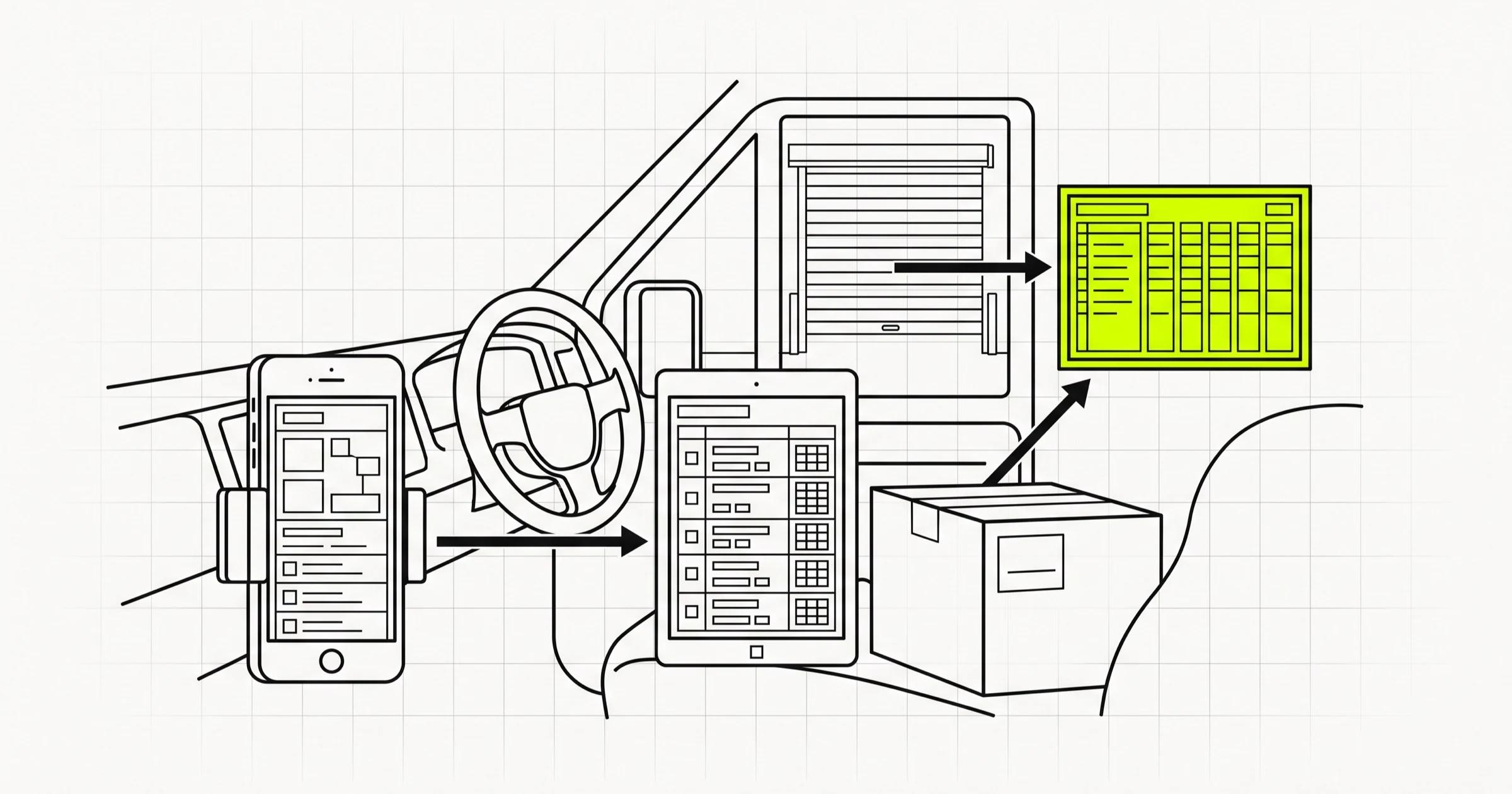
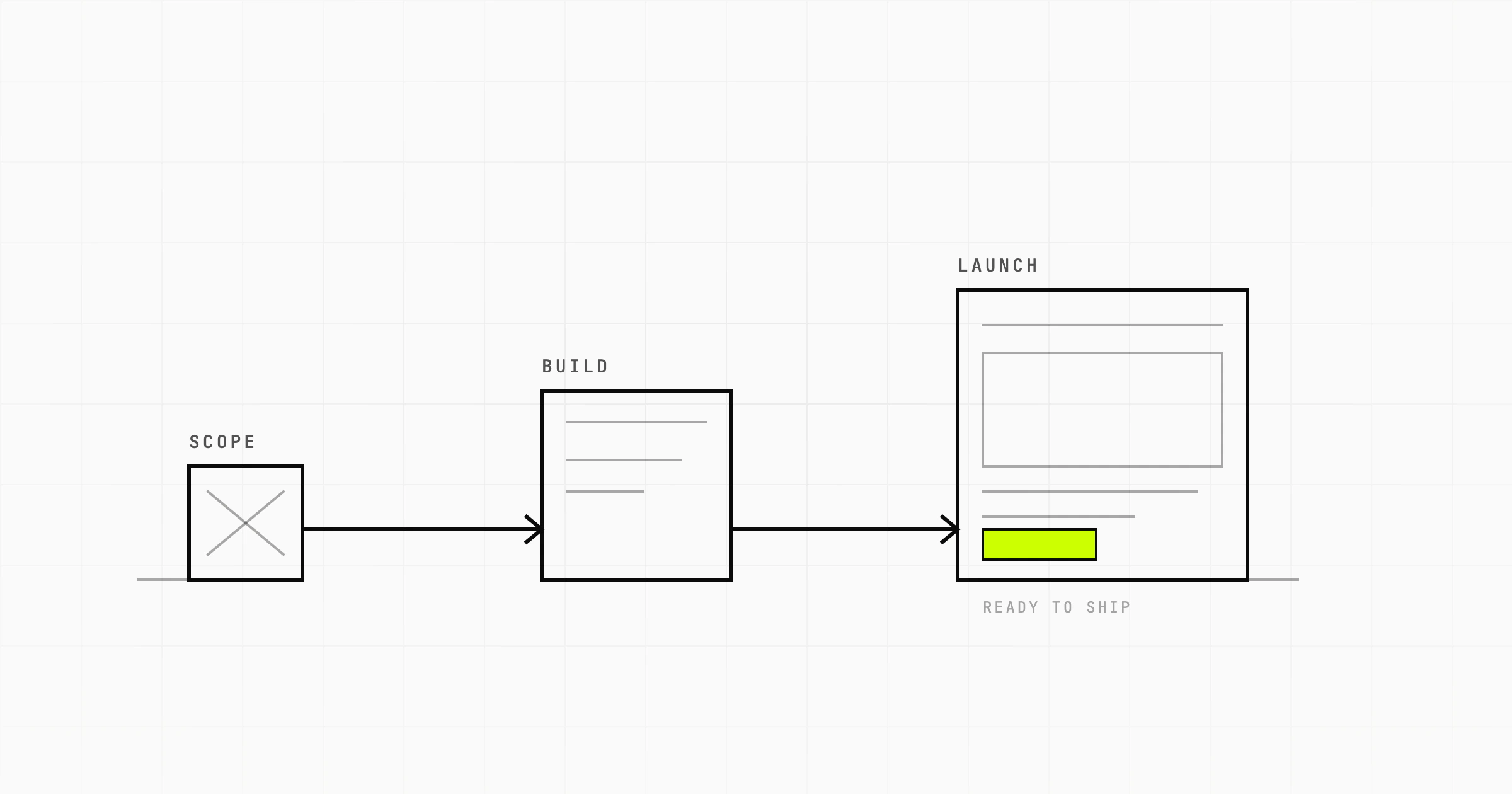
A product development company owns the outcome. The obligation runs to the product working in front of users, not to the hours or the specification. The firm does discovery and writes the scope, produces the design, makes and records the architecture decisions, writes acceptance criteria before build, tests against them, launches, and stays on a retainer afterwards. Above all, it owns the hand-offs between those stages, so a problem at the join between design and build is its problem and not a change request. Our own end-to-end product development service is structured this way, with the decision owner named for each stage.
The distinction matters more in India because of volume. Most of the work sold here is staffing or dev-shop work, because those models are simpler to run, and many of those firms put "product development" on the homepage because the phrase ranks. So the first question on any call is: if the product does not work, whose problem is it, in writing?
The real shape of the market: product development companies in India by size
Indian software firms cluster at three sizes, and size predicts more about the engagement than anything else on the website. Each is good at something and bad at something.
The 5-person shop
A founder who codes, two or three developers, and someone doing design or QA part-time. Good at attention: you talk to the person writing the code, decisions get made in one conversation, and the price is low because there is no overhead layer. Bad at depth and continuity: if one developer leaves, a third of your team has gone, and if the project needs a mobile specialist for a month they subcontract, so the hand-off you were told would not exist appears. Process is whatever the founder does personally. They fit a small, well-specified build with a hands-on client, and fit badly with a product that must be maintained for years by a team that will need to change.
The 20 to 50 person studio
Large enough to have a designer, a tester, a few senior engineers and a bench; small enough that the founders still see every project. Good at owning a product from scoping to support with named people, and at holding a fixed quote because the people who estimated are the people who build. Bench depth is real but limited: a studio can replace a developer without the project stalling, but cannot stand up fifteen people in a fortnight. Bad at very large programmes and anything needing staff in three countries or a compliance department. This is our size, and we say so at the end rather than pretending the trade-offs do not apply to us.
The 500-plus firm
A sales organisation, delivery managers, a practice for each technology, and hundreds of engineers on a bench. Good at scale, formal process, and paper: if procurement needs a vendor security questionnaire answered in a week and a team of forty by next month, this is the only shape that can do it. Bad, for product work, at what follows from that structure: the person who sold you is not the person who builds, the person who builds is usually the most junior the rate card permits, and the team is staffed to a utilisation target rather than to your product. A founder with a $60,000 build is a small account and gets a small account's attention.
The three shapes side by side
| 5-person shop | 20 to 50 person studio | 500-plus firm | |
|---|---|---|---|
| Typical blended rate | Lowest; often one flat hourly figure | Around $20 an hour for a senior-weighted team, at published rates | Wide range by rate card; often higher for less senior staff |
| Who you talk to | The founder, who also codes | A founder or lead engineer who is on the project | An account manager and a delivery manager; engineers on request |
| Bench depth | None; a leaver is a crisis | Can replace a developer; cannot triple a team overnight | Deep; can grow a team fast, at the cost of who you get |
| Product ownership | Whatever the founder personally does | Usually the whole chain, scoping to retainer, if the studio also runs its own products | Formally yes; in practice split across teams and hand-offs |
| Where the risk sits | Continuity and specialist gaps | Very large or multi-site programmes | Seniority substitution and attention for small accounts |
What a $20 an hour blended rate buys, and why $12 and $45 are not quality signals
Every quote from India is, or can be reduced to, a blended hourly rate. Ours is published at about $20 an hour for a senior offshore team. You will also see $12 and $45 for what looks like the same project. The temptation is to read those as cheap, mid and premium. That is nearly always wrong. They are three different seniority mixes.
A blended rate is a weighted average of everyone whose time lands on the invoice. One senior engineer, three juniors and a part-time tester average to a low number; two seniors, a mid-level developer, a designer and a tester average to a higher one. The same firm can produce both quotes from the same rate card by changing who is on the project. So the question to ask of any rate is not "why so low" or "why so high" but "who, by name and years, is on the team that adds up to this number, and what share of the hours does each carry?"
Read that way, the three numbers usually decode like this. A quote near $12 is arithmetic: at Indian market salaries plus office, management and sales overhead, that rate cannot fund a mostly senior team. It funds a mostly junior team with a senior name on the proposal who is shared across several clients. That is not fraud; it is a staffing model, and for a well-specified build with a strong client-side lead it can work. A quote near $45 from an Indian firm is usually carrying something other than seniority: a sales organisation, an onshore account layer, a margin on subcontracted work, or a brand. Sometimes it is genuinely a senior-only team on a hard problem; the names and hours split will tell you which. A rate near $20 is where a senior-weighted team lands when the firm has thin overhead and does not staff junior and bill senior. It is not a bargain and not a premium. It is what the people cost, which is why a firm at that rate offering to match $12 should be asked what changed about the team.
The rate also says nothing about hours. A $12 team that takes 2,000 hours costs more than a $20 team that takes 1,000, and junior-heavy teams on product work usually do take longer, because product work is mostly decisions. Compare totals against a scope both firms have read, and compare the lists of people behind them.
How to check the things that matter about a product development agency in India
Everything a firm tells you about itself is a claim. Four of them can be checked in an hour.
Retention rate. Ask what share of clients came back for a second engagement or are still on a retainer. Clients do not return to firms that made their lives hard, so this number survives a bad quarter. Ours is 95 percent. Whatever number you are given, ask how it is counted: over what period, and whether it includes clients whose project simply ended. A firm that cannot say does not track it.
Review platforms, read skeptically. A 4.8 on Clutch, which is where we sit, is a useful signal and an incomplete one. Read the reviews rather than the score. Check that the reviewer's project size is near yours, because a firm that is excellent on $200,000 programmes may be indifferent on $30,000 builds. Check the dates, because reviews clustered in one month are often a campaign. And check whether the reviewer says what went wrong, because every real project has something.
Whether the firm runs its own products. This is the check most buyers skip and the one that best predicts whether "product development" is real. A firm that only builds for clients has never had to live with its own maintenance bill, support queue or store review. A firm that runs a dual track, client work alongside products it operates itself, has those numbers by construction. In our case that is Denti360, a multi-branch dental practice SaaS live in daily use in clinics, plus DatumQ for manufacturing QA, Cleargate for plant vehicle compliance and gate passes, and Nestlet, a lease marketplace we built in-house. Operating Denti360 is where our post-launch planning number comes from: 15 to 20 percent of the original build cost per year, before any new feature. Ask any firm you are considering for its equivalent. If it has never run a product, it will not have one.
Who you will actually talk to at 9am your time. Get a name, a role, and a working-hours overlap in writing, then ask to meet that person before you sign, not the founder or sales lead standing in for them. In a small studio the person on the call is the person on the project. In a large firm it is an account layer, with engineers assigned after signature, which means you are buying a process rather than a team. Neither is wrong, but know which you are paying for.
The questions that expose a bad fit for product work specifically
The general guide has ten questions that expose weak agencies. These five are narrower: they test whether a firm owns a product or just builds features, and each has a wrong answer that sounds reasonable on a call.
- Who writes the acceptance criteria, and when? Wrong answer: "the developers, as part of each ticket". Then the criteria describe what was built and testing is a formality. The right answer: derived from scope and design before the sprint starts, readable without an engineer, and your sign-off against them closes the work.
- Who owns the cloud account, the app store accounts, the domain and the payment processor? Wrong answer: "we set those up under our account to save you the admin, and transfer them at hand-over". Hand-over is where things get lost, and an account in the agency's name is a lock-in whether or not it was meant as one. Every account should be created in your name from the start, with the firm holding delegated access you can revoke.
- Who owns the IP, and when do I get access to the repository? Wrong answer: "on final payment". The code should sit in a repository under your organisation from the first commit, with you as admin, and the contract should say the IP is yours as it is written, not on completion. Client owns all IP, with repo access from day one, is our standing term. It costs a firm nothing to offer unless it planned to use the code as a bargaining chip.
- What happens when the estimate slips? Wrong answer: "we will let you know and discuss options". The right answer names a mechanism, a fixed quote the firm absorbs overrun against or a bounded estimate with a written renegotiation trigger, and names the module the firm expects to overrun. Every product has one. In Denti360 it was billing, which took longer than its estimate implied because the money edge cases are where the logic lives. A firm that says "we do not expect to slip" has not built many products or is not telling you.
- What does post-launch support cost, and what does it cover? Wrong answer: "we can discuss packages after launch". The right answer is a share of build cost per year, agreed before launch, with the coverage written down: dependency upgrades, security patches, third-party API changes, small fixes, and a separate path for new features so maintenance money is not silently spent on roadmap. No number means the firm has not run a product long enough to know.
Ask all five on the first call. A firm that owns products answers with specifics because the answers are its own operating decisions. A firm that does not will reach for "it depends", the sound of a question nobody in the building has had to answer.
Time zone and communication reality for UK, Australian and Canadian clients
India runs on a single time zone, five and a half hours ahead of UTC, and does not change its clocks. The overlap arithmetic is simple and worth doing plainly rather than accepting "we work in your time zone", which no Indian firm does without someone working nights.
UK. India is four and a half hours ahead of London in summer and five and a half in winter. A UK morning is an Indian afternoon: a 9am call in London is early afternoon in Surat, and the overlap runs through the UK morning until the Indian team's day ends. This is the most comfortable of the three: nobody shifts their hours, and a question sent from London in the afternoon is answered before you are back at your desk.
Australia. The east coast is four and a half to five and a half hours ahead of India depending on daylight saving, and Perth is two and a half. An Australian afternoon is an Indian morning: a 2pm meeting in Sydney is around 9am in Surat, so the overlap sits in the Australian afternoon and anything raised in a Sydney morning is picked up when the Indian team starts. Perth shares more than half the working day.
Canada. This is the honest hard case. Toronto is nine and a half to ten and a half hours behind India; Vancouver is twelve and a half to thirteen and a half. The live overlap is at the edges: a Canadian morning meets the Indian evening. It works, provided communication is written and asynchronous by default and calls are scheduled rather than expected on demand. If a firm promises a Toronto client full-day live overlap from India, ask who is working nights and for how long. The same numbers apply to the US east coast.
Across all three, agree four things in writing: which hours are live overlap, the response time outside them, the named contact, and where decisions get recorded so that a question asked at the end of your day has an answer at the start of it.
Judge us by this checklist
It would be strange to write all of this and then exempt ourselves. Here is Sapient Codelabs against the same criteria, using only the numbers we publish. Check every one of them.
- Shape: a 20-plus person product engineering studio in Surat, Gujarat, founded in 2019. The middle size in the table, with its trade-offs: named people and a fixed quote, and not the right choice for a forty-person programme or a buyer who needs a vendor with a compliance department.
- Ownership model: product development, not staffing. Scoping, design, architecture, build, QA, launch and retainer under one roof, with the decision owner written down for each stage. We also place dedicated developers under a client's own process, and call that what it is.
- Rate: a blended rate of about $20 an hour for a senior offshore team, published rather than quoted per prospect.
- Track record: 100-plus projects for 60-plus clients since 2019, 95 percent client retention, 4.8 on Clutch.
- Dual track: Denti360 live in multi-branch dental clinics; DatumQ and Cleargate as in-house products; Nestlet in build. Our post-launch planning number, 15 to 20 percent of build cost per year, comes from operating Denti360.
- Markets and overlap: UK, Australian, Canadian and Indian clients. The time zone arithmetic above applies to us exactly as to anyone else; we do not claim full-day live overlap with Toronto.
- Contract terms: client owns all IP, repository access from day one.
- How to test us cheaply: a two-week Scoping Sprint at a fixed $2,300, ending in a clickable prototype, a technical plan and a fixed quote, credited in full if we build. If we are the wrong fit, you leave with a scope any firm on your shortlist can quote against.
Shortlisting product development companies in India and unsure whose rate and team you are really comparing? A Scoping Sprint ($2,300, two weeks) ends with a written scope and technical plan any firm can be held to, a prototype, and a fixed quote. Or just start a conversation.