Two agencies in India can quote the same MVP at $8,000 and $40,000 and both be telling the truth, because "MVP development" does not name a fixed piece of work. It names whatever the quote happens to contain: a rate, a seniority mix, design or no design, a paid scoping step or a guess, and an "8 weeks" that means something different in every proposal. Once you can read those five variables off a quote, the spread stops being mysterious and starts being a decision.
Founders searching for MVP development cost in India usually arrive with a deck and a number they hope is enough. They collect three or four quotes, find they disagree by a factor of five, and conclude that the cheap one is hiding something or the expensive one is padding. Both are often partly true. The real problem is that the quotes are pricing different products, because nobody has yet decided what the product is.
This piece is about that gap: why Indian MVP pricing varies so much, what a two-week scoping step buys, what an 8-week build contains week by week, how to budget for the months after launch, and how to read a quote for padding or hollowness. The worked example is our own product, the only build whose numbers we can stand behind in public. For a feature-by-feature cost table, the MVP development cost guide already has one.
Why MVP development cost in India varies so much between agencies
The country is not the variable. India has agencies billing $12 an hour and agencies billing $60, and the differences that matter are inside the quote. Five of them explain almost all of the spread.
The rate, and the seniority mix behind it
A blended rate is only meaningful with a team behind it. Our published rate is about $20 an hour for a senior offshore team, and the word that matters is "senior". Two seniors for eight weeks and one senior plus three juniors for eight weeks can cost the same and produce very different codebases. The junior-heavy team writes more code and more of it needs rewriting. The senior team writes less and argues with you about scope, which is annoying in week two and cheap by week twenty. Quotes that are strikingly low for their stated rate are usually low because of mix, and mix is what agencies are least eager to state.
Whether design is inside the number
Some quotes include product design: the flows, the clickable prototype, the states nobody wants to draw. Some assume you are bringing Figma files. Some include "UI" and mean a theme applied to whatever the developers built. If two quotes differ by 15 to 20 percent and only one includes design, the numbers may be equal. If design is missing, the engineers will invent the screens and you will meet their choices in QA.
Whether scoping is a paid step or a guess
An agency that quotes from a call and a deck is pricing risk. Either it pads the number to cover the unknowns, or it quotes thin and recovers the difference through change requests once you are committed. A fixed quote that follows a paid scoping step is the only kind that can be held to, because the scope it is fixed against exists on paper. This is the largest single cause of the spread, and the one place we have a commercial interest, so the argument is laid out below rather than asserted.
What "8 weeks" contains
"MVP in 8 weeks" can mean eight weeks of engineering after scoping and design are done, or eight weeks from the first call including everything, or eight weeks to a staging link that never reaches production. The first is a build. The second is usually a prototype with a login. The third is a demo. The table below is what the phrase should contain.
What a two-week scoping step buys, and why paying for it lowers the build price
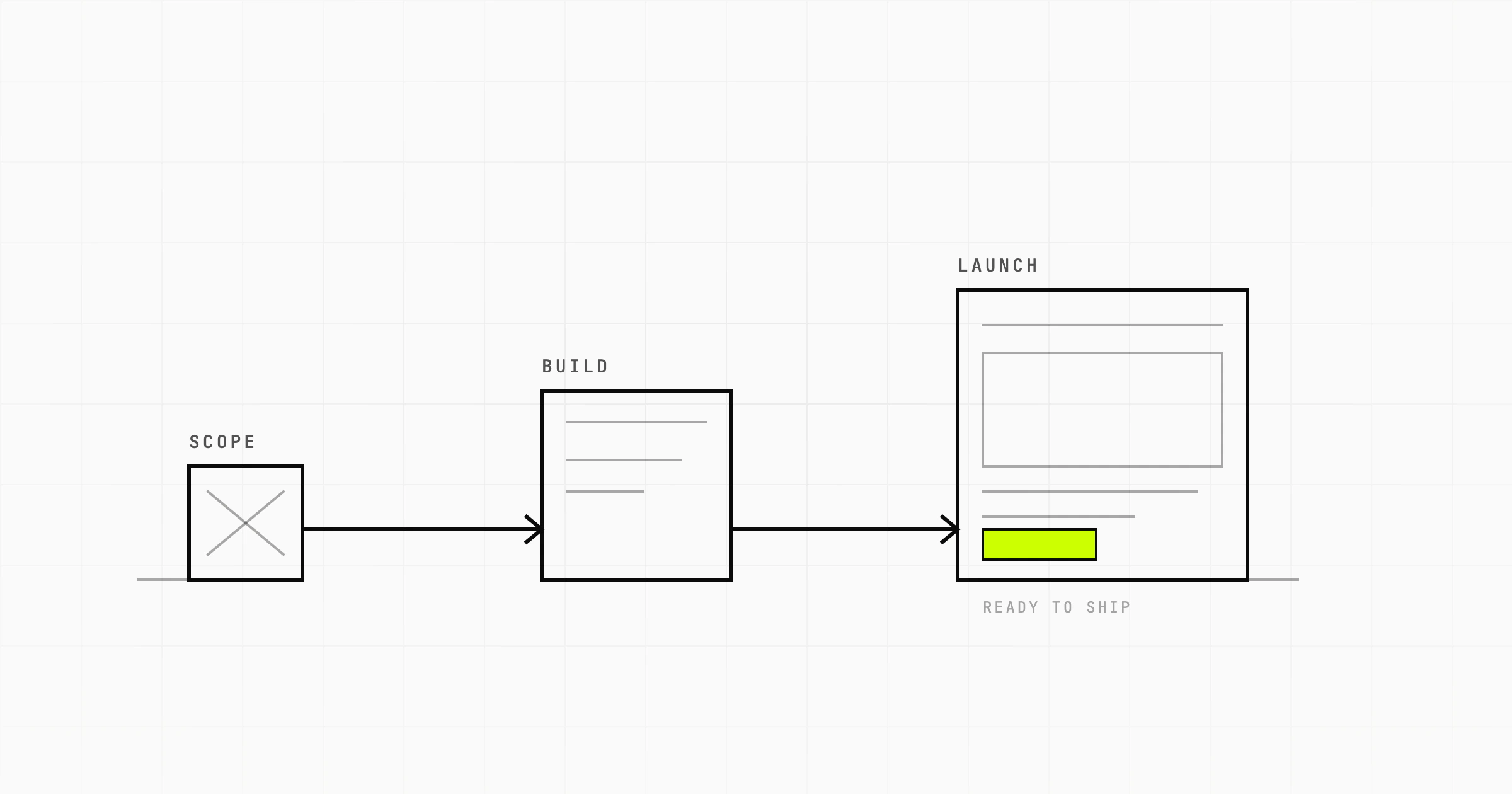
The MVP prototype cost question and the build cost question should be answered in that order. Our version of the first is the Scoping Sprint: $2,300 fixed, two weeks, ending with a clickable prototype of the core journey, a technical plan covering architecture, data model and stack choices, and a fixed quote and timeline for the build. If we go on to build, the $2,300 is credited in full. If you take the documents elsewhere, they are yours, written so a technical advisor can audit them.
A paid scoping step lowers the build price because an agency quoting from a scoped prototype is no longer pricing uncertainty. Three things happen in those two weeks that each take money out of the quote.
Features get cut before they get estimated. The prototype forces a decision about which one or two journeys the product exists for. Everything else becomes a manual step, a later phase, or nothing. A feature that leaves now costs a conversation. One that leaves during build costs the code already written for it.
The expensive-to-reverse decisions get made on paper. Tenancy model, permission boundaries, how money moves, which platform. These are cheap to decide in a document and very expensive to decide implicitly by whoever writes the first migration. A plan that names them lets the quote assume them instead of carrying a contingency for whichever way they might go.
The quote can be fixed. With a prototype and a plan, the agency knows what it is building, so it can commit to a number and a date rather than a range and a hope. "$15,000 to $30,000, depending" means the agency has not done the scoping and would like you to fund it inside the build, at build rates, with the meter running.
Put plainly: a founder who pays $2,300 for scoping and receives a $20,000 fixed quote is better off than one who receives a free $18,000 estimate that becomes $26,000 through change requests. The difference is not the $2,000. It is knowing the number before committing rather than afterwards.
MVP development in 8 weeks: what an 8-week build actually contains
The table is what eight weeks of build look like when scoping and core-flow design are already done. It assumes a responsive web product, one or two core journeys, standard authentication, a data model with tenancy and permissions already decided, and payments where the model needs them. Native apps, heavy integrations or two-sided marketplace onboarding push the schedule out. The third column matters more than the second: builds slip more often because the founder was not ready to decide than because the engineers were slow.
| Week | What ships | What you have to decide that week |
|---|---|---|
| 1 | Repository in your organisation, staging and production environments, CI, first migration with the data model and tenancy scoping in it, authentication skeleton | Final sign-off on the data model and the roles. After this week, changing them costs real money. |
| 2 | Core entities with create, read, update and list screens, roles enforced in the API, first prototype screen working against real data | Which fields are required at launch versus nice to have. Over-specifying here becomes onboarding friction. |
| 3 | Primary user journey end to end on staging, rough but complete, event tracking on each step | The one metric the MVP exists to move, and what "activated" means for a user. |
| 4 | Second journey if there is one, or the primary journey's edge cases: empty states, errors, failed actions, no-permission views | What the product does when things go wrong. Refund and correction rules are decided here or by the developer. |
| 5 | Payments where the model needs them, one mode, money edge cases handled. Email and notification flows | Pricing and billing model, in writing: per seat, per branch, per usage, one-off. |
| 6 | Admin panel so you can operate the product without asking for a database query. Onboarding polish on the primary journey | Who on your side uses the admin panel and what they must be able to fix without an engineer. |
| 7 | QA against the acceptance criteria written in scoping, defects triaged by severity, security pass, dependency scan | Which defects block launch and which do not. A conversation about severity, not feelings. |
| 8 | Production deployment, domain and certificates, monitoring, runbook, handover of accounts and documentation in your name, list of what to build or kill next | Launch date, who is on call for the first fortnight, and who your first ten users are. |
Two things in the table are deliberate. QA sits in week seven as a separate person testing against written criteria, but developers test their own work every week before it. And the tenancy decision sits in week one, because retrofitting it onto a live database touches every query and takes months. If an agency's "8 weeks" lacks the first week's environments and the last week's handover, it is a coding phase inside a longer, unpriced project.
How much does an MVP cost? The arithmetic, labelled as arithmetic
This is not a quote. It is the napkin sum from a published rate and a team size, so you can sanity-check any number an agency gives you, including ours.
Take about $20 an hour and a team that can execute the table above: two engineers full time, with design, QA and project management at roughly a quarter of the engineering hours between them. Two engineers for eight weeks is 640 hours. Add a quarter and the build is around 800 hours, about $16,000. Three engineers on the same schedule is roughly 1,200 hours, about $24,000. A twelve-week build with two engineers lands there too, which is why an 8-week quote and a 12-week quote for the same team should not cost the same.
Now hold that against the real numbers. Growth SaaS builds on our published bands run $10,000 to $100,000 over four to seven months, a wider and longer engagement than a first MVP. Denti360, our own dental practice product, reconstructed at the published rate, came to roughly $18,000 to $39,500, which at $20 an hour is about 900 to 2,000 hours. That is more than the eight-week arithmetic, and it should be: it is more than one or two journeys.
The arithmetic tells you three things. A quote well under $10,000 for an eight-week build with real payments is a very small team, a junior one, or a coding phase with the ends cut off. A quote at $40,000 for the same shape is pricing risk because scoping was skipped, or contains more weeks and people than stated. And a quote whose hours you cannot reconstruct is not one you can hold anyone to.
A worked example: what Denti360 cost to build and where the estimate slipped
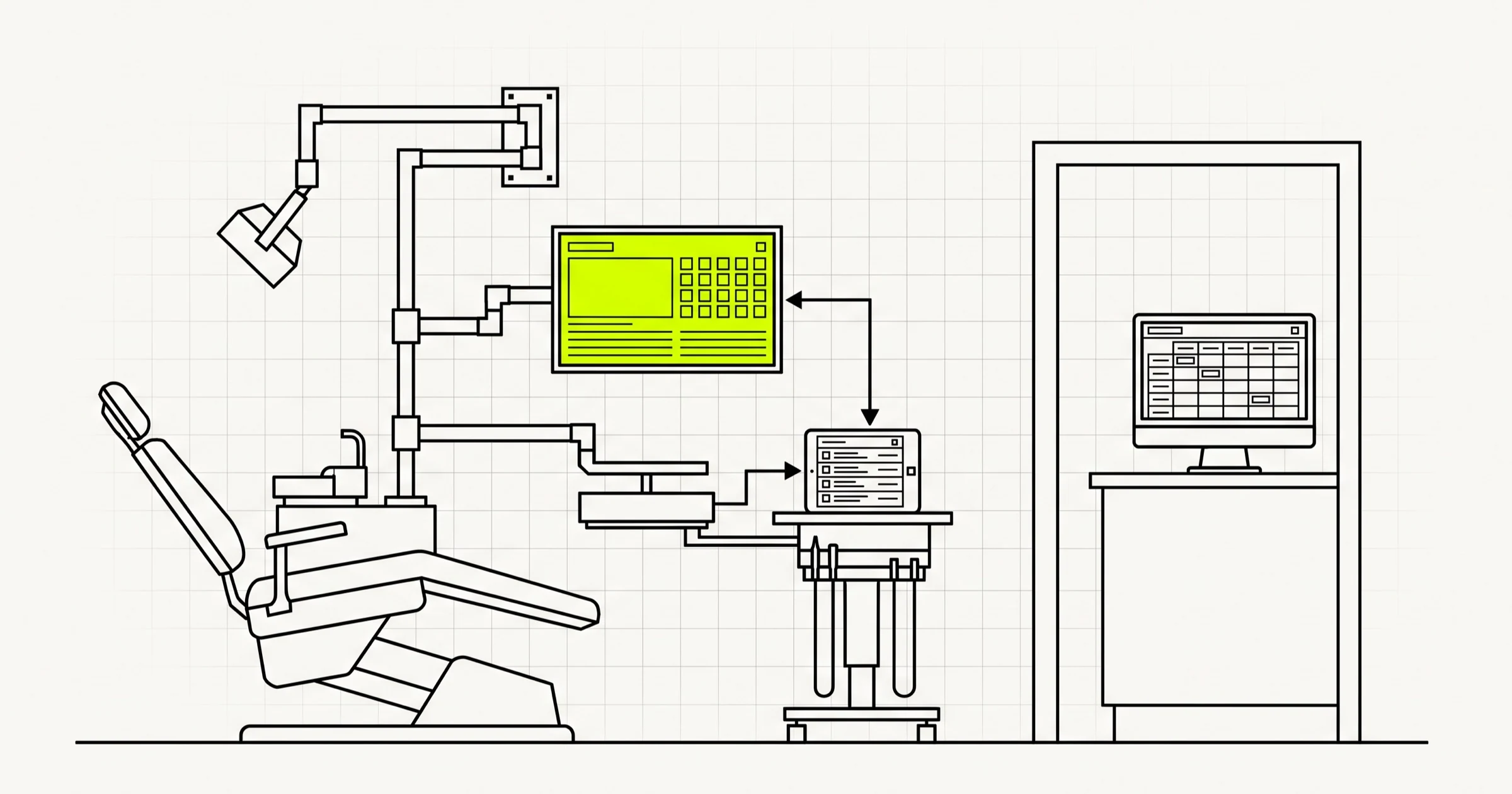
Denti360 is a dental practice management SaaS we built and run ourselves. It is live, in daily use by multi-branch clinics, and covers appointments across branches and chairs, patient records and treatment plans, billing and receivables, expense tracking, multi-branch operations and dashboards. Three decisions from the build are worth more to a founder than the number.
No native apps, on purpose. Clinic staff work at a desk with a monitor. The receptionist booking a chair, the dentist reading a treatment plan, the person raising an invoice: none of them are on a phone. So the product is a responsive web application with no iOS or Android app. That one scoping decision removed an entire platform from the build, and it still stands. Most first versions have an equivalent decision available, usually the most expensive item on the list and there because it felt expected.
Branch scoping in the schema from the first migration. A multi-branch clinic needs every appointment, patient, invoice and expense to belong to a branch, with staff seeing only what their role and branch allow. That went into the database design on day one. It cost a little more thinking in week one and nothing afterwards; doing it later, on a database full of live patient records, would have meant touching every query. If your product has any equivalent, tenancy, organisations, teams, workspaces, it belongs in week one.
Billing took longer than its estimate implied. This is the honest part. The billing and receivables module looked simple on the plan: raise an invoice, take a payment, show what is outstanding. The time went into the cases off the happy path. Partial payments against one invoice. Corrections to an invoice already paid. Receivables spanning a treatment plan across several visits. None of it is exotic; all of it is where the real logic lives, and the estimate was written against the screens rather than the cases. The lesson is that the unglamorous money-handling module is the one to estimate widest and schedule earliest, which is why payments sit in week five of the table rather than week seven.
MVP budgeting: the number to hold back for the three months after launch
The $18,000 to $39,500 above is build. Most MVP budgeting advice stops there, which is where the founder's real spending starts. Two operating numbers from Denti360 size the reserve.
The first is upkeep. Keeping the product current, before any new feature, costs 15 to 20 percent of the original build cost per year: dependency and framework upgrades, security patches, third-party APIs that change under you, and the small fixes that accumulate. It is not optional; a product that gets none of it stops being deployable within a couple of years. For the first quarter after launch that is about 4 to 5 percent of build cost, so on a $20,000 build, $800 to $1,000.
The second is support, and it is the counterintuitive one. Support load tracks how many customers are new, not how many you have. A new customer asks about setup and how the product works; once it is routine the questions stop. So in the three months after launch, when every customer is new, support is at its peak relative to customer count. The month you sign your first batch is the month you need the most hands.
Then there is the line nobody puts in the plan: the first round of changes real users force. Not features, changes. The onboarding step everyone drops out of. The field that should have been optional. The report the first three customers all asked for. This is the best money you will spend, because it is spent on evidence rather than assumption. A launch budget with no room for it turns the MVP's lessons into a wish list.
So the reserve has three parts: upkeep, a support allowance sized to how many customers you plan to sign, and a change budget. A budget that spends every dollar on the build is a budget for a product that launches and then freezes.
How to reduce MVP development costs without building something you throw away
The honest answer to "reduce MVP development costs" splits down the middle: cuts that save money, and cuts that borrow it at a bad rate. Our MVP development service page draws that line for how we work; here is the general version.
Cuts that save money outright:
- One platform. Responsive web unless your users are genuinely on a phone at the moment of use. A native app is the most expensive thing a first version can contain.
- One or two journeys built properly, not five built partially. The scoping step exists to make this choice while it is still cheap.
- Manual back-office steps. If a human on your side can do it in a spreadsheet for the first hundred customers, do not build it. Build the admin panel and move on.
- Off-the-shelf authentication, hosted payments, hosted email. Solved problems with good vendors.
- One payment mode. Subscriptions or one-off or split payments, whichever the model needs. Not all three "for flexibility".
- Fewer user roles at launch. Every role is screens, permissions and test cases. Two is often plenty.
Cuts that borrow money and charge interest:
- Skipping the tenancy and permission decisions. They get made anyway, implicitly, by the first migration. Retrofitting them is months.
- Skipping code review on the money flow. Billing defects are the ones customers notice first and forgive last.
- Shipping without event tracking. An MVP with no analytics cannot answer the question it was built to answer. You paid for a build and got a demo.
- A junior-only team to hit a price. The saving on the rate is spent, with interest, on the rewrite.
- Cutting the handover. Accounts and infrastructure in the agency's name save a week and cost you the option to leave.
A good cut removes something from the scope. A bad cut keeps the scope and removes the quality, and it always presents as the same product at a lower price. Build fewer things properly, never the same things worse.
How to read an MVP development company's quote: eight questions that expose padding or hollowness
The general questions for any engagement, references, contracts, IP terms, are in the guide to choosing a software development agency. These eight test an MVP quote specifically, from an agency in India or anywhere else, and a padded quote and a hollow quote fail them in different directions.
- Can you show me the hours behind the number, by role? A real quote decomposes into people, weeks and a rate, and the sum matches. A padded quote has hours you cannot account for. A hollow one has a team that cannot deliver the table above in the time stated.
- What was this quote fixed against? A call and a deck means an estimate wearing a quote's clothes. A prototype and a technical plan means you can ask to see them, and ask what happens to the price if they change.
- Is design inside this number, and what does "design" mean? Flows, prototype and edge-case states is design. A theme applied to developer-built screens is not.
- What does "8 weeks" start and end with? If week one is not environments and the data model, and week eight is not production and handover, it is a coding phase with an unpriced project around it.
- Who owns the repository, cloud account, domain and payment processor on day one? You, with the agency holding delegated access. Our standing term is client owns all IP with repository access from the first commit; ask for the equivalent in writing.
- Which module do you expect to run over, and how does the fixed price handle it? An agency that has built products will name one. "None" means it has not built enough of them. "We will raise a change request" tells you how the fixed price stops being fixed.
- What does keeping this running cost after launch, as a share of build? A firm that operates a product has a number. A firm that only ships says it depends.
- What happens to the scoping fee if we build with you, and what do I keep if we do not? Credited in full and you keep everything. Anything less makes the scoping step a sales cost you are being asked to pay for.
Ask all eight and the mysterious quotes sort themselves. The $8,000 one is a coding phase by a junior team with no design and no handover. The $40,000 one carries a contingency for scoping that was never done. The one in between, fixed against a prototype and a plan, is the one whose number is still the number in week eight.
Comparing MVP quotes that disagree by a factor of five and unsure which one is pricing the product you actually mean? A Scoping Sprint ($2,300, two weeks) ends with the scope, technical plan and week-by-week build plan made for your case, a prototype, and a fixed quote. Or just start a conversation.