Introduction to Drug Interaction Analysis in Pharmaceuticals
Drug interaction analysis represents one of the most critical challenges in modern healthcare. With thousands of medications available on the market, healthcare providers face an increasingly complex landscape when prescribing treatments. Adverse drug reactions due to undetected interactions cost the healthcare system billions of dollars annually and, more importantly, pose significant risks to patient safety. Traditional methods of drug interaction checking rely on static databases and rule-based systems that struggle to keep pace with the exponential growth of pharmaceutical knowledge.
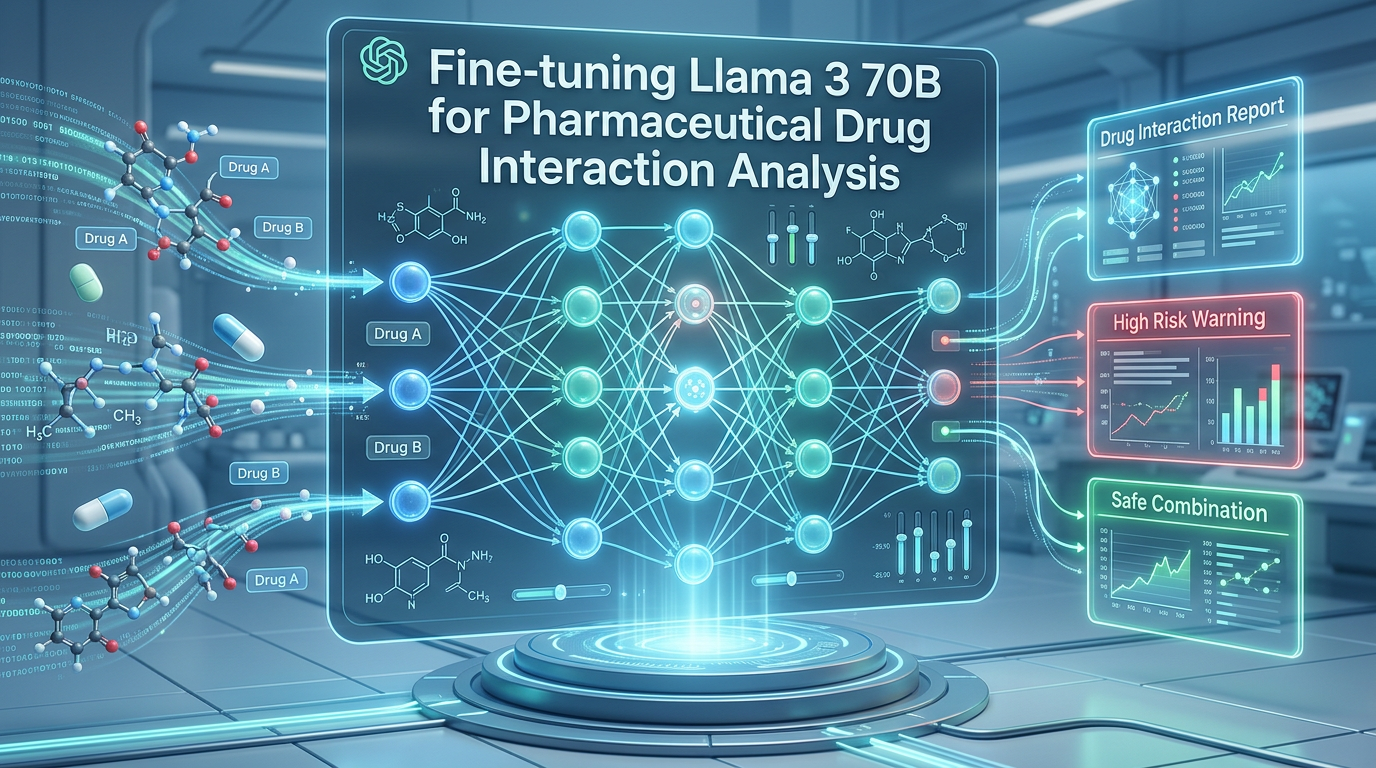
The emergence of large language models (LLMs) has opened new possibilities for intelligent drug interaction analysis. Among these, Meta's Llama 3 70B stands out as a particularly powerful foundation model due to its impressive reasoning capabilities and extensive pre-training. However, to achieve accurate and reliable results in the pharmaceutical domain, fine-tuning becomes essential. This blog post explores the technical approach to fine-tuning Llama 3 70B specifically for pharmaceutical drug interaction analysis, providing healthcare organizations and developers with actionable insights for implementation.
That product surface is what we mean by healthcare software development: workflow, compliance and integrations, not a model demo alone.
Understanding Llama 3 70B Architecture
Llama 3 70B represents Meta's latest advancement in open-source large language models. With 70 billion parameters, it offers substantial computational power and reasoning capabilities that surpass many competing models. The architecture builds upon previous Llama iterations while introducing improvements in attention mechanisms, training data quality, and instruction following.
The model's foundation capabilities include advanced natural language understanding, context comprehension across long sequences, and the ability to follow complex instructions. These characteristics make it an excellent candidate for domain-specific adaptation. However, its general-purpose training means it lacks the specialized knowledge required for precise pharmaceutical analysis. Fine-tuning addresses this gap by adapting the model's parameters to the specific nuances of drug interactions, medical terminology, and regulatory requirements.
Why Fine-tuning Matters for Pharmaceutical Applications
General-purpose LLMs, regardless of their sophistication, suffer from several limitations when applied directly to pharmaceutical analysis. First, they lack exposure to domain-specific literature, clinical trial data, and pharmacovigilance reports that inform our understanding of drug interactions. Second, they may generate plausible-sounding but inaccurate information—a phenomenon known as hallucination that proves dangerous in medical contexts. Third, they don't inherently understand the hierarchical structure of drug information, from molecular mechanisms to clinical manifestations.
Fine-tuning transforms Llama 3 70B from a general conversational model into a specialized pharmaceutical analysis tool. Through exposure to curated datasets containing verified drug interaction information, clinical guidelines, and peer-reviewed research, the model learns to recognize patterns specific to this domain. The result is a system capable of identifying potential interactions with higher accuracy while maintaining the reasoning capabilities that make LLMs valuable.
Data Preparation for Fine-tuning
Successful fine-tuning begins with comprehensive data preparation. The quality and representativeness of training data directly influence model performance in production. For pharmaceutical drug interaction analysis, training datasets should encompass several key categories of information.
Budget compliance and integration work explicitly — our healthcare app development cost guide lists where those line items typically land.
Drug interaction databases form the foundation, including established resources such as DrugBank, MedlinePlus, and FDA adverse event reporting systems. These provide verified interaction pairs along with severity classifications, mechanism descriptions, and clinical recommendations. The dataset must capture the full spectrum of interaction types: pharmacodynamic interactions where drugs amplify or counteract each other's effects, pharmacokinetic interactions affecting absorption, distribution, metabolism, and excretion, and indirect interactions through shared metabolic pathways.
Clinical guidelines from organizations like the American Hospital Formulary Service, Micromedex, and Lexicomp provide evidence-based context for interpreting interactions. Medical literature, including peer-reviewed journal articles and conference proceedings, exposes the model to emerging research and atypical interaction cases. Importantly, the training data must include negative examples—cases where drugs are commonly prescribed together without significant interaction—to prevent the model from over-flagging potential issues.
Technical Approach to Fine-tuning
The fine-tuning process for Llama 3 70B requires careful consideration of computational resources, training methodology, and evaluation metrics. Several technical approaches merit consideration depending on organizational constraints and performance requirements.
Parameter-efficient fine-tuning (PEFT) methods have gained prominence as they dramatically reduce computational requirements while maintaining strong performance. LoRA (Low-Rank Adaptation) represents the most widely adopted approach, introducing small trainable matrices into the model's attention layers while keeping the original parameters frozen. This approach typically requires only 1-4% of the original model's parameters to be updated, making it feasible for organizations without massive computational infrastructure.
Full-parameter fine-tuning remains viable for organizations with substantial GPU resources, typically requiring clusters of high-end GPUs with sufficient memory. This approach offers maximum adaptation potential but demands significant investment in infrastructure and expertise. Regardless of the approach chosen, careful hyperparameter tuning proves essential. Learning rate selection, batch size optimization, and training duration all significantly impact final model quality.
Evaluation and Validation Framework
Rigorous evaluation distinguishes successful pharmaceutical AI implementations from problematic deployments. The evaluation framework for fine-tuned drug interaction models must address multiple dimensions of performance.
When the model has to act inside a live workflow, that path is AI agentic development, not a notebook.
Accuracy metrics including precision, recall, and F1 score provide baseline performance indicators. However, pharmaceutical applications demand additional considerations. The model must demonstrate low false negative rates—failing to detect a genuine interaction poses direct patient safety risks. Simultaneously, excessive false positives lead to alert fatigue among clinicians, ultimately reducing patient care quality. Balancing these competing priorities requires careful threshold selection and continuous monitoring.
Cross-validation using held-out datasets that the model has never seen during training ensures generalization capabilities. Testing against newly discovered interactions not present in training data validates the model's ability to reason about novel cases. Human evaluation by clinical pharmacists provides qualitative assessment of output coherence, clinical relevance, and appropriateness of recommendations.
Implementation Considerations and Best Practices
Deploying a fine-tuned Llama 3 70B model for pharmaceutical drug interaction analysis requires attention to several operational considerations that extend beyond model training.
Integration with existing clinical systems presents technical challenges. Electronic health record (EHR) systems, computerized physician order entry (CPOE) platforms, and clinical decision support systems require well-designed APIs to leverage the model's capabilities effectively. Response latency becomes critical in clinical workflows—models must deliver actionable recommendations within seconds to maintain clinical utility.
Regulatory compliance shapes deployment strategies. Healthcare organizations must navigate FDA guidance on clinical decision support software, HIPAA requirements for data privacy, and potentially emerging regulations specific to AI in healthcare. Documentation of model training processes, validation results, and ongoing performance monitoring supports regulatory demonstrations of safety and effectiveness.
Future Directions and Emerging Opportunities
The intersection of large language models and pharmaceutical analysis continues evolving rapidly. Emerging capabilities in multimodal reasoning suggest future models capable of analyzing structured drug data alongside unstructured clinical notes, medical literature, and real-time patient information. Retrieval-augmented generation (RAG) architectures promise to ground model responses in current pharmaceutical databases, addressing concerns about knowledge currency.
Personalized drug interaction analysis represents another frontier, where patient-specific factors including genetics, organ function, and concurrent conditions inform interaction predictions. While current models provide general guidance, future iterations may offer individualized risk assessments that account for the unique physiological characteristics of each patient.
Conclusion
Fine-tuning Llama 3 70B for pharmaceutical drug interaction analysis offers healthcare organizations a powerful approach to enhancing medication safety. The process transforms a capable general-purpose model into a specialized tool capable of identifying, explaining, and contextualizing potential drug interactions with impressive accuracy. Success requires careful attention to data quality, technical methodology, rigorous evaluation, and operational deployment considerations.
As healthcare organizations increasingly embrace AI-powered clinical decision support, properly fine-tuned language models will play an expanding role in medication safety initiatives. The investment in domain-specific adaptation yields substantial returns through improved patient outcomes, reduced adverse events, and more efficient clinical workflows. Organizations willing to navigate the technical and regulatory complexities position themselves at the forefront of intelligent healthcare delivery.
Building this? A Scoping Sprint ($2,300, two weeks) ends with a clickable prototype, a technical plan and a fixed quote — or just start a conversation.