Introduction: The Promise and Challenge of AI in Healthcare
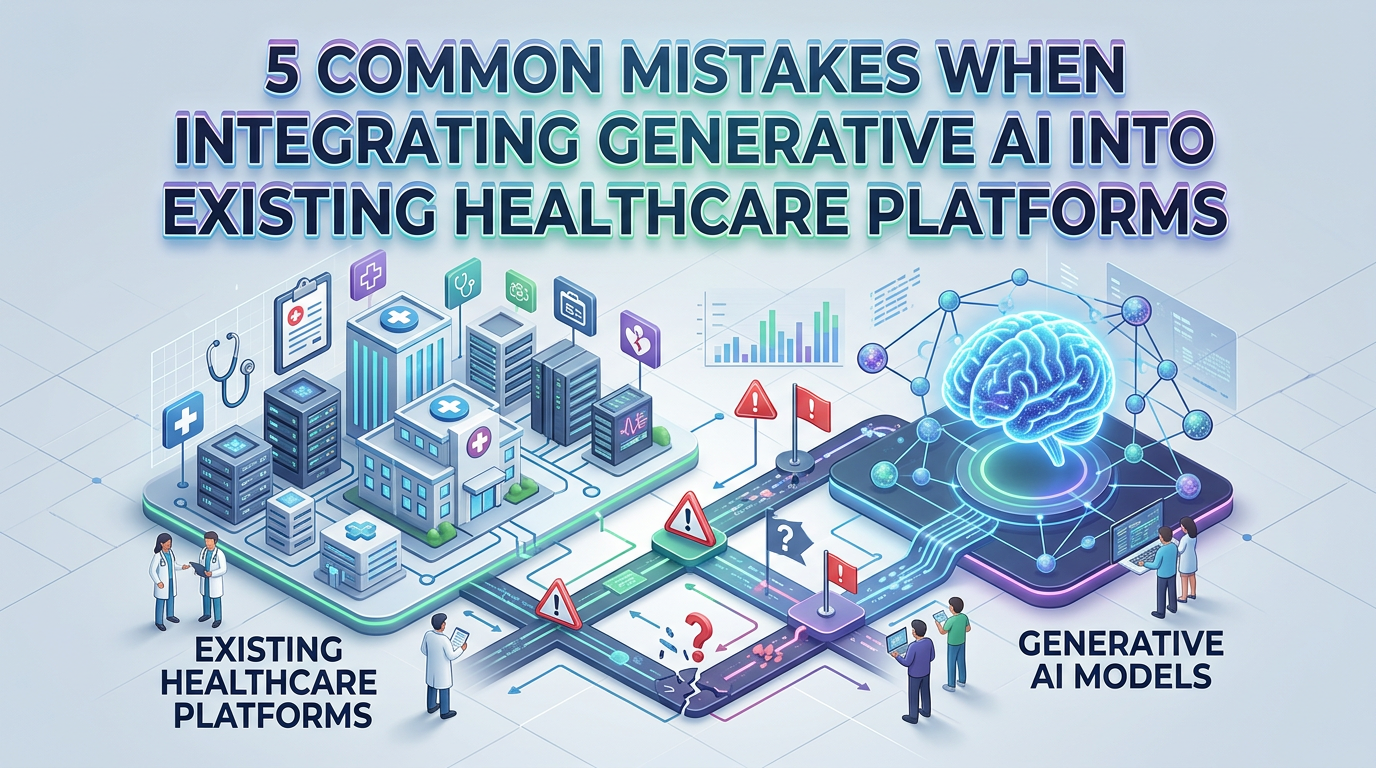
Healthcare organizations are increasingly turning to generative AI to revolutionize patient care, streamline operations, and enhance diagnostic capabilities. From automated clinical documentation to predictive analytics, the potential applications seem limitless. However, integrating generative AI into existing healthcare platforms presents unique challenges that many organizations underestimate.
Sapient Codelabs has worked with numerous healthcare providers to implement AI solutions, and we've witnessed firsthand how well-intentioned projects can falter when common pitfalls are overlooked. The stakes in healthcare are exceptionally high—patient safety, data privacy, and regulatory compliance demand meticulous attention throughout the integration process.
In this comprehensive guide, we'll explore the five most common mistakes organizations make when integrating generative AI into their existing healthcare infrastructure. Understanding these challenges is the first step toward building robust, compliant, and effective AI-powered healthcare solutions. We've written more specifically about the stack and constraints of healthcare software development if you need the industry framing before the mistakes.
Mistake #1: Neglecting HIPAA Compliance and Data Privacy Requirements
Perhaps the most critical oversight in healthcare AI integration is failing to prioritize HIPAA compliance and patient data privacy. Generative AI systems often require vast amounts of data to train and operate effectively, but healthcare data is subject to stringent regulatory requirements — which is why any production path has to budget for compliance work, not treat it as a late checklist item. Our healthcare app development cost breakdown includes those line items explicitly.
Many organizations make the mistake of implementing AI solutions without conducting thorough privacy impact assessments. They may use cloud-based AI services that store data on servers outside the healthcare organization's control, potentially violating HIPAA's Business Associate requirements. Others fail to implement proper de-identification protocols before feeding data into AI models.
The consequences of these oversights can be severe—regulatory fines, reputational damage, and most importantly, compromised patient trust. When integrating generative AI, healthcare organizations must ensure that all data handling meets HIPAA standards, including proper encryption, access controls, and audit trails.
Best practices include working with AI providers who offer HIPAA-compliant solutions, implementing on-premise or hybrid deployment options where data remains under organizational control, and establishing clear data governance policies before any AI implementation begins.
Mistake #2: Insufficient Data Quality and Preprocessing
Generative AI is only as good as the data it processes, and healthcare data is notoriously complex. Electronic health records contain unstructured text, standardized codes, imaging data, and vital signs—all in different formats and often with gaps or inconsistencies. Many organizations underestimate the extent of data preprocessing required for successful AI integration.
A common error is implementing AI solutions without first assessing and cleaning the existing data infrastructure. AI models trained on inconsistent, incomplete, or biased data will produce unreliable outputs. In healthcare settings, this can lead to incorrect diagnoses, inappropriate treatment recommendations, or flawed operational predictions.
Healthcare organizations must invest in robust data pipelines that normalize, validate, and enrich data before it reaches AI systems. This includes standardizing medical terminology, handling missing values appropriately, and implementing quality assurance processes that continuously monitor data integrity.
Additionally, organizations should establish clear data provenance tracking—understanding exactly where each piece of data originated, how it was transformed, and when it was last updated. This transparency is crucial for both clinical accuracy and regulatory compliance.
Mistake #3: Skipping Clinical Validation and Testing
In the excitement to deploy generative AI solutions, many healthcare organizations bypass rigorous clinical validation. They may assume that AI systems proven effective in one clinical setting will automatically transfer to their environment, or they may rely solely on vendor-provided validation studies without conducting independent testing.
This mistake can have life-threatening consequences. An AI system that performs well in controlled research environments may behave differently when exposed to the diverse patient populations, varied clinical workflows, and unique data patterns of a real-world healthcare setting. Without proper validation, organizations have no way to understand an AI system's limitations or potential failure modes.
Clinical validation should be a multi-phase process. Initial retrospective studies should validate AI performance on historical data. Prospective pilot programs should then test the system in controlled real-world environments with close monitoring. Finally, ongoing post-deployment surveillance should track performance metrics and identify any emerging issues.
Healthcare organizations should establish clear clinical validation protocols that involve physicians, nurses, and other clinical stakeholders in the testing process. Their input is invaluable for identifying practical issues that purely technical testing might miss — and it's also the moment most teams realize they need a structured AI and agentic development partner, not another pilot slide deck.
Mistake #4: Poor Integration with Existing Clinical Workflows
Generative AI solutions that don't align with how healthcare professionals actually work are destined to fail. Many organizations implement sophisticated AI systems that require clinicians to navigate separate interfaces, duplicate data entry, or follow unnatural processes—creating additional burden rather than alleviating it.
The most successful AI integrations are those that meet clinicians where they already work. This means embedding AI capabilities directly into electronic health record systems, clinical decision support tools, and existing clinical workflows. The AI should enhance human decision-making rather than replace or complicate it.
Organizations often make the mistake of treating AI integration as a purely technical project, failing to involve end-users in the design and implementation process. Clinicians should be consulted early and often to understand their workflows, pain points, and requirements. Their feedback should shape how AI capabilities are deployed and presented.
Implementation should also include comprehensive training programs. Healthcare professionals need to understand not just how to use the AI system, but also how to interpret its outputs, when to trust its recommendations, and how to override them when necessary. Without this training, clinicians may either ignore valuable AI insights or place undue trust in potentially flawed recommendations.
Mistake #5: Ignoring Explainability and Human Oversight
Generative AI systems, particularly large language models, can produce outputs that seem authoritative but are actually incorrect or fabricated—a phenomenon known as "hallucination." In healthcare contexts, where decisions directly impact patient outcomes, this presents serious risks. Yet many organizations implement AI systems without adequate explainability mechanisms or human oversight protocols.
Healthcare professionals cannot effectively use AI recommendations they don't understand. When an AI system suggests a particular diagnosis or treatment, clinicians need to know what data informed that recommendation, what logic led to that conclusion, and how confident the system is in its assessment. Without this transparency, informed clinical judgment becomes impossible.
Organizations should prioritize AI solutions that provide clear explanations for their outputs. This includes highlighting relevant patient data, explaining the reasoning process, and indicating confidence levels. Healthcare organizations should also establish clear protocols for human oversight—defining which AI recommendations require clinician review, how disagreements between AI and human judgment should be handled, and when AI assistance should beEscalated to specialists.
Perhaps most importantly, the ultimate responsibility for patient care must always rest with qualified human professionals. AI should be positioned as a decision support tool, not an autonomous decision-maker. Organizations must clearly communicate this distinction to all stakeholders and design their systems and processes accordingly.
Conclusion: Building a Foundation for Successful Healthcare AI Integration
Integrating generative AI into existing healthcare platforms offers tremendous potential for improving patient care, operational efficiency, and clinical outcomes. However, realizing this potential requires careful attention to the unique challenges of healthcare contexts. By avoiding the five common mistakes outlined in this guide—neglecting compliance, underestimating data quality needs, skipping clinical validation, ignoring workflow integration, and overlooking explainability—organizations can build robust AI implementations that truly serve their patients and clinical staff.
Successful healthcare AI integration is not primarily a technology challenge—it's a strategic initiative that requires collaboration between technical teams, clinical stakeholders, compliance officers, and organizational leadership. Organizations that approach AI implementation with this comprehensive perspective are best positioned to harness the transformative power of generative AI while maintaining the highest standards of patient care and regulatory compliance.
As generative AI continues to evolve, healthcare organizations that develop strong foundational practices now will be best equipped to adopt new capabilities as they emerge. The investment in proper integration—though it may require more time and resources upfront—will pay dividends in safer, more effective, and more trustworthy AI-powered healthcare delivery.
Integrating generative AI into a live clinical platform? A Scoping Sprint ($2,300, two weeks) produces a prototype, a compliance-aware technical plan and a fixed quote — or talk to us about the integration path.