Introduction to Vendor Contract Automation in B2B Marketplaces
B2B marketplaces have transformed the way businesses procurement, with vendor contracts forming the backbone of these digital ecosystems. However, managing hundreds or thousands of vendor agreements manually creates bottlenecks, increases legal risks, and slows down transaction cycles. This is where artificial intelligence steps in—specifically, large language models like GPT-4 and Claude 3.5.
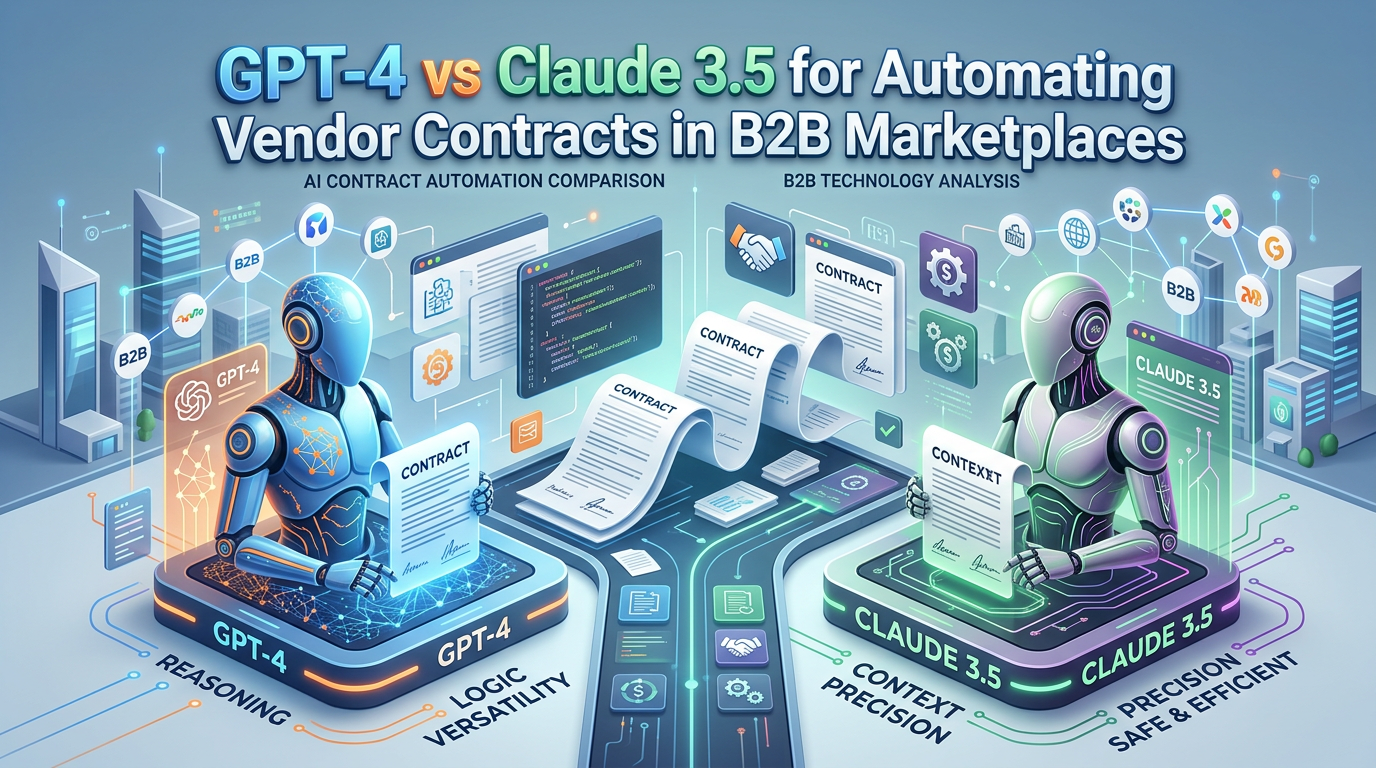
The question facing many organizations today is straightforward: which AI model delivers superior performance for automating vendor contracts in B2B marketplaces? The answer requires a deep dive into the capabilities, strengths, and limitations of both GPT-4 and Claude 3.5 in the context of contract lifecycle management.
Payments, splits and seller tools are core marketplace development, not a checkout plugin.
Understanding the Contract Automation Challenge
Vendor contracts in B2B marketplaces present unique challenges that generic document processing tools struggle to address. These include:
- Complex clause structures: Multi-party agreements with conditional terms, tiered pricing, and performance metrics
- High volume processing: Marketplaces may onboard dozens of new vendors weekly, each requiring contract review
- Risk identification: Detecting unfavorable terms, liability clauses, and compliance gaps
- Standardization needs: Ensuring contracts align with marketplace policies and regulatory requirements
- Dynamic terms: Handling recurring renewals, amendments, and termination conditions
Traditional rule-based automation fails to capture the nuanced language and contextual meaning embedded in legal documents. This is precisely where modern AI language models demonstrate their value—they can understand context, extract meaning, and make intelligent decisions about contract content.
GPT-4: Capabilities for Contract Automation
OpenAI's GPT-4 represents a significant advancement in natural language processing, offering several features particularly relevant to vendor contract automation:
Contextual Understanding and Extraction
GPT-4 excels at extracting key information from unstructured contract text. It can identify parties involved, contract dates, payment terms, liability limits, and termination clauses with high accuracy. For B2B marketplaces processing diverse vendor agreements, this capability enables rapid digitization of contract data into structured formats suitable for database storage and analytics.
Multi-language Support
B2B marketplaces often operate globally, requiring contract review across multiple languages. GPT-4 demonstrates strong multilingual capabilities, allowing organizations to automate contract review for international vendors without manual translation overhead.
API Integration Flexibility
OpenAI's API architecture provides developers with extensive integration options. Organizations can embed GPT-4 into existing contract management systems, create custom workflows, and build proprietary automation pipelines tailored to their specific marketplace requirements.
Limitations to Consider
Despite its strengths, GPT-4 presents certain challenges for contract automation:
- Cost considerations: API usage costs can accumulate significantly with high-volume contract processing
- Latency issues: Response times may vary, affecting real-time automation workflows
- Hallucination risks: While improved, GPT-4 can occasionally generate inaccurate information, requiring human oversight for critical contract decisions
Claude 3.5: Capabilities for Contract Automation
Anthropic's Claude 3.5 brings distinct advantages to the vendor contract automation landscape:
Enhanced Safety and Alignment
Claude 3.5 is designed with a strong emphasis on helpful, harmless, and honest responses. For contract review—where accuracy and reliability are paramount—this safety orientation reduces the risk of generating misleading summaries or missing critical clauses.
Webhook handling, payouts and disputes burn real engineering weeks — see e-commerce app development cost for how that shows up in budgets.
Extended Context Window
One of Claude 3.5's standout features is its extended context window, allowing it to process entire contracts in a single pass without fragmentation. This proves invaluable for comprehensive contract analysis where understanding the relationship between early and late clauses matters significantly.
Superior Instruction Following
Claude 3.5 demonstrates exceptional adherence to specific instructions, making it easier to implement custom review criteria, compliance checklists, and organization-specific validation rules without extensive prompt engineering.
Cost Efficiency
For high-volume contract processing, Claude 3.5 often presents a more cost-effective solution, with competitive pricing that scales favorably for marketplace operations processing substantial vendor volumes.
Limitations to Consider
- Smaller knowledge cutoff: May have less exposure to very recent legal precedents or industry-specific developments
- Fewer third-party integrations: The ecosystem of pre-built connectors is less mature compared to OpenAI's offerings
- Less multimodal capability: Currently more focused on text-based processing compared to GPT-4's vision capabilities
Direct Comparison: GPT-4 vs Claude 3.5 for Contract Automation
Accuracy and Reliability
When evaluating contract extraction accuracy, both models perform impressively, though with different profiles. Claude 3.5 tends to produce more conservative outputs, often indicating uncertainty when appropriate—valuable for high-stakes contract review where overconfidence could lead to missed risks. GPT-4, while generally accurate, sometimes presents information with higher confidence even when ambiguity exists.
Speed and Throughput
For B2B marketplaces processing high vendor volumes, throughput matters significantly. Claude 3.5's optimized architecture often delivers faster response times for standard contract analysis tasks, while GPT-4's processing speed varies more based on prompt complexity and current server load.
Customization and Fine-tuning
Both platforms offer customization options, but with different approaches. GPT-4's fine-tuning capabilities allow organizations to train models on their specific contract templates and review criteria. Claude 3.5 achieves similar results through advanced prompt engineering and constitutional AI techniques, reducing the technical barrier to customization.
Compliance and Governance
B2B marketplaces operate under various regulatory frameworks including GDPR, CCPA, and industry-specific requirements. Claude 3.5's safety-focused design provides stronger built-in guardrails for handling sensitive data, while GPT-4 requires more explicit configuration to ensure compliance behaviors.
Use Cases in B2B Marketplace Contexts
Vendor Onboarding Automation
When new vendors join a B2B marketplace, their contracts must be reviewed, validated, and processed quickly. Both GPT-4 and Claude 3.5 can automate this workflow by extracting key terms, comparing against standard marketplace agreements, and flagging discrepancies requiring human attention. Claude 3.5's extended context window proves particularly useful here, as it can review complete contracts in one pass.
We usually ship Connect-backed platforms as end-to-end product development when payments are one slice of a larger product.
Risk Assessment and Clause Detection
Identifying risky clauses—such as unlimited liability provisions, automatic renewal terms, or restrictive termination conditions—requires understanding both individual clauses and their interaction within the broader contract. GPT-4's broad training enables it to recognize a wide variety of unusual clauses, while Claude 3.5's careful analysis reduces false positives in risk flagging.
Contract Standardization
B2B marketplaces often maintain standardized contract templates. AI can compare incoming vendor contracts against these templates, highlighting deviations and suggesting modifications. This ensures consistency across the marketplace while accommodating legitimate vendor-specific needs.
Renewal and Expiration Management
Automated tracking of contract renewals, expirations, and key dates prevents revenue leakage and service interruptions. Both models can extract date information and build structured timelines, though Claude 3.5's instruction-following capabilities make it particularly effective at applying complex date logic consistently.
Implementation Considerations for B2B Marketplaces
Integration Architecture
Successful implementation requires more than selecting an AI model—it demands thoughtful integration with existing systems. Organizations should consider:
- Document management system compatibility
- Database and CRM integration requirements
- Workflow automation platform connections
- Security and access control mechanisms
Human-in-the-Loop Requirements
While AI dramatically reduces manual review burden, complete automation without human oversight introduces unacceptable risk for legally binding agreements. The optimal approach combines AI efficiency with human judgment for edge cases and high-value decisions.
Cost-Benefit Analysis
Organizations must evaluate not just API costs, but the total cost of implementation including development time, integration complexity, and ongoing maintenance. For some marketplaces, Claude 3.5's cost efficiency provides better ROI; for others, GPT-4's broader capabilities justify higher investment.
Sapient Codelabs: Your Partner in AI-Powered Contract Automation
Implementing AI-driven vendor contract automation requires expertise in both artificial intelligence technologies and B2B marketplace operations. Sapient Codelabs specializes in developing custom solutions that leverage the strengths of leading AI models to streamline contract lifecycle management.
Our team of experienced developers and AI specialists can help you evaluate, implement, and optimize AI-powered contract automation tailored to your marketplace's unique requirements. Whether you choose GPT-4, Claude 3.5, or a hybrid approach, we ensure seamless integration with your existing systems while maximizing efficiency and minimizing risk.
Conclusion
The choice between GPT-4 and Claude 3.5 for automating vendor contracts in B2B marketplaces depends on your specific requirements, existing infrastructure, and operational priorities. GPT-4 offers broader capabilities, extensive integration options, and strong multilingual support—making it suitable for global marketplaces with complex, varied contract portfolios. Claude 3.5 provides superior cost efficiency, enhanced safety features, and exceptional instruction following—ideal for organizations prioritizing reliability and predictable performance.
For many B2B marketplaces, the optimal strategy involves leveraging both models for different aspects of contract automation—using GPT-4 for complex, novel situations requiring broad understanding, and Claude 3.5 for high-volume, standardized processing where consistency matters most.
The future of vendor contract automation in B2B marketplaces is undeniably AI-driven. Organizations that embrace these technologies now will gain significant competitive advantages in speed, accuracy, and vendor experience. Contact Sapient Codelabs today to explore how we can help you build a tailored AI solution that transforms your vendor contract management.
If you're serious about a marketplace product, a Scoping Sprint ($2,300, two weeks) gets you a prototype, technical plan and fixed quote — or contact us directly.