Introduction: The Last-Mile Delivery Challenge
Last-mile delivery remains the most complex and costly segment of the logistics chain, accounting for up to 53% of total shipping costs. As customer expectations continue to rise—with same-day and next-day deliveries becoming the norm—companies are under immense pressure to optimize their delivery routes while reducing operational expenses. Traditional routing methods, often relying on static rules or basic GPS navigation, simply cannot keep pace with the dynamic nature of modern delivery operations.
The challenges are multifaceted: traffic congestion, unpredictable weather conditions, vehicle capacity constraints, driver availability, and ever-changing customer delivery windows all create a complex optimization puzzle. This is where artificial intelligence emerges as a game-changer, enabling logistics software to not just calculate routes, but to learn, adapt, and predict optimal delivery sequences in real-time.
In this comprehensive guide, we'll explore three powerful AI-driven approaches that are transforming last-mile delivery routing for logistics companies worldwide. Whether you're a logistics manager, operations director, or technology decision-maker, these insights will help you understand how AI can revolutionize your delivery operations and drive significant cost savings. For the broader product picture, see how we approach logistics software development.
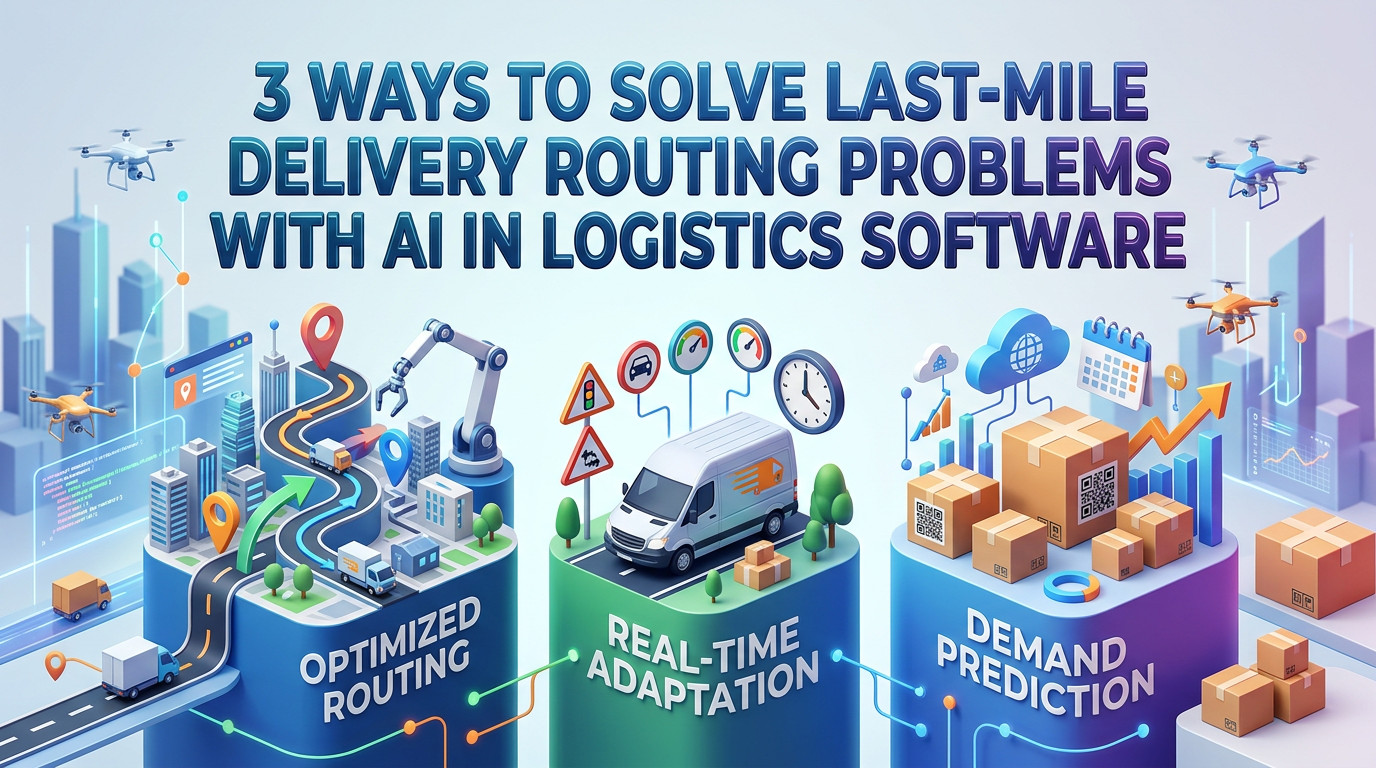
1. Machine Learning-Based Dynamic Route Optimization
Traditional route optimization algorithms rely on deterministic approaches, calculating the shortest or fastest path between points based on fixed parameters. While effective in controlled environments, these methods fail to account for the numerous variables that affect delivery efficiency in real-world scenarios. Machine learning introduces the capability to analyze historical data patterns and make intelligent predictions that improve over time.
Machine learning models can process vast amounts of historical delivery data—including traffic patterns, delivery time windows, package characteristics, driver behavior, and seasonal variations—to identify patterns that human analysts would never detect. These models then use these insights to generate routes that minimize fuel consumption, reduce drive time, and maximize the number of deliveries per route.
The power of machine learning lies in its ability to handle multi-objective optimization. Unlike simple shortest-path algorithms, AI-powered systems can simultaneously optimize for multiple goals: minimizing total distance, reducing fuel costs, balancing driver workloads, respecting time windows, and prioritizing deliveries based on customer importance or package urgency. This holistic approach results in routes that are significantly more efficient than those generated by traditional methods.
Furthermore, machine learning models continuously improve as they process more data. A system that has been operational for several months will outperform a newly implemented solution because it has learned from thousands of actual delivery scenarios, including both successful executions and problematic situations. This continuous learning capability ensures that your routing optimization improves organically without requiring manual intervention. Implementation usually means wiring AI modules into an existing TMS — the same class of build we take on for end-to-end product development when routing is only one slice of a larger logistics stack.
Implementation of machine learning-based route optimization typically involves integrating AI modules with your existing Transportation Management System (TMS) or fleet management platform. The AI component analyzes your historical data, learns from past performance, and provides routing recommendations that consider factors traditional systems simply cannot process.
2. Real-Time Adaptive Routing with AI
Static route plans created at the beginning of the workday often become obsolete within hours. Traffic accidents, road closures, sudden weather changes, emergency delivery requests, and vehicle breakdowns can all derail the most carefully planned routes. Real-time adaptive routing powered by AI addresses this challenge by continuously monitoring conditions and automatically adjusting routes as situations evolve.
AI-powered real-time routing systems integrate with multiple data sources: GPS traffic data, weather APIs, road condition reports, and even social media feeds to maintain a comprehensive view of conditions affecting delivery operations. When unexpected events occur, the system instantly calculates alternative routes and can automatically notify drivers through their mobile devices or in-vehicle navigation systems.
The sophistication of modern AI routing goes beyond simple re-routing. These systems understand the ripple effects of changes—if a delivery is delayed by fifteen minutes, the AI can calculate whether this impacts subsequent deliveries, customer time windows, and driver break schedules. It can then recommend specific actions: whether to skip a low-priority delivery, add additional time to the route, or rearrange the remaining stops to minimize overall impact.
Customer communication is another critical aspect of real-time adaptive routing. When delays are anticipated, AI systems can automatically trigger proactive notifications to customers, providing updated delivery windows and managing expectations. This proactive communication significantly improves customer satisfaction and reduces the volume of customer service inquiries that typically plague logistics operations.
The technology also enables dynamic order assignment. When new orders come in during the day, AI can instantly evaluate whether adding them to existing routes is feasible and cost-effective, or whether they require dedicated resources. This flexibility allows companies to handle same-day orders without compromising the efficiency of planned routes.
For companies operating in urban environments with high delivery densities, real-time adaptive routing provides particularly substantial benefits. The ability to dynamically adjust routes based on current traffic conditions, parking availability, and delivery complexity can reduce delivery times by 20-30% compared to static planning.
3. Predictive Analytics for Proactive Delivery Planning
Predictive analytics turns historical delivery data into next-day capacity plans — and that planning layer is usually where fleet budgets get decided. If you're sizing the build, our notes on what custom software actually costs are a useful companion to the routing design.
While real-time optimization handles immediate conditions, predictive analytics enables logistics companies to anticipate demand, prepare resources, and plan routes before the day even begins. By analyzing historical data, market trends, and external factors, AI-powered predictive models can forecast delivery volumes with remarkable accuracy, allowing for proactive capacity planning and resource allocation.
Predictive analytics transforms last-mile delivery from a reactive to a proactive operation. Instead of reacting to tomorrow's orders as they arrive, companies can anticipate order volumes based on patterns such as seasonal trends, promotional calendars, day of week, and even weather forecasts. This forward-looking capability enables better driver scheduling, vehicle allocation, and route planning.
The integration of external data sources significantly enhances predictive accuracy. AI models can incorporate weather predictions, local events, economic indicators, and even social media trends to forecast demand spikes. For example, if a major weather event is predicted for a specific region, the system can anticipate increased demand for essential goods and pre-position resources accordingly.
Route planning based on predicted demand allows for more efficient resource utilization. Rather than creating routes based on today's orders, AI can design routes that account for anticipated volume, ensuring that capacity is available where and when it's needed most. This approach is particularly valuable for companies with recurring delivery patterns, such as subscription services, meal kit deliveries, or scheduled replenishment runs.
Customer behavior prediction is another powerful application of predictive analytics in last-mile delivery. By analyzing historical delivery data, AI can identify customers who are more likely to not be available at the time of delivery, or those who frequently reschedule. This insight allows for intelligent routing decisions—such as prioritizing these addresses for morning deliveries when recipients are more likely to be home, or flagging them for specific handling procedures.
Predictive maintenance powered by AI also contributes to delivery reliability. By analyzing vehicle telemetry data, AI systems can predict when delivery vehicles are likely to require maintenance, preventing unexpected breakdowns that could disrupt delivery operations. This predictive capability ensures that fleet availability matches planned delivery volumes.
Implementation Considerations for AI-Powered Logistics
While the benefits of AI in last-mile delivery routing are substantial, successful implementation requires careful planning and consideration of several factors. Data quality is paramount—AI models are only as good as the data they consume. Companies must ensure they have robust data collection mechanisms and that historical data is clean, accurate, and accessible.
Integration with existing systems is another critical consideration. AI-powered routing solutions must seamlessly connect with your Transportation Management System, warehouse management platform, customer service tools, and driver applications. Choose solutions that offer robust APIs and proven integration capabilities to minimize implementation complexity.
Change management is often underestimated but critically important. Drivers and dispatchers need training to work effectively with AI-generated recommendations. The system should be designed to augment human decision-making rather than replace it entirely—providing recommendations while allowing experienced operators to override suggestions when they have situational knowledge the AI cannot access.
Start with pilot programs before full-scale deployment. Select a specific geographic area or delivery fleet to test the AI routing solution, measure results, and refine processes. This approach allows you to demonstrate ROI and build organizational confidence before broader implementation.
Conclusion: The Future of Last-Mile Delivery is AI-Powered
Last-mile delivery routing represents one of the most significant opportunities for cost reduction and service improvement in logistics operations. AI-powered solutions—through machine learning optimization, real-time adaptive routing, and predictive analytics—provide capabilities that traditional methods simply cannot match.
Companies that embrace AI for last-mile delivery routing are seeing dramatic improvements: fuel cost reductions of 15-25%, delivery time improvements of 20-30%, and significant increases in customer satisfaction scores. As AI technology continues to advance, these benefits will only grow more substantial.
The journey to AI-powered logistics doesn't require a complete system overhaul. Modern AI solutions can integrate with existing infrastructure, allowing companies to incrementally adopt intelligent routing capabilities. The key is to start: identify your most pressing routing challenges, evaluate AI-powered solutions that address those specific needs, and begin your transformation to intelligent, adaptive delivery operations.
In an era where customer expectations continue to rise and competitive pressures intensify, AI-powered last-mile delivery routing is no longer a luxury—it's a necessity for logistics companies aiming to thrive in the modern marketplace.
Planning last-mile routing or a fleet product? A Scoping Sprint ($2,300, two weeks) ends with a clickable prototype, a technical plan and a fixed quote — or just start a conversation.