Introduction: The AI Revolution for Business Owners
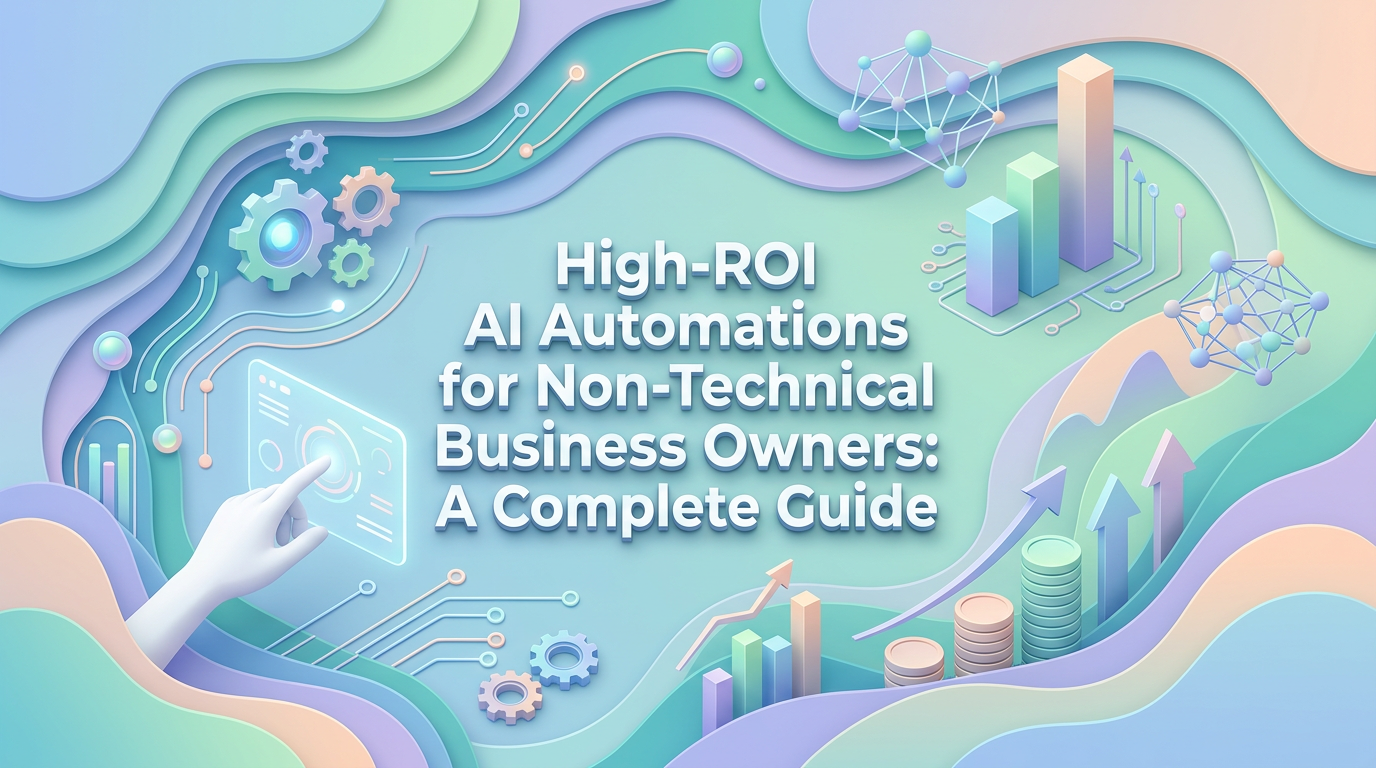
In today's fast-paced business landscape, artificial intelligence is no longer a luxury reserved for tech giants and Fortune 500 companies. Small and medium-sized business owners now have access to powerful AI tools that can dramatically increase efficiency, reduce costs, and free up valuable time. The key lies in understanding which AI automations deliver the highest return on investment (ROI) and how to implement them without requiring a computer science degree.
For non-technical business owners, the world of AI can seem overwhelming. Terms like machine learning, natural language processing, and neural networks often create barriers to entry. However, the reality is far more accessible. Modern AI tools are designed with user-friendliness in mind, offering intuitive interfaces and plug-and-play solutions that require minimal technical expertise.
Turning this into a shipped product is end-to-end product development.
This comprehensive guide explores the most impactful AI automations available to business owners who want to work smarter, not harder. We'll examine proven strategies that deliver measurable results and provide a clear roadmap for implementation, regardless of your technical background.
Understanding AI Automation ROI
Before diving into specific automations, it's essential to understand how to measure the return on your AI investment. ROI in AI automation typically comes from three primary sources: time savings, error reduction, and revenue generation.
Time Savings represents the most immediate and visible benefit. When AI handles repetitive tasks, your team can focus on high-value activities that require human creativity and judgment. Consider your hourly rate or your employees' wages, multiply by hours saved weekly, and you'll begin to see the financial impact.
Error Reduction often delivers even greater long-term value. Manual data entry, for example, typically contains errors that cascade into downstream problems. AI systems maintain consistency and accuracy while operating continuously without fatigue.
Revenue Generation emerges when AI improves customer experiences, accelerates sales cycles, or enables new capabilities that were previously impossible. These benefits often compound over time as your AI systems learn and improve.
Top High-ROI AI Automations for Business Owners
1. Intelligent Customer Service Automation
Customer service represents one of the largest opportunities for AI automation. AI-powered chatbots and virtual assistants can handle routine inquiries 24/7, freeing your team to focus on complex issues that require human empathy and problem-solving skills.
Modern AI chatbots go beyond simple scripted responses. They understand context, learn from interactions, and can route conversations to appropriate team members when escalation is needed. Implementation costs have dropped significantly, with many platforms offering pay-per-use pricing that scales with your business.
The ROI calculation is straightforward: a single customer service representative costs $40,000-$60,000 annually plus benefits. An AI chatbot handling even half that volume represents substantial savings while improving response times from hours to seconds.
2. Automated Lead Generation and Nurturing
AI can transform your sales pipeline by automatically identifying qualified prospects, personalizing outreach, and nurturing leads through automated follow-up sequences. These systems analyze customer behavior, predict purchase intent, and optimize timing for maximum engagement.
Email automation powered by AI analyzes open rates, click-through patterns, and response data to optimize send times and content personalization. Rather than sending generic broadcasts, AI enables one-to-one personalization at scale that previously required an entire marketing team.
The revenue impact is significant: businesses using AI for lead scoring see an average 20% increase in qualified leads and 15% improvement in conversion rates. When applied to a substantial sales pipeline, these improvements translate to tens or hundreds of thousands in additional revenue.
3. Financial and Administrative Automation
Bookkeeping, invoicing, and financial reporting consume enormous amounts of small business owner time. AI-powered accounting tools now automate data entry, categorize transactions, and generate real-time financial insights without manual intervention.
Receipt scanning and expense tracking AI extracts relevant data from invoices and receipts, eliminating hours of manual data entry each week. Bank reconciliation algorithms match transactions automatically, reducing errors and closing books faster at month-end.
For business owners who currently handle finances themselves or employ dedicated bookkeepers, these AI tools typically reduce accounting time by 50-80% while improving accuracy. The savings can be redirected to growth initiatives or simply recovered as personal time.
4. Marketing Content Generation
AI writing assistants have matured dramatically, now capable of generating marketing copy, social media posts, blog drafts, and sales communications that require minimal human editing. These tools don't replace human creativity but amplify it, handling first drafts while you refine the message.
If you're still validating, start from a published MVP cost breakdown.
Content repurposing AI transforms one piece of content into multiple formats—a blog post becomes social media snippets, email newsletters, and video scripts. This multiplication effect dramatically increases your content output without proportional time investment.
The ROI manifests in reduced content creation costs. Whether you currently create content in-house or outsource to agencies, AI can reduce production time by 40-60% while maintaining quality standards. For businesses spending $5,000-$10,000 monthly on content, the savings are substantial.
5. Document Processing and Data Extraction
Contracts, proposals, quotes, and forms generate enormous paperwork in most businesses. AI document processing extracts relevant data, populates databases, and initiates workflows automatically upon receipt.
Proposal and quote generation AI assembles customized documents from your library of templates and client data, ensuring accuracy while reducing preparation time from hours to minutes. Version control becomes simpler when AI maintains consistency across all customer-facing documents.
Customer onboarding flows trigger automatically when contracts are signed, initiating account setup, welcome communications, and task assignments without manual coordination. This automation eliminates the gap between sale and delivery that often frustrates customers.
How to Identify AI Opportunities in Your Business
Finding the right AI opportunities requires honest assessment of your current operations. Start by identifying tasks that meet three criteria: they are repetitive, follow defined rules, and consume significant time.
Create a simple spreadsheet listing your business processes alongside the time they consume weekly. Look for patterns: tasks that multiple team members perform, activities that feel like "busy work," and processes that require extensive manual coordination.
Consult with your team members who perform these tasks daily. They often identify inefficiencies that leadership overlooks. Ask them what tasks they would eliminate if they could—what would free them to do more meaningful work?
Prioritize opportunities by impact and implementation difficulty. High-impact, low-difficulty projects deliver quick wins that build momentum for larger transformations. Customer service chatbots often fit this category—relatively simple to implement while delivering immediate, visible results.
Implementation Roadmap for Non-Technical Owners
Successful AI implementation doesn't require technical expertise, but it does require a systematic approach. Follow this roadmap to maximize your chances of success.
Phase 1: Assessment and Planning (Week 1-2)
Document your target processes, define success metrics, and identify data sources. Understand what information your AI tools will need and ensure it's accessible. Clean, organized data dramatically improves AI performance.
Where AI is involved in the workflow, we implement under AI agentic development.
Phase 2: Tool Selection (Week 2-3)
Research available solutions within your budget and technical capability. Prioritize platforms offering free trials or money-back guarantees. Look for comprehensive support resources—video tutorials, documentation, and responsive customer service.
Phase 3: Pilot Implementation (Week 3-6)
Start small with a limited scope pilot. Implement your chosen AI tool for one process or department. This approach allows you to learn, adjust, and demonstrate value before broader deployment.
Phase 4: Measurement and Optimization (Week 6-8)
Compare actual results against your defined metrics. Identify what's working and what needs adjustment. Most AI tools improve over time as they learn from your data and feedback.
Phase 5: Scale and Expand (Week 8+)
Once you've proven ROI in one area, expand to additional processes. Build on your learning and established workflows. Each subsequent implementation becomes easier as your team develops AI fluency.
Common Mistakes to Avoid
Understanding common pitfalls saves time, money, and frustration. Here are the mistakes most frequently encountered by non-technical business owners implementing AI.
Attempting Too Much Too Soon creates overwhelm and often leads to abandoned projects. Start with focused, achievable objectives and expand gradually. Quick wins build organizational buy-in and technical capability.
Ignoring Data Quality undermines AI performance from the start. Garbage in, garbage out applies to AI as it does to any automated system. Invest time in organizing your data before implementing AI solutions.
Expecting Perfection Immediately sets unrealistic expectations. AI tools improve over time as they learn from interactions. Initial imperfections are normal and typically resolve within weeks of implementation.
Conclusion: Your Path to AI-Powered Business
The AI revolution presents unprecedented opportunities for non-technical business owners to compete more effectively, serve customers better, and build more profitable enterprises. The automations discussed in this guide represent proven, high-ROI solutions that have delivered results for thousands of businesses across industries.
The key to success lies not in technical knowledge but in strategic selection and systematic implementation. Identify your highest-impact opportunities, start with focused pilots, measure rigorously, and expand thoughtfully. Each step forward builds capability and confidence for the next.
Your competitors are already implementing AI. Businesses that embrace these technologies will gain lasting advantages in efficiency, customer experience, and ultimately, profitability. The question isn't whether to implement AI—it's how quickly you can begin capturing its benefits.
The time to start is now. Your future, more efficient and profitable business awaits.
If you're serious about this, a Scoping Sprint ($2,300, two weeks) gets you a prototype, technical plan and fixed quote — or contact us directly.