Introduction: The Critical Transition Point
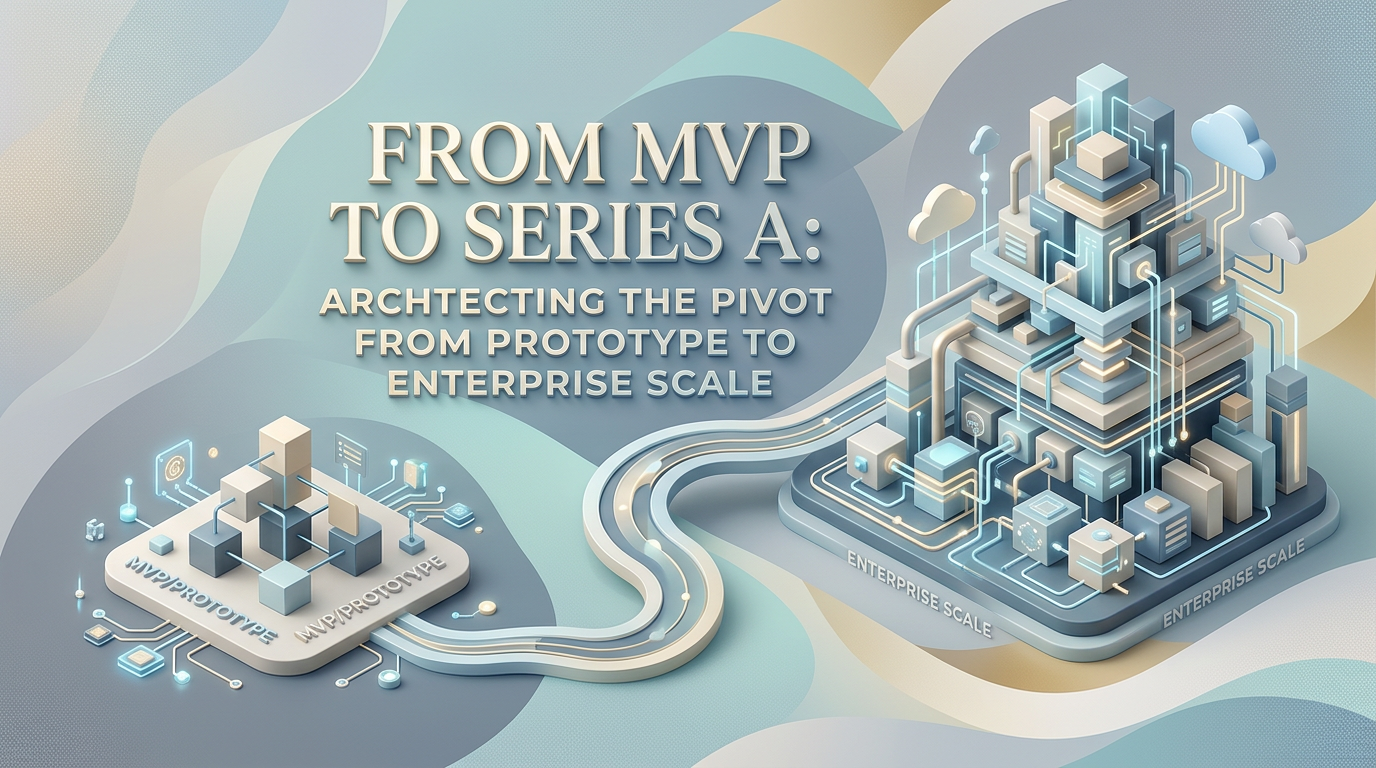
Every successful tech startup begins with a minimum viable product (MVP)—a lean version of your vision designed to validate market fit and gather user feedback. However, as your user base grows and investor expectations escalate during Series A funding, the architectural decisions you made during those early days can either become your greatest asset or your most significant bottleneck. The transition from MVP to Series A represents one of the most challenging yet transformative periods in a technology company's lifecycle.
At Sapient Code Labs, we've witnessed countless startups struggle with this pivotal moment. The difference between those who successfully scale and those who falter often lies in how early they begin thinking about enterprise-grade architecture. This comprehensive guide explores the technical, organizational, and strategic considerations necessary to transform your prototype into a scalable, investment-ready platform.
Prove one valuable workflow first — that's how we run MVP development.
Understanding the MVP to Series A Gap
The fundamental difference between MVP and Series A readiness extends far beyond adding more features. Your MVP was designed to solve specific problems for early adopters with minimal overhead. Series A readiness demands a platform that can handle exponential growth, maintain security compliance, support multiple user personas, and integrate with enterprise ecosystems.
Investors evaluating your company at the Series A stage aren't just looking at your user numbers—they're scrutinizing your technical foundation. Can your system handle ten times your current load? Is your code maintainable enough to attract senior engineers? Do you have the infrastructure to ensure 99.9% uptime? These questions determine whether you'll secure that crucial funding round.
Technical Architecture: Building the Foundation for Scale
Monolithic to Microservices: When to Make the Leap
One of the first architectural decisions you'll face is whether to refactor your monolithic application into microservices or optimize your existing structure. The honest answer depends on your current complexity and anticipated scaling trajectory. Many startups benefit from a modular monolith approach—keeping services logically separated within a single deployable unit until traffic demands true distribution.
The key indicator that you need microservices is when different components of your application have drastically different scaling requirements. Perhaps your core application sees moderate traffic while your reporting engine requires significant computational resources only during end-of-month processing. Microservices allow you to scale each component independently, optimizing costs and performance.
API-First Design Philosophy
Series A-ready applications require robust, well-documented APIs. This isn't merely about exposing endpoints—it's about designing an API architecture that supports multiple clients (web, mobile, third-party integrations) while maintaining backward compatibility. Implement API versioning from day one to prevent breaking changes that could disrupt your growing ecosystem of integrations.
Consider adopting the OpenAPI specification to document your APIs comprehensively. This documentation becomes invaluable for internal development teams, potential partners, and the technical due diligence process investors will conduct.
Infrastructure Scaling Strategies
Cloud-Native Architecture
Modern cloud infrastructure provides the flexibility necessary to scale from hundreds to millions of users. Rather than provisioning fixed servers, leverage auto-scaling groups that respond to traffic patterns in real-time. Cloud-native architecture also enables horizontal scaling—adding more instances of your application rather than upgrading to larger servers.
Containerization through Docker and orchestration through Kubernetes have become industry standards for managing distributed applications. These technologies provide consistent deployment across environments, easier scaling operations, and improved resource utilization. While the learning curve is significant, the long-term benefits for Series A companies are substantial.
Database Architecture for Enterprise Scale
Your database strategy often determines your application's ultimate scalability. As you transition from MVP to enterprise scale, consider these critical decisions:
Use published numbers for what an MVP actually costs, then add model spend as an explicit line item.
SQL vs. NoSQL: Relational databases remain excellent for structured data with complex relationships, while NoSQL databases excel at handling unstructured data and horizontal scaling. Many successful Series A companies employ polyglot persistence—using different database technologies for different data requirements within their application.
Read Replicas: Implement read replicas to distribute database load. This separation allows your primary database to handle writes while replicas service read queries, significantly improving performance as your user base grows.
Caching Layers: Implement Redis or Memcached to cache frequently accessed data. Effective caching can reduce database load by 80-90% while dramatically improving response times for end users.
Security and Compliance: Non-Negotiable Requirements
As your platform handles more sensitive data and attracts enterprise customers, security becomes a primary concern. Series A investors will conduct thorough security audits, making proactive measures essential.
Data Protection Implementation
Implement end-to-end encryption for sensitive data, both in transit and at rest. Adopt the principle of least privilege for user and service account permissions. Regular security audits and penetration testing should become part of your operational rhythm rather than one-time events.
If you operate in regulated industries or handle data from European users, prepare for GDPR compliance. This includes implementing data deletion capabilities, obtaining proper consent mechanisms, and establishing data processing agreements with any third-party services.
Authentication and Authorization
Move beyond basic authentication to implement robust identity and access management. Consider OAuth 2.0 and OpenID Connect for modern authentication flows that support single sign-on (SSO) capabilities enterprise customers expect. Role-based access control (RBAC) and attribute-based access control (ABAC) provide the granular permission structures enterprise environments require.
Team Scaling and Development Processes
Technical architecture cannot scale without an organization capable of supporting it. The transition from a small development team to a scaled engineering organization requires deliberate process development.
Implementing DevOps Culture
Establish CI/CD pipelines that automate testing and deployment processes. This automation becomes crucial as your team grows and the complexity of your application increases. Each developer shouldn't need manual intervention to deploy code to production—they should simply commit to the repository and trust your pipeline to handle the rest.
If the MVP includes agents or tool-use, that slice is AI agentic development.
Infrastructure as Code (IaC) through tools like Terraform or CloudFormation ensures your infrastructure can be reproduced, versioned, and audited. This practice supports disaster recovery, enables consistent environments, and simplifies the scaling process.
Documentation and Knowledge Management
As your team expands, institutional knowledge cannot reside solely in the minds of founding engineers. Invest in comprehensive documentation covering architecture decisions, API specifications, deployment procedures, and operational runbooks. This documentation supports both current operations and the due diligence process investors undertake.
Performance Optimization for Enterprise Readiness
User expectations scale alongside your ambitions. What felt fast with hundreds of users may become unbearable at scale. Proactive performance optimization demonstrates technical maturity to investors and ensures positive user experiences.
Monitoring and Observability
Implement comprehensive monitoring covering application performance, infrastructure metrics, and business KPIs. Tools like Prometheus for metrics collection, Grafana for visualization, and ELK stack for log aggregation provide the observability necessary to identify and resolve issues before they impact users.
Distributed tracing becomes essential as your architecture grows more complex. Solutions like Jaeger or AWS X-Ray help identify performance bottlenecks across microservices architectures, enabling targeted optimization efforts.
CDN and Edge Computing
Implement a Content Delivery Network (CDN) to serve static assets from locations geographically close to your users. This distribution dramatically improves load times while reducing origin server load. Consider edge computing capabilities for running logic closer to users, further reducing latency for global applications.
Preparing for Technical Due Diligence
Series A investors will conduct thorough technical due diligence. Preparing for this process proactively demonstrates maturity and reduces deal friction.
Ensure you can speak confidently about your architecture decisions, scalability limits, and growth projections. Document your technical roadmap and be prepared to explain how current architecture supports future requirements. Be honest about technical debt—investors appreciate awareness of limitations more than false perfection.
Maintain clean, organized repositories with clear contribution guidelines. Code quality matters because it indicates your ability to attract talent and maintain velocity as you scale. Consider third-party code reviews or certifications that provide external validation of your technical practices.
Conclusion: The Journey of Continuous Evolution
The transition from MVP to Series A is not a destination but an ongoing journey of evolution. The architectural decisions you make today create the foundation for your company's future capabilities. By investing in scalable infrastructure, robust security practices, and mature development processes, you position your company for both successful Series A fundraising and long-term market success.
At Sapient Code Labs, we understand that this transition represents both excitement and challenge. Our team has guided numerous startups through this critical phase, transforming prototypes into enterprise-ready platforms. Whether you need guidance on microservices architecture, cloud infrastructure design, or comprehensive development support during your scaling journey, we're here to help you build the technical foundation that Series A investors seek.
Growing past the MVP? Work with a product development company that takes you end to end — Sapient Codelabs designs, builds and scales products with one accountable senior team. Talk to our team.
Building an MVP? A Scoping Sprint ($2,300, two weeks) ends with a clickable prototype, a technical plan and a fixed quote — or just start a conversation.