Introduction
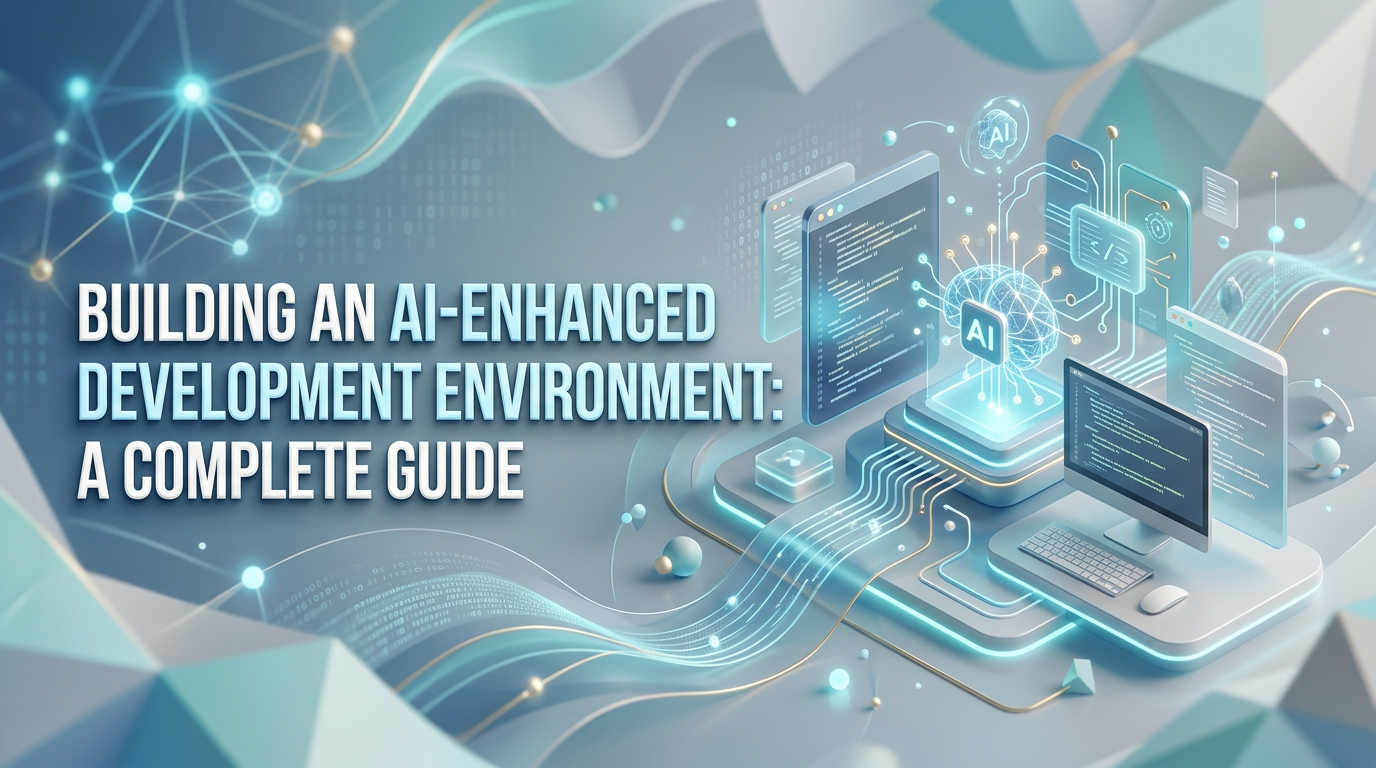
In today's rapidly evolving software development landscape, staying competitive requires more than just skilled developers—it demands intelligent tools that amplify human capabilities. An AI-enhanced development environment represents the next frontier in software engineering, combining powerful IDEs with intelligent assistants that understand context, predict patterns, and automate repetitive tasks.
At Sapient Code Labs, we've witnessed firsthand how integrating artificial intelligence into development workflows transforms not just individual productivity but entire team dynamics. Whether you're a startup looking to maximize limited resources or an enterprise seeking to accelerate delivery cycles, understanding how to build an effective AI-enhanced development environment has become an essential skill.
This comprehensive guide walks you through the critical components, implementation strategies, and best practices for creating a development environment where human creativity and artificial intelligence work in harmony.
Understanding AI-Enhanced Development Environments
An AI-enhanced development environment goes far beyond traditional IDEs with basic autocomplete features. It represents a holistic ecosystem where artificial intelligence assists developers at every stage of the software development lifecycle—from initial code generation and intelligent autocomplete to automated testing, security analysis, and deployment optimization.
The foundation of any AI-enhanced environment rests on three pillars: intelligent code analysis, contextual understanding, and adaptive learning. Modern AI development tools leverage large language models trained on billions of lines of code to understand programming patterns across hundreds of languages and frameworks. This enables them to provide meaningful suggestions that go beyond simple syntax completion.
What sets truly AI-enhanced environments apart is their ability to understand project context. These systems analyze your entire codebase, learning from your coding style, architectural decisions, and business logic to provide suggestions that align with your specific requirements rather than generic patterns.
Essential Components of an AI-Enhanced Development Environment
Building a comprehensive AI-enhanced development environment requires integrating several key components that work together seamlessly. Let's explore each element in detail.
Intelligent Code Editors and IDEs
The foundation of your AI-enhanced environment starts with selecting the right code editor. Modern IDEs like Visual Studio Code, JetBrains IntelliJ, and Cursor have built-in AI capabilities, but the true power emerges when you integrate specialized AI assistants. These tools provide real-time code completion, intelligent refactoring suggestions, and contextual code generation that understands your project's unique structure.
When selecting an IDE, consider factors like language support, extension ecosystem, and AI integration capabilities. Visual Studio Code, for example, offers extensions like GitHub Copilot and Tabnine that bring powerful AI assistance to virtually any programming language. JetBrains IDEs provide their own AI assistant with deep integration into the IDE's understanding of your code structure.
AI-Powered Code Review Tools
Integrating AI into your code review process dramatically improves code quality while reducing the burden on human reviewers. Tools like CodeRabbit, Amazon CodeGuru, and SonarQube's AI capabilities can analyze pull requests for potential bugs, security vulnerabilities, and performance issues in seconds—tasks that would take human reviewers significantly longer.
These tools excel at identifying common issues like SQL injection vulnerabilities, memory leaks, and inefficient algorithms. More importantly, they learn from your team's coding standards and can enforce consistency across your codebase, ensuring that all contributions meet your quality bar regardless of who wrote them.
Automated Testing and Quality Assurance
AI-enhanced testing tools represent one of the most impactful investments in your development environment. Tools like Testim, Applitools, and Mabl use machine learning to create, maintain, and execute tests that adapt to your application's UI changes. This dramatically reduces test maintenance overhead while improving test coverage.
Beyond functional testing, AI tools can generate unit tests, integration tests, and even end-to-end scenarios based on your codebase. They analyze code changes and automatically determine which tests need updating or creation, ensuring your test suite evolves alongside your application.
Documentation and Knowledge Management
Maintaining comprehensive documentation is notoriously challenging, yet it's crucial for team productivity. AI-enhanced documentation tools can automatically generate and update documentation based on code changes. Tools like GitHub's AI documentation features and specialized solutions like Sourcegraph's Cody can analyze your code and produce meaningful documentation, API references, and inline comments.
These systems also enable natural language queries about your codebase, allowing developers to ask questions like "How does the authentication flow work?" and receive accurate answers drawn from the actual implementation.
Implementation Strategies for Maximum Impact
Successfully implementing an AI-enhanced development environment requires careful planning and phased rollout. Rushing to adopt every available tool simultaneously often leads to confusion and underutilization. Instead, follow a strategic approach that builds momentum while managing change effectively.
Phase One: Foundation Building
Begin by establishing your core development environment with AI-powered IDEs and basic code completion tools. GitHub Copilot serves as an excellent starting point, providing contextual code suggestions across multiple languages. Install these tools across your team and allow developers to explore their capabilities organically.
During this phase, encourage team members to experiment with AI features and share discoveries. Create internal documentation about effective prompts and workflows that work for your specific technology stack. This grassroots exploration often surfaces insights that top-down mandates would miss.
Phase Two: Integration and Automation
Once your team is comfortable with basic AI tools, expand into code review automation and testing integration. Implement AI-powered pull request analysis to catch issues before human review. Introduce automated testing tools that reduce manual testing burden while improving coverage.
Critical during this phase is establishing feedback loops. AI tools learn from usage patterns, so ensure your team provides feedback on suggestion quality. Most tools include mechanisms to indicate when suggestions are helpful or unhelpful—actively using these features improves results for your entire team.
Phase Three: Advanced Optimization
The final phase involves sophisticated AI capabilities: natural language code search, automated refactoring suggestions, and predictive analytics for project planning. Tools like Amazon CodeWhisperer and specialized AI agents can take on increasingly complex tasks, from generating entire functions to identifying architectural improvements.
During this phase, consider developing custom AI integrations specific to your domain. If your team works on a particular type of application, training or configuring AI tools to understand your specific patterns yields compounding benefits over time.
Best Practices for AI-Enhanced Development
Maximizing the benefits of your AI-enhanced environment requires following established best practices while maintaining healthy skepticism about AI limitations.
Maintain Human Oversight
AI suggestions are never infallible. Even the most sophisticated models can generate code with subtle bugs, security vulnerabilities, or logic errors. Establish clear guidelines requiring human review of AI-generated code, especially for critical systems, security-sensitive operations, and complex business logic. The goal is AI augmentation, not replacement—human judgment remains essential.
Prioritize Security and Privacy
When using AI tools that process your code externally, understand where your data goes and how it's protected. Many AI coding assistants send code to cloud services for processing, potentially exposing proprietary information. Evaluate enterprise options that keep your code within your infrastructure, or establish clear policies about what can and cannot be shared with external AI services.
Invest in Team Training
Technology alone doesn't drive transformation—people do. Provide comprehensive training on effective AI tool usage, including prompt engineering techniques, understanding AI limitations, and integrating AI assistance into existing workflows. The most successful teams develop shared practices that leverage AI strengths while compensating for its weaknesses.
Measure and Iterate
Track metrics around developer productivity, code quality, and delivery speed to understand the actual impact of AI tools. Look beyond simple metrics like lines of code written—focus on outcomes like time to feature completion, defect rates, and developer satisfaction. Use this data to refine your tool selection and usage patterns continuously.
Future Trends in AI-Enhanced Development
The landscape of AI-enhanced development continues evolving rapidly. Emerging trends point toward increasingly sophisticated capabilities that will further transform how software gets built.
Multi-modal AI systems that understand code alongside visual designs, requirements documents, and runtime behavior are becoming reality. These systems will provide suggestions that span entire applications, understanding how changes in one area affect others.
Autonomous AI agents capable of handling increasingly complex development tasks are also emerging. Rather than simply suggesting code, these agents can plan and execute multi-step tasks, manage dependencies, and handle integration challenges—potentially handling significant portions of routine development work.
At Sapient Code Labs, we're actively tracking these developments and incorporating the most promising tools into our development methodology. Our commitment to staying at the forefront of AI-enhanced development ensures our clients benefit from the latest advances in intelligent tooling.
Conclusion
Building an AI-enhanced development environment represents a strategic investment in your team's productivity and code quality. By thoughtfully integrating AI tools across your development workflow—starting with intelligent code editors, expanding into automated review and testing, and eventually leveraging advanced AI capabilities—you create an environment where developers focus on creative problem-solving while AI handles routine tasks and amplifies their capabilities.
The transformation doesn't happen overnight. Success requires patient adoption, continuous learning, and willingness to evolve your practices as AI capabilities expand. But organizations that invest in building effective AI-enhanced environments consistently outperform those that don't, delivering better software faster with more consistent quality.
Whether you're just beginning your AI-enhanced journey or looking to optimize an existing setup, the key is starting with clear objectives, selecting tools that match your team's needs, and maintaining focus on human-AI collaboration rather than replacement. The future of software development belongs to teams that effectively harness artificial intelligence while preserving the creativity and judgment that only humans provide.
At Sapient Code Labs, we specialize in helping organizations navigate this transformation. Our expertise in AI integration and modern development practices enables us to build environments that maximize the synergy between human talent and artificial intelligence.