Introduction: The Paradigm Shift in Enterprise AI
The enterprise artificial intelligence landscape is undergoing a fundamental transformation. For years, organizations in regulated industries—finance, healthcare, legal, and government sectors—approached AI as a static infrastructure component: powerful models deployed within rigid boundaries, operating on predetermined rules and limited autonomy. This model served as a foundation, but it increasingly fails to meet the dynamic demands of modern compliance requirements, real-time decision-making, and adaptive business processes.
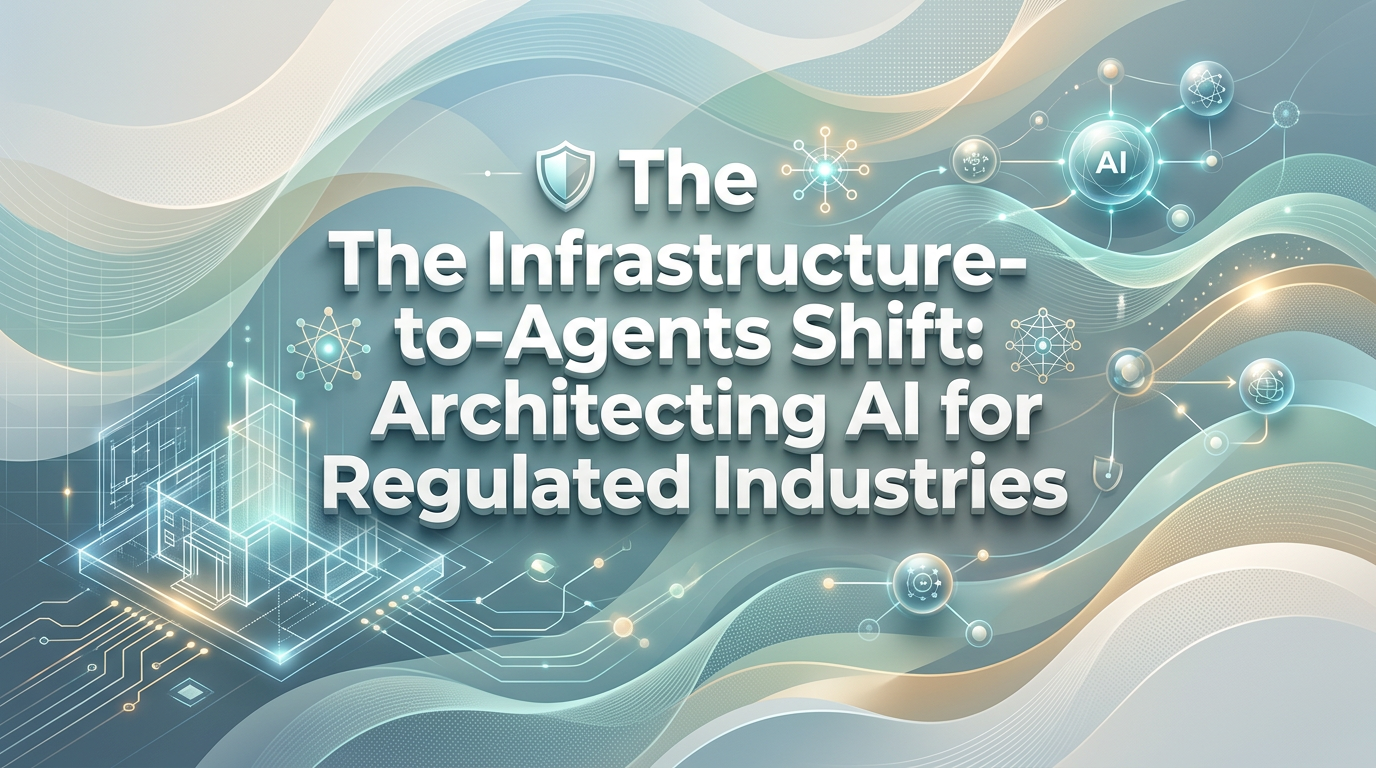
The emergence of AI agents marks a decisive shift from this infrastructure-centric approach. Rather than treating artificial intelligence as a fixed tool, organizations now architect systems where AI operates as an autonomous or semi-autonomous agent capable of reasoning, acting, and learning within defined parameters. This transformation, which we call the "infrastructure-to-agents shift," is particularly consequential for regulated industries where the stakes of AI decisions extend far beyond efficiency metrics to legal compliance, public safety, and financial stability.
Production agents need auth, audit, evaluation and integration — that's AI agentic development.
Sapient Code Labs has witnessed this transformation across numerous client engagements, where the question has evolved from "how do we implement AI?" to "how do we architect AI agents that operate reliably within regulatory frameworks?" This blog post examines this architectural evolution, exploring the technical foundations, compliance considerations, and strategic implications for organizations building the next generation of intelligent systems.
Understanding the Infrastructure-to-Agents Shift
To appreciate the significance of this transformation, we must first distinguish between infrastructure-based AI and agent-based AI. Traditional AI implementations function as infrastructure: they accept inputs, process them through trained models, and generate outputs. The system remains largely passive, responding to requests but not initiating actions or adapting its behavior based on outcomes.
AI agents, by contrast, embody a fundamentally different architectural pattern. An agent maintains context, reasons about complex situations, takes autonomous actions within defined boundaries, and iteratively improves its performance based on feedback. Rather than a single model processing discrete requests, an agent orchestrates multiple capabilities—language understanding, reasoning, tool use, and memory management—into a cohesive system that pursues objectives.
This shift introduces both tremendous opportunity and significant complexity for regulated industries. Consider a compliance monitoring system: an infrastructure-based approach might scan transactions for predefined patterns and flag potential violations. An agent-based system, however, could proactively investigate anomalies, gather context from multiple data sources, assess risk profiles, and recommend actions—all while maintaining comprehensive audit trails and operating within regulatory constraints.
The transition is not merely technological; it represents a philosophical change in how organizations conceptualize the role of artificial intelligence in their operations. Infrastructure implies static deployment; agents imply dynamic partnership. For regulated industries, this distinction carries profound implications for governance, accountability, and risk management.
Why Regulated Industries Need Specialized AI Architecture
Regulated industries face unique challenges that generic AI solutions cannot adequately address. Financial institutions must comply with Anti-Money Laundering regulations, Know Your Customer requirements, and Basel III capital adequacy standards. Healthcare organizations navigate HIPAA privacy protections, FDA device regulations, and state-specific licensing requirements. Legal firms operate under attorney-client privilege constraints and bar association ethical rules.
These regulatory frameworks share common themes that directly impact AI architecture. First, there is the requirement for explainability: regulators increasingly demand that automated decisions can be justified, traced, and understood by human reviewers. Second, there is the imperative of data sovereignty: sensitive information must remain within jurisdictional boundaries and under appropriate access controls. Third, there is the necessity of auditability: every significant action must be logged, timestamped, and retrievable for regulatory examination.
Traditional AI infrastructure can address these requirements to some degree, but agent-based systems introduce additional complexity. When an AI agent takes autonomous action, the organization must ensure that the agent's decision-making process remains transparent and defensible. When agents operate across multiple systems and data sources, the organization must maintain comprehensive lineage tracking. When agents learn and adapt, the organization must verify that this adaptation does not introduce bias or violate regulatory constraints.
Sapient Code Labs has developed specialized architectural approaches that address these challenges directly. Our methodology emphasizes modular agent design, where each agent component maintains clear boundaries, defined interfaces, and explicit compliance controls. This architectural discipline enables organizations to harness the power of agentic AI while maintaining the rigorous governance that regulated industries demand.
Key Architectural Considerations for AI Agents in Regulated Sectors
Building AI agents for regulated industries requires careful attention to several architectural dimensions that may be less critical in less constrained environments.
We treat the surrounding product as end-to-end product development, not a separate science project.
1. Guardrails and Constraint Systems
Agent autonomy must operate within rigorously defined boundaries. Effective architectures incorporate multiple layers of guardrails: input validation that prevents malicious or inappropriate requests from reaching the agent, output filtering that ensures responses comply with regulatory requirements, and action constraints that prevent agents from exceeding their authorized scope.
These guardrails should be implemented as independent systems rather than embedded within the agent itself. This separation ensures that constraint enforcement remains robust even if the agent experiences unexpected behavior or adversarial manipulation.
2. Memory and Context Management
AI agents require sophisticated memory architectures to maintain state, track interactions, and build contextual understanding. In regulated environments, memory management carries additional weight: the system must distinguish between short-term operational memory and long-term persistent storage, implement appropriate retention policies, and ensure that sensitive information is handled according to regulatory requirements.
3. Multi-Agent Orchestration
Complex regulatory processes often require coordination across multiple specialized agents. A financial compliance system might involve separate agents for transaction monitoring, customer risk assessment, regulatory reporting, and case management. Architectural patterns for multi-agent orchestration must address communication protocols, conflict resolution, and consistent governance across the agent ecosystem.
4. Tool Use and System Integration
Effective agents must interact with existing enterprise systems—CRMs, case management platforms, regulatory databases, and reporting tools. This integration must be carefully architected to maintain security boundaries, preserve data integrity, and ensure that all system interactions comply with regulatory requirements.
5. Observability and Monitoring
Regulated industries cannot afford to operate "black box" AI systems. Architectures must incorporate comprehensive observability that provides visibility into agent reasoning, decision justification, and system behavior. This observability serves both operational management and regulatory compliance, enabling organizations to demonstrate that their AI systems operate as intended.
Building Trust and Transparency in AI Systems
The success of AI adoption in regulated industries ultimately depends on building trust—in trust among regulators, customers, employees, and the broader public.Architectural decisions directly impact an organization's ability to demonstrate that its AI systems are trustworthy.
Transparency begins with documentation. Organizations must maintain comprehensive records of agent design decisions, training methodologies, constraint implementations, and operational parameters. This documentation must be accessible to regulators and defensible in legal proceedings.
Explainability represents a related but distinct requirement. When an AI agent makes a decision or recommendation, stakeholders must be able to understand the reasoning behind that output. Modern agent architectures increasingly incorporate explanation generation as a core capability, producing human-readable justifications that accompany agent outputs.
Use our SaaS development cost guide to budget the product shell around the models.
Human oversight remains essential, even as agents become more capable. Effective architectures implement appropriate human-in-the-loop mechanisms, ensuring that significant decisions receive human review while avoiding unnecessary friction that would undermine operational efficiency. The specific balance between agent autonomy and human oversight depends on the use case, regulatory requirements, and organizational risk tolerance.
Sapient Code Labs emphasizes these trust-building considerations throughout our architectural approach. We work with clients to establish governance frameworks that define not only what AI agents can do but how their behavior will be monitored, evaluated, and reported. This systematic approach to trust enables organizations to pursue AI innovation with confidence.
Implementation Strategies for the Infrastructure-to-Agents Transition
Organizations embarking on this transformation face practical challenges that extend beyond technical architecture. Successful implementation requires coordinated attention to technology, process, and organizational change.
We recommend a phased approach that begins with well-bounded use cases where the benefits of agentic AI are substantial but the risks remain manageable. Initial deployments might focus on internal processes where the organization maintains full control over the operating environment and can implement extensive monitoring. Success in these initial deployments builds organizational confidence and generates practical learnings that inform subsequent expansion.
Investment in foundational capabilities precedes agent deployment. Organizations should establish robust data governance, ensure appropriate infrastructure for AI operations, and develop the internal expertise necessary to design, deploy, and maintain agentic systems. Attempting to build sophisticated AI agents on inadequate foundations typically results in systems that are difficult to govern and challenging to scale.
Cross-functional collaboration proves essential. Legal and compliance teams must be involved from the earliest stages of architectural design, not brought in only after technical decisions have been made. This early engagement ensures that regulatory considerations shape the architecture rather than being retrofitted as constraints.
The Future of AI Agents in Regulated Industries
Looking ahead, we anticipate continued acceleration in the adoption of AI agents across regulated sectors. The technology continues to mature, with improvements in reasoning capabilities, reliability, and safety mechanisms. Regulatory frameworks are evolving to provide clearer guidance on AI governance, creating a more predictable environment for investment and innovation.
Organizations that establish strong architectural foundations now will be positioned to capitalize on these developments. The transition from infrastructure-based AI to agent-based AI is not a temporary trend but a fundamental shift in how enterprises leverage artificial intelligence. Those that master this transition will achieve significant competitive advantages in efficiency, responsiveness, and capability.
At Sapient Code Labs, we remain committed to helping our clients navigate this transformation. Our expertise in AI architecture, combined with deep experience in regulated industries, enables us to design and implement systems that deliver on the promise of agentic AI while maintaining the compliance, security, and trust that these industries require.
Conclusion: Architecting for the Agentic Future
The infrastructure-to-agents shift represents one of the most significant architectural transformations in enterprise technology history. For regulated industries, this transition offers the promise of more capable, adaptive, and intelligent AI systems—but only when implemented with appropriate attention to compliance, security, and governance.
Success requires more than adopting new technology; it demands a fundamental rethinking of how AI systems are architected, deployed, and managed. Organizations must invest in specialized architectures that incorporate robust guardrails, comprehensive observability, and effective human oversight. They must build cross-functional teams that bring together technical, legal, and compliance expertise. And they must approach the transition with patience, starting with well-bounded use cases and expanding as experience and confidence grow.
The organizations that embrace this transformation thoughtfully and systematically will define the future of AI in regulated industries. They will build systems that not only meet regulatory requirements but exceed them—demonstrating that artificial intelligence can operate with both remarkable capability and unwavering responsibility.
Sapient Code Labs stands ready to partner with organizations pursuing this vision. Our team combines deep technical expertise in AI architecture with extensive experience in regulated industries, enabling us to deliver solutions that are both innovative and compliant. Contact us to explore how we can help you architect AI systems prepared for the agentic future.
Building production AI agents? A Scoping Sprint ($2,300, two weeks) ends with a clickable prototype, a technical plan and a fixed quote — or just start a conversation.