The Evolution of Legacy Modernization
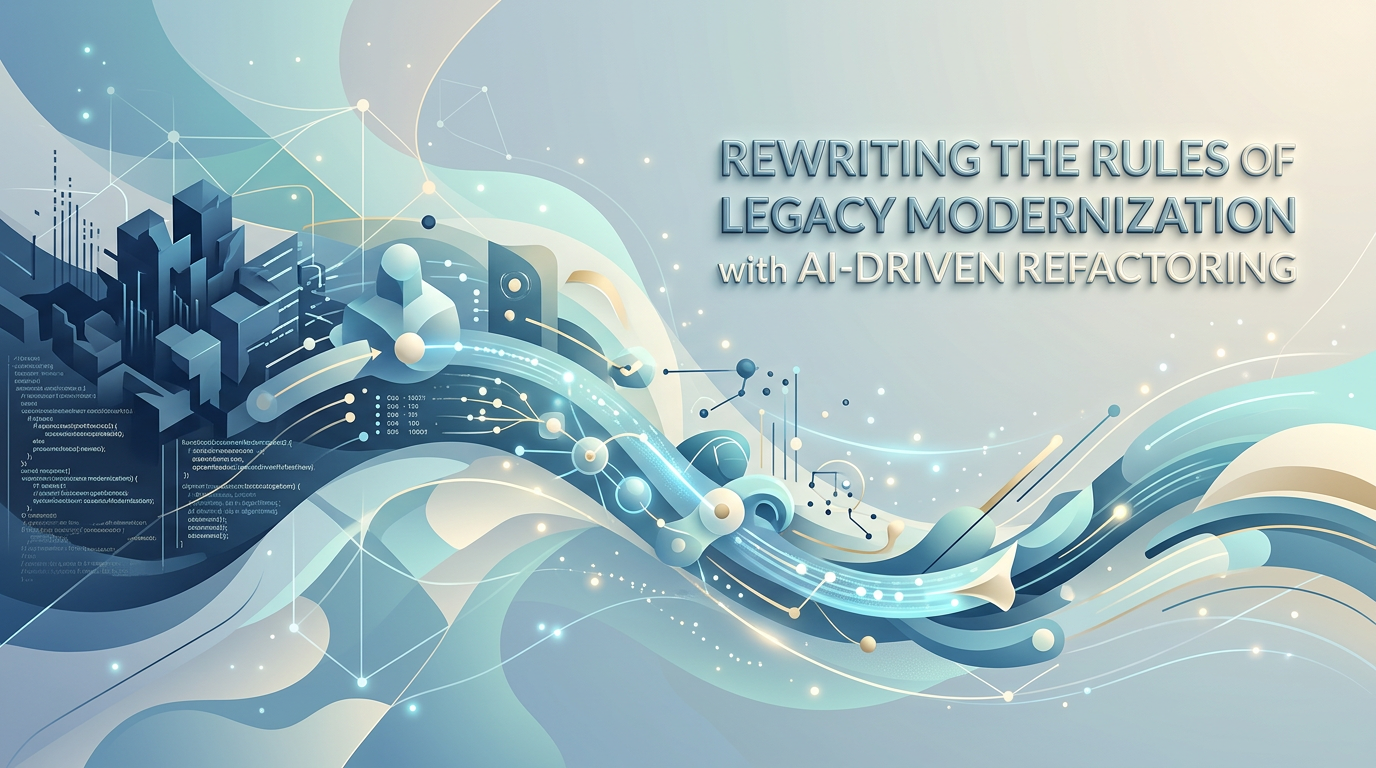
For decades, organizations have struggled with aging codebases that power critical business operations. Legacy systems, often built on outdated technologies, pose significant challenges including security vulnerabilities, maintenance difficulties, and the inability to meet modern business requirements. Traditional modernization approaches have been costly, time-consuming, and risky, leaving many companies stuck with systems that limit their competitive edge.
The landscape is changing dramatically in 2025. Artificial intelligence has emerged as a game-changer in the realm of software modernization, offering unprecedented capabilities to analyze, understand, and transform legacy codebases. AI-driven refactoring represents a fundamental shift in how organizations approach the modernization journey, making it faster, safer, and more cost-effective than ever before.
Understanding AI-Driven Refactoring
AI-driven refactoring leverages advanced machine learning models, large language models, and static code analysis tools to automatically examine, understand, and restructure existing codebases. Unlike traditional manual refactoring, which requires extensive human intervention and carries significant risk, AI-powered approaches can analyze millions of lines of code, identify patterns, and propose intelligent transformations that maintain functionality while improving code quality.
The core advantage of AI in refactoring lies in its ability to comprehend code semantics rather than just syntax. Modern AI models can understand the intent behind code, recognize anti-patterns, identify technical debt, and suggest improvements that align with contemporary best practices. This deep understanding enables AI to make informed decisions about how to transform code without breaking existing functionality.
AI-driven refactoring encompasses several key capabilities that distinguish it from conventional approaches. These include automated code analysis and documentation generation, intelligent pattern recognition across large codebases, predictive impact assessment for proposed changes, and automated test generation to ensure transformation accuracy. Together, these capabilities create a powerful toolkit for tackling modernization challenges that were previously considered insurmountable.
The Business Case for AI-Powered Modernization
Organizations considering legacy modernization must weigh the costs of inaction against the investment required for transformation. Legacy systems typically incur escalating maintenance costs, with organizations spending increasingly larger portions of their IT budgets simply keeping aging systems operational. Security vulnerabilities in outdated codebases pose significant risks, and the inability to rapidly respond to market changes limits business agility.
AI-driven refactoring addresses these challenges through several compelling advantages. First, the speed of transformation accelerates dramatically. What previously took months or years of manual effort can now be accomplished in weeks, with AI capable of processing vast codebases continuously without fatigue. This acceleration translates directly to reduced modernization costs, often achieving 60-80% savings compared to traditional approaches.
Risk mitigation represents another critical benefit. AI systems can exhaustively analyze potential impacts of changes, identifying dependencies and potential breaking points that human reviewers might miss. This comprehensive analysis enables more predictable outcomes and reduces the likelihood of introducing regressions during modernization. Additionally, AI-generated test suites provide confidence that functionality remains intact throughout the transformation process.
Key Strategies for AI-Driven Legacy Modernization
Successful AI-driven modernization requires a strategic approach that balances automation with human expertise. The process typically begins with comprehensive code assessment, where AI tools analyze the entire codebase to understand its structure, dependencies, and quality metrics. This assessment provides a detailed map of the modernization landscape, identifying areas of highest technical debt and greatest modernization priority.
Strangler pattern implementation has emerged as a particularly effective strategy for modernization. This approach involves gradually replacing specific components of a legacy system with modern alternatives, allowing incremental migration rather than risky big-bang transitions. AI assists by identifying suitable candidates for initial replacement, analyzing coupling between components, and ensuring smooth integration between old and new systems during the transition period.
Automated documentation generation represents another valuable application of AI in modernization efforts. Legacy systems often suffer from inadequate documentation, making understanding and maintenance increasingly difficult over time. AI tools can analyze code to generate comprehensive documentation including API specifications, data flow diagrams, and architectural overviews, preserving institutional knowledge and accelerating onboarding of new team members.
Quality improvement automation extends beyond simple refactoring to encompass comprehensive code quality enhancement. AI systems can identify and automatically address issues including code duplication, inconsistent naming conventions, inefficient algorithms, and security vulnerabilities. This automated quality improvement ensures that modernized code meets contemporary standards and maintains long-term maintainability.
Implementation Considerations and Best Practices
Organizations embarking on AI-driven modernization should establish clear governance frameworks and success metrics before beginning transformation efforts. Defining scope boundaries helps maintain focus and enables meaningful progress measurement. Selecting appropriate pilot projects that demonstrate value while managing risk provides organizational confidence for broader modernization initiatives.
Investment in testing infrastructure proves essential for successful modernization. While AI can generate test cases, establishing robust CI/CD pipelines and automated validation processes ensures ongoing quality maintenance. These pipelines should include comprehensive regression testing, performance benchmarking, and security scanning to catch issues early in the development process.
Human expertise remains crucial despite AI capabilities. Modernization efforts should combine AI efficiency with experienced architect oversight to ensure that transformations align with business requirements and long-term technical strategy. This hybrid approach leverages AI for scale and consistency while applying human judgment to critical architectural decisions.
Change management considerations extend beyond technical implementation to encompass organizational adoption. Modernized systems often require updated skills and modified processes. Proactive planning for these organizational aspects helps ensure that technical transformations deliver anticipated business value.
Common Use Cases and Transformation Patterns
AI-driven refactoring proves particularly valuable across several common modernization scenarios. Monolithic application decomposition represents a frequent challenge, where AI can identify natural service boundaries, extract independent modules, and generate appropriate API interfaces. This decomposition enables organizations to adopt microservices architectures incrementally while maintaining system coherence.
Technology stack migration benefits significantly from AI capabilities. Whether transitioning from older languages like COBOL to modern alternatives or moving from proprietary frameworks to open-source solutions, AI can automate substantial portions of the translation process. The technology understands language semantics well enough to produce idiomatic code in target languages rather than literal translations that would remain difficult to maintain.
Database modernization presents another area where AI delivers substantial value. Schema transformations, query optimization suggestions, and automated data migration validation all leverage AI capabilities. These tools can analyze database performance patterns, identify optimization opportunities, and ensure data integrity throughout migration processes.
API modernization and development enable legacy systems to participate in contemporary integration ecosystems. AI can generate RESTful APIs from existing system functionality, create API documentation, and ensure that modernized interfaces meet current security and performance standards. This modernization enables legacy systems to serve as valuable components within broader digital ecosystems.
The Future of AI in Software Modernization
The trajectory of AI capabilities suggests even more transformative possibilities on the horizon. Emerging developments in code understanding, multi-language models, and autonomous refactoring point toward increasingly sophisticated modernization capabilities. Organizations that establish foundations in AI-driven modernization now position themselves to leverage these advances as they emerge.
Integration between AI development tools and broader DevOps ecosystems continues to deepen. Modernization increasingly becomes part of continuous delivery pipelines rather than discrete projects. This integration enables ongoing refinement of legacy components alongside new development, gradually improving system quality without disruptive transformation efforts.
The emergence of autonomous coding agents represents a particularly significant development. These AI systems can not only analyze and suggest improvements but also implement changes autonomously within defined boundaries. This capability accelerates modernization while requiring robust governance frameworks to ensure appropriate oversight.
Conclusion
Legacy modernization represents one of the most significant challenges facing technology organizations today. Traditional approaches have proven costly, risky, and slow, leaving many organizations with aging systems that constrain their ability to compete. AI-driven refactoring fundamentally changes this equation, offering capabilities that make modernization faster, safer, and more affordable than ever before.
The transformation extends beyond mere code improvement to encompass strategic business advantage. Organizations that embrace AI-driven modernization gain improved agility, reduced operational costs, enhanced security, and the ability to leverage contemporary technologies and practices. These advantages compound over time as modernized systems enable faster innovation and easier adaptation to changing requirements.
Sapient Code Labs specializes in guiding organizations through successful legacy modernization journeys using AI-driven approaches. Our expertise combines deep technical knowledge with proven methodologies to deliver transformations that meet business objectives while managing risk effectively. Contact us to discover how AI-driven refactoring can unlock the value trapped in your legacy systems and position your organization for future success.