Introduction: The Imperative of Enterprise AI Modernization
In today's rapidly evolving digital landscape, enterprise AI modernization has transitioned from a competitive advantage to an operational necessity. Organizations that fail to embrace artificial intelligence risk falling behind in efficiency, customer experience, and market relevance. However, the journey toward AI-powered operations requires careful planning, systematic execution, and a clear understanding of organizational goals.
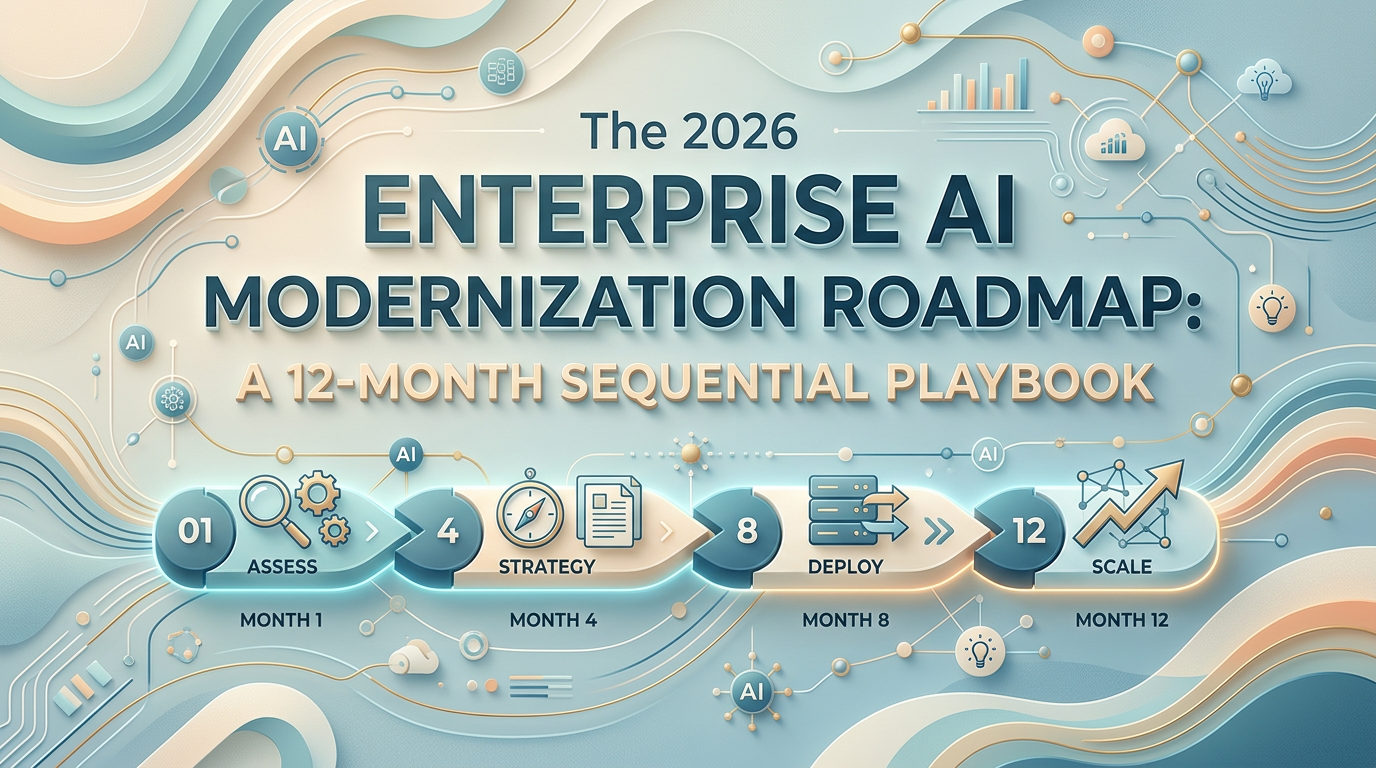
This comprehensive playbook presents a 12-month sequential roadmap designed specifically for enterprises seeking to modernize their infrastructure, processes, and decision-making capabilities through artificial intelligence. Whether you are just beginning your AI journey or looking to optimize existing implementations, this guide provides the strategic framework necessary for sustainable transformation.
Phase 1: Assessment and Strategic Planning (Months 1-2)
The foundation of any successful AI modernization initiative begins with a thorough assessment of current capabilities and a clear definition of strategic objectives. During the first two months, organizations must conduct a comprehensive audit of their existing technology stack, data infrastructure, and human capabilities.
Month 1: Current State Analysis
Begin by mapping your current technology landscape. Identify legacy systems that require modernization, data silos that impede information flow, and processes that would benefit most from AI automation. Engage stakeholders across departments to understand pain points and opportunities. This collaborative approach ensures that your AI initiatives address real business challenges rather than theoretical possibilities.
Document your organization's data maturity level. Assess data quality, accessibility, and governance frameworks. AI systems are only as effective as the data feeding them, making data infrastructure assessment critical to overall success.
Month 2: Strategic Roadmap Development
With comprehensive assessment data in hand, develop a strategic roadmap that aligns AI initiatives with business objectives. Prioritize use cases based on potential impact, feasibility, and resource requirements. Establish key performance indicators (KPIs) that will measure success throughout the modernization journey.
Create a detailed budget plan that accounts for technology investments, talent acquisition, training programs, and ongoing maintenance costs. Secure executive sponsorship and establish governance structures that will oversee the transformation program.
Phase 2: Foundation Building (Months 3-4)
With strategic alignment in place, the next phase focuses on building the technical and organizational foundation required for AI implementation. This phase addresses infrastructure readiness, team capability development, and governance framework establishment.
Month 3: Infrastructure and Architecture
Evaluate and upgrade your technical infrastructure to support AI workloads. This includes assessing cloud computing capabilities, data storage solutions, and processing power requirements. Consider hybrid cloud architectures that provide flexibility while maintaining data sovereignty and compliance requirements.
Implement robust data pipelines that enable seamless data flow between systems. Establish appropriate data lakes or data warehouses that can handle the volume, velocity, and variety of data required for AI model training and inference. Ensure that security protocols are integrated into your architecture from the beginning rather than added as an afterthought.
Month 4: Team Capability and Governance
Assemble your AI modernization team or augment existing capabilities. This includes data scientists, machine learning engineers, AI architects, and business analysts who can translate technical capabilities into business value. Invest in training programs that upskill existing employees while recruiting specialized talent.
Establish governance frameworks that address ethical AI considerations, bias mitigation, and regulatory compliance. Develop policies for data usage, model deployment, and ongoing monitoring. Create cross-functional oversight committees that ensure AI initiatives align with organizational values and regulatory requirements.
Phase 3: Core Implementation (Months 5-7)
With infrastructure and governance in place, organizations can begin implementing core AI solutions. This phase focuses on pilot projects, proof of concepts, and initial production deployments that demonstrate value and build organizational confidence.
Month 5: Pilot Project Selection and Design
Select 2-3 high-impact pilot projects that align with your prioritized use cases. These initial implementations should be scoped appropriately—ambitious enough to demonstrate meaningful value while contained enough to manage risk. Choose projects that have clear success metrics and visible business outcomes.
Design pilot architectures with scalability in mind. Even though these are initial implementations, building with future expansion in mind prevents costly rearchitecting later. Document lessons learned throughout the pilot phase to inform future implementations.
Month 6: Pilot Implementation and Validation
Execute pilot implementations using agile methodologies that allow for rapid iteration and feedback incorporation. Deploy models in controlled environments and validate performance against established KPIs. Collect feedback from end users and stakeholders to identify usability improvements and functional gaps.
Conduct thorough testing that includes performance benchmarking, security vulnerability assessments, and compliance verification. Ensure that models perform accurately across different scenarios and edge cases before proceeding to broader deployment.
Month 7: Evaluation and Iteration
Analyze pilot results comprehensively. Evaluate not only technical performance but also business impact, user adoption, and organizational readiness. Identify success factors and obstacles that will inform broader implementation strategies.
Iterate on pilot solutions based on learnings. Refine models, improve data pipelines, and enhance user interfaces. Document best practices and create reusable components that accelerate subsequent implementations.
Phase 4: Integration and Optimization (Months 8-10)
Following successful pilot validation, organizations enter the integration phase where AI solutions are extended across departments and use cases. This period focuses on scaling proven solutions, optimizing performance, and embedding AI into core business processes.
Month 8: Enterprise-Wide Scaling
Expand successful pilot implementations to additional business units and use cases. Leverage the reusable components and best practices documented in previous phases to accelerate deployment. Establish Centers of Excellence that disseminate knowledge and provide guidance to departments adopting AI capabilities.
Implement integration layers that connect AI solutions with existing enterprise systems including ERP, CRM, and supply chain management platforms. Ensure seamless data flow between AI systems and operational technology infrastructure.
Month 9: Process Automation and Enhancement
Identify opportunities for AI-driven process automation across the enterprise. Implement intelligent automation solutions that combine AI capabilities with robotic process automation (RPA) to streamline complex workflows. Focus on high-volume, repetitive tasks that offer significant efficiency gains.
Deploy AI-enhanced decision support systems that provide insights and recommendations to human decision-makers. These hybrid approaches leverage AI's analytical capabilities while maintaining human judgment for nuanced decisions.
Month 10: Performance Optimization
Conduct comprehensive optimization of deployed AI solutions. Fine-tune models based on production performance data and evolving business requirements. Optimize inference latency, reduce computational costs, and improve prediction accuracy.
Implement robust monitoring and alerting systems that detect model drift, performance degradation, and anomalies. Establish automated retraining pipelines that maintain model accuracy as data patterns evolve.
Phase 5: Scaling and Enterprise-Wide Deployment (Months 11-12)
The final phase focuses on achieving enterprise-wide AI maturity. Organizations move from isolated implementations to an integrated AI ecosystem that drives continuous innovation and competitive advantage.
Month 11: Full Enterprise Integration
Complete integration of AI capabilities across all relevant business functions. Ensure that AI becomes a native part of business operations rather than a separate initiative. Establish self-service AI platforms that enable business users to leverage AI capabilities without requiring specialized technical skills.
Implement advanced AI capabilities including natural language processing, computer vision, and predictive analytics that address complex business challenges. Build sophisticated analytics layers that provide unified insights across the enterprise.
Month 12: Maturity and Continuous Innovation
Assess overall AI maturity and identify areas for continued improvement. Celebrate achievements while establishing ongoing innovation priorities. Create feedback loops that ensure AI capabilities evolve with changing business requirements and technological advancements.
Develop long-term AI strategies that account for emerging technologies, evolving regulatory landscapes, and shifting competitive dynamics. Position your organization for continuous improvement rather than viewing AI modernization as a destination.
Conclusion: Embracing the AI-First Future
The 12-month enterprise AI modernization roadmap presented in this guide provides a structured approach to transforming your organization into an AI-powered enterprise. By following this sequential playbook, organizations can systematically address the technical, organizational, and strategic challenges inherent in AI adoption.
Success in enterprise AI modernization requires more than technology implementation. It demands strong executive leadership, cross-functional collaboration, and a commitment to continuous learning and adaptation. Organizations that approach AI modernization with strategic intent and disciplined execution will emerge as leaders in their respective industries.
The journey toward AI maturity is ongoing, but this roadmap provides the foundation for sustainable transformation. By investing in proper assessment, building robust foundations, executing thoughtful implementations, and continuously optimizing deployed solutions, your organization can successfully navigate the complexities of AI modernization and achieve lasting competitive advantage.