Introduction: The Problem with Traditional MVP Development
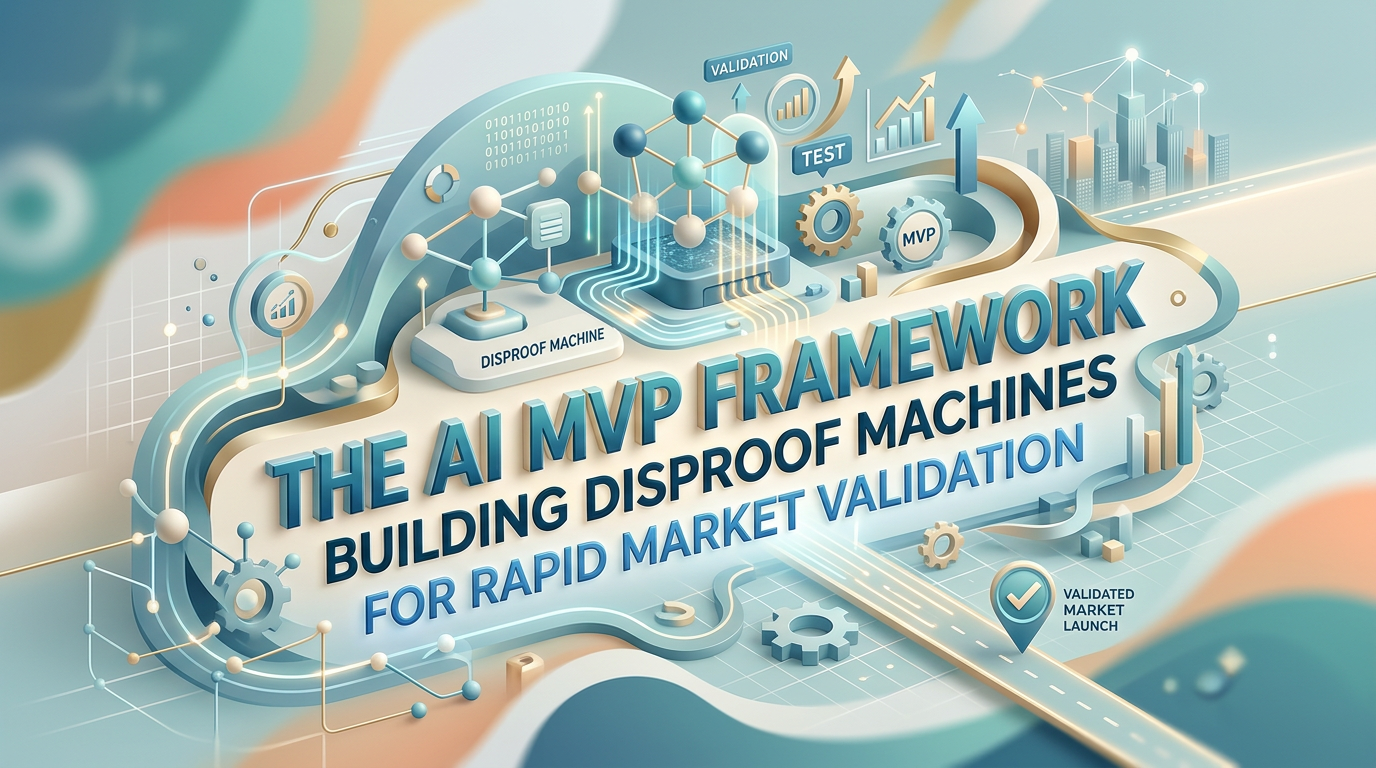
Most startups and product teams approach MVP development with a fundamental flaw: they build to validate their ideas rather than to disprove them. This confirmation bias leads to wasted resources, products nobody actually wants, and the devastating reality of launching something the market rejects. At Sapient Code Labs, we've developed a revolutionary approach that flips this paradigm on its head—the AI MVP Framework, centered around what we call "Disproof Machines."
The traditional MVP methodology asks: "Will users want this?" Our framework asks a different question: "What would prove us wrong, and how quickly can we find out?" This subtle shift in thinking represents one of the most powerful advances in product development methodology in recent years. By designing your minimum viable product to actively seek evidence against your assumptions, you dramatically reduce the time and money spent on products destined to fail.
Prove one valuable workflow first — that's how we run MVP development.
In this comprehensive guide, we'll explore how the AI MVP Framework transforms market validation from a hopeful guessing game into a systematic, data-driven process that identifies product-market fit faster than ever before.
Understanding Disproof Machines: The Conceptual Foundation
A Disproof Machine is an AI-enhanced MVP specifically architected to test and challenge your core business hypotheses rather than confirm them. Unlike traditional MVPs that present a polished (or minimally polished) version of your intended product, a Disproof Machine is designed with intentional friction—specific touchpoints engineered to reveal where user behavior diverges from your predictions.
The philosophy draws from scientific methodology. In science, a hypothesis is only valuable if it's falsifiable. A theory that cannot be tested against reality isn't science—it's speculation. The same applies to product development. Your business model, feature set, and value proposition are hypotheses. A Disproof Machine makes them falsifiable by design.
Consider this example: Traditional MVP thinking leads you to build a task management app and hope users adopt it. Disproof Machine thinking leads you to ask: "What would prove that users don't need another task manager?" Perhaps it's discovering that users abandon the onboarding process at the second screen, or that they use the app for three days then stop. The Disproof Machine is built to surface these signals within days, not months.
Artificial intelligence amplifies this approach by enabling rapid hypothesis testing at scale. Machine learning models can identify patterns in user behavior that would take humans weeks to discover. AI can generate multiple variations of your value proposition and measure which ones create the strongest disengagement signals. This creates a feedback loop that traditional MVP development cannot match.
The Four Pillars of the AI MVP Framework
The framework rests on four interconnected pillars that work together to create Disproof Machines capable of rapid market validation.
Pillar One: Hypothesis Archaeology
Before writing a single line of code, the AI MVP Framework requires you to excavate and articulate every assumption underlying your product. This goes beyond the obvious assumptions to the hidden beliefs that drive your decisions. What do you believe about your target user's pain points? Their willingness to pay? The alternatives they're currently using?
Our methodology uses AI-assisted assumption mapping to identify the most critical assumptions and rank them by the risk they pose to your business. The AI analyzes your business plan, market research, and competitive analysis to surface assumptions you might have overlooked. Each assumption then becomes a specific test case within your Disproof Machine.
Pillar Two: Signal-First Architecture
Traditional MVPs are feature-first—they ask "What minimum features do we need?" Disproof Machines ask a different question: "What minimum signals do we need to collect evidence against our assumptions?" This architectural shift means every element of your MVP serves the dual purpose of delivering value and collecting disconfirmation data.
Signal-first architecture means instrumenting every user interaction from day one. When a user lands on your landing page, you need to know exactly where their eyes go, how long they stay, and what action they take next. When they encounter your core feature, you need to measure not just if they use it, but how their usage patterns compare to your predicted behavior. This data infrastructure is built into the MVP from inception, not bolted on later.
Use published numbers for what an MVP actually costs, then add model spend as an explicit line item.
Pillar Three: Adaptive Disconfirmation
The third pillar leverages AI to make your Disproof Machine intelligent. Rather than running static tests, your MVP learns from each interaction and adjusts its testing strategy. If early data suggests a particular assumption is likely false, the system intensifies testing on that front. If an assumption appears robust, the system shifts focus to higher-risk areas.
This adaptive approach dramatically accelerates the validation timeline. A traditional MVP might spend six weeks testing assumption A before moving to assumption B. An AI-enhanced Disproof Machine allocates testing resources dynamically, getting you to a go/no-go decision in a fraction of the time.
Pillar Four: The Kill Protocol
The final pillar is perhaps the most important: designing your Disproof Machine with predetermined failure thresholds. Before building anything, you define exactly what evidence would convince you to abandon the project. This prevents the common startup trap of endlessly iterating on a failing concept.
The Kill Protocol specifies quantitative metrics: if user retention drops below X percent, if cost per acquisition exceeds Y dollars, if user testing reveals Z confusion points, the project terminates. This might seem pessimistic, but it's actually liberating. Teams with clear kill criteria make bolder bets because they know failure is acceptable—failure is expected when you're actively trying to disprove something.
Building Your First Disproof Machine: A Technical Roadmap
Now that you understand the conceptual framework, let's explore how to actually build a Disproof Machine. At Sapient Code Labs, we've refined this process across dozens of client engagements.
Phase One: Assumption Documentation (Days 1-3)
Begin by documenting every assumption in a structured format. Use our AI-powered assumption scanner to help identify hidden beliefs. For each assumption, define what evidence would disprove it. Be specific. "Users want a mobile app" is not a testable assumption. "At least 40% of our target users will attempt to access the mobile version within the first week" is testable.
Phase Two: Signal Infrastructure Design (Days 4-7)
Map out every data point your Disproof Machine must collect. This includes behavioral analytics (click paths, time on page, feature usage frequency), quantitative metrics (conversion rates, retention curves, NPS scores), and qualitative triggers (questions that prompt user interviews). Choose your analytics stack carefully—the data infrastructure must be in place before launch.
Phase Three: MVP Construction with Built-in Failure Points (Days 8-21)
Build your minimum viable product with deliberate friction points designed to test specific assumptions. These aren't bugs—they're features specifically engineered to reveal user behavior. A fintech MVP might include intentionally complex onboarding to test whether users value the product enough to persist. An SaaS MVP might show only one pricing tier to test price sensitivity.
Phase Four: Launch and Rapid Iteration (Days 22-35)
Release to a small, targeted audience and monitor your signal infrastructure obsessively. Run daily standups focused on one question: what did we learn about our assumptions today? Use AI analysis tools to identify patterns in the data that escape human notice. Adjust your testing strategy based on emerging evidence.
If the MVP includes agents or tool-use, that slice is AI agentic development.
Phase Five: The Decision Point (Day 36+)
Review your Kill Protocol criteria. Has the evidence disconfirmed your core assumptions? If yes, you have valuable information worth more than any successful MVP could provide. If no—if the evidence supports your assumptions—you've earned the right to invest more heavily in product development. Either outcome moves you forward faster than the traditional approach.
Real-World Applications: Case Studies in Disproof
One of our clients, a B2B SaaS startup targeting the healthcare industry, used the Disproof Machine methodology to avoid a $2 million mistake. Their original plan was a comprehensive platform for patient scheduling, billing, and records management—a massive undertaking requiring significant development time.
Using our framework, they built a much simpler Disproof Machine focused on a single assumption: that healthcare administrators would be willing to adopt a new scheduling system. The MVP was deliberately limited—it could only handle basic appointment scheduling, nothing more. Within two weeks, the data revealed a critical disconfirmation: 73% of administrators who tested the system immediately asked why they should switch from their existing solution when the new one offered fewer features.
This single signal, surfaced in days rather than months, completely changed their approach. Rather than building a comprehensive platform, they pivoted to a specialized tool focused on a specific pain point their research hadn't initially identified: cross-provider appointment coordination. The pivot succeeded because the Disproof Machine had proven their original assumption wrong before they'd invested heavily in the wrong direction.
Another case study involves an e-commerce client who believed their customers would embrace AI-powered personalized recommendations. Their Disproof Machine tested this by implementing the recommendation engine and carefully measuring not just if users clicked the suggestions, but how the recommendations affected their overall purchase behavior. The disconfirmation was surprising: users who saw AI recommendations had a 12% lower average order value than those who didn't.
This counterintuitive result led to a deeper investigation and ultimately a different implementation strategy. The Disproof Machine didn't just validate or invalidate—it revealed nuance that would have been invisible without careful signal collection.
The Competitive Advantage of Faster Failure
In the startup world, speed is survival. The team that learns fastest, iterates fastest, and fails fastest (when failure is inevitable) wins. The AI MVP Framework provides a structured methodology for accelerated learning.
The traditional approach to MVP development assumes success. You build something, hope it works, and only discover it doesn't work after significant investment. The Disproof Machine approach assumes you'll likely be wrong about something—and designs for that reality. This isn't pessimism; it's intellectual honesty that leads to better outcomes.
Companies adopting this methodology report平均 60% faster time-to-decision on new product ideas. They launch more experiments, learn more quickly, and avoid the sunk cost trap that claims so many promising ventures. Most importantly, they build products people actually want because they've systematically eliminated the features and approaches people don't want.
Conclusion: Embrace Disproof for Better Products
The AI MVP Framework represents a fundamental shift in how we approach product development. By building Disproof Machines rather than validation machines, product teams gain something more valuable than a successful MVP: the truth. And the truth, however uncomfortable, is always cheaper in the long run than a beautiful product nobody needs.
At Sapient Code Labs, we believe this methodology should be standard practice for every product team, from scrappy startups to enterprise innovation labs. The tools and techniques are available. The framework is proven. What remains is for product developers to embrace a counterintuitive truth: your MVP's job is not to succeed—it's to find out what's wrong as quickly as possible.
The companies that master this mindset will build better products, waste less money, and reach product-market fit faster than competitors still clinging to validation-first thinking. The AI MVP Framework isn't just a methodology—it's a competitive advantage in an era where speed to learning determines market success.
Ready to transform your product development approach? Our team at Sapient Code Labs specializes in helping companies implement the Disproof Machine methodology. Contact us to learn how we can help you build smarter MVPs that accelerate your path to market success.
If you're serious about an MVP, a Scoping Sprint ($2,300, two weeks) gets you a prototype, technical plan and fixed quote — or contact us directly.