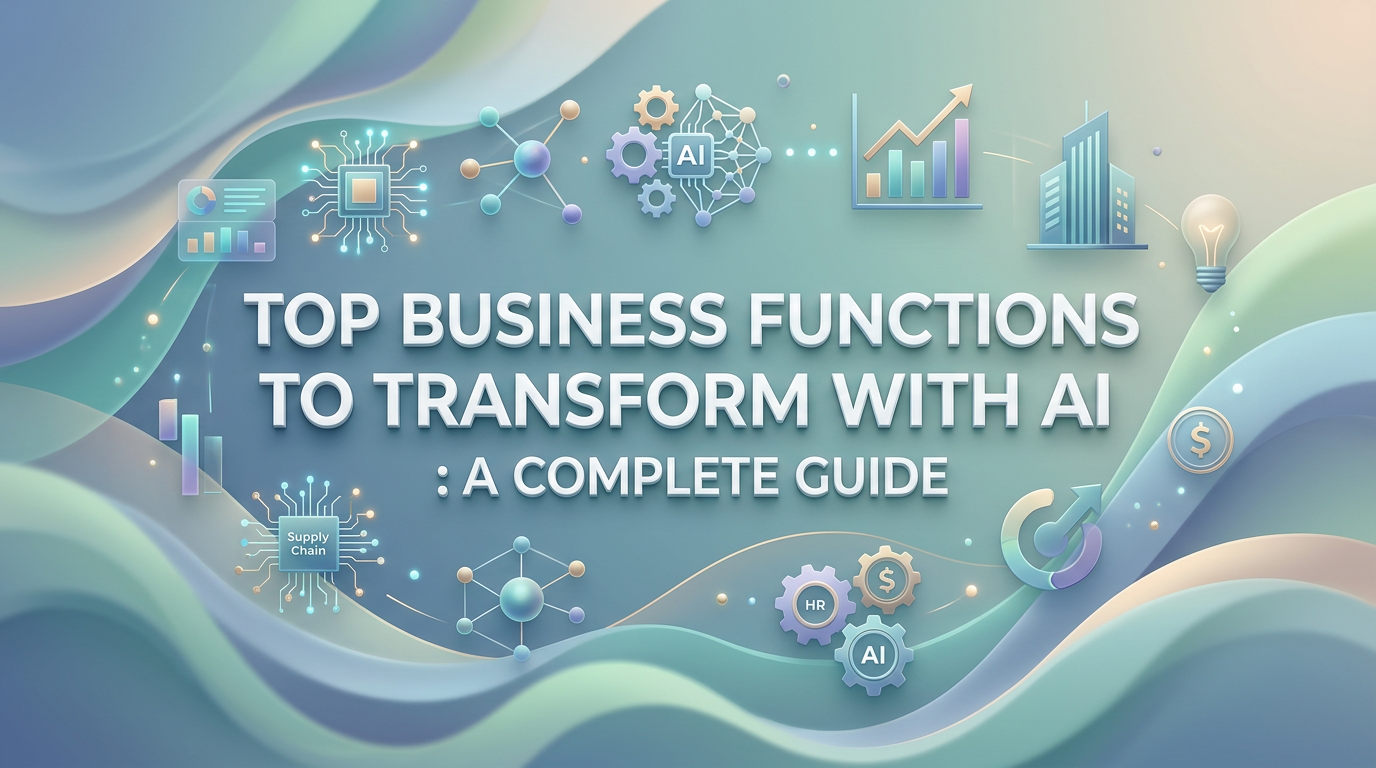
Introduction: The AI Revolution in Business
The business landscape is undergoing a profound transformation, driven by the rapid advancement of artificial intelligence. Organizations across industries are recognizing that AI is no longer a futuristic concept but a present-day necessity for maintaining competitive advantage. From streamlining operations to enhancing customer experiences, AI is reshaping how businesses function at every level.
According to recent industry research, companies that successfully implement AI across their business functions see significant improvements in efficiency, accuracy, and profitability. However, knowing where to start the AI transformation journey can be overwhelming. This comprehensive guide explores the top business functions that benefit most from AI implementation and provides insights into how your organization can leverage this transformative technology.
At Sapient Code Labs, we specialize in helping businesses navigate their AI transformation journey with tailored solutions that address unique operational challenges. Let's dive into the key business functions where AI delivers the most impactful results.
1. Customer Service and Support
Customer service is one of the most immediate and visible areas where AI delivers transformative results. Traditional customer support models often struggle with rising query volumes, inconsistent response quality, and escalating labor costs. AI addresses these challenges through intelligent automation and enhanced service capabilities.
AI-Powered Chatbots and Virtual Assistants: Modern AI chatbots go beyond basic scripted responses. They understand natural language, context, and customer intent, providing instant responses 24/7 across multiple channels. These intelligent systems can handle routine inquiries, freeing human agents to focus on complex issues that require empathy and critical thinking.
Sentiment Analysis and Proactive Support: AI algorithms can analyze customer communications to detect frustration, dissatisfaction, or emerging issues before they escalate. This proactive approach enables businesses to address problems early, improving customer retention and loyalty.
Knowledge Base Optimization: AI can automatically categorize and surface relevant information from knowledge bases, ensuring customers and agents access accurate content quickly. Machine learning continuously improves content relevance based on user interactions and feedback.
The result is faster response times, consistent service quality, and significant cost reductions while maintaining high customer satisfaction scores.
2. Sales and Marketing
Sales and marketing teams generate vast amounts of data, but extracting actionable insights traditionally required extensive manual analysis. AI transforms this function by turning data into predictive intelligence and personalized customer experiences.
Predictive Lead Scoring: AI algorithms analyze historical customer data, behavioral patterns, and engagement metrics to identify which leads are most likely to convert. This enables sales teams to prioritize their efforts on high-potential prospects, improving conversion rates and shortening sales cycles.
Personalized Marketing Campaigns: Machine learning models analyze customer preferences, browsing behavior, and purchase history to deliver highly targeted content and product recommendations. This personalization increases engagement rates, click-through conversions, and overall marketing ROI.
Customer Churn Prediction: AI can identify early warning signs of customer attrition by analyzing usage patterns, support interactions, and engagement metrics. Armed with these insights, retention teams can implement targeted interventions to keep valuable customers.
Dynamic Pricing Optimization: For businesses in competitive markets, AI-driven pricing models analyze competitor pricing, demand fluctuations, and customer sensitivity to optimize pricing strategies in real-time, maximizing revenue without sacrificing volume.
3. Finance and Accounting
Finance and accounting departments are ideal candidates for AI transformation due to their reliance on structured data, repetitive processes, and accuracy requirements. AI brings unprecedented efficiency and accuracy to financial operations.
Automated Invoice Processing: AI-powered optical character recognition (OCR) and natural language processing (NLP) enable automatic extraction of invoice data, matching with purchase orders, and routing for approval. This dramatically reduces manual data entry errors and processing time.
Fraud Detection and Prevention: Machine learning algorithms analyze transaction patterns in real-time to identify suspicious activities that deviate from normal behavior. These systems continuously learn from new fraud patterns, providing robust protection against evolving threats.
Financial Forecasting and Planning: AI models can analyze historical financial data, market trends, and external factors to generate more accurate revenue forecasts, budget projections, and cash flow predictions. This enables better strategic planning and resource allocation.
Expense Categorization and Reconciliation: AI automatically categorizes expenses, identifies duplicates, and reconciles transactions across multiple accounts and systems, reducing the administrative burden on finance teams and improving accuracy.
4. Human Resources
Human resources is experiencing a significant shift from administrative functions to strategic talent management, and AI is accelerating this transformation. From recruitment to employee retention, AI enables HR teams to make data-driven decisions that improve organizational outcomes.
Intelligent Recruitment and Screening: AI-powered applicant tracking systems can automatically screen resumes, assess candidate qualifications, and rank applicants based on job requirements. This significantly reduces time-to-hire while ensuring a more objective evaluation process.
Skills Gap Analysis and Workforce Planning: AI analyzes employee skills, performance data, and industry trends to identify current and future skill gaps. This insight enables proactive workforce development and strategic hiring decisions.
Employee Engagement and Retention: AI can analyze employee feedback, communication patterns, and work habits to identify factors affecting engagement and predict flight risks. HR teams can then implement targeted interventions to improve retention.
Performance Management Optimization: Machine learning models help identify high performers, understand performance drivers, and provide personalized development recommendations. This data-driven approach creates more effective performance review processes.
5. Operations and Supply Chain
Operational efficiency is the backbone of business profitability, and AI provides unprecedented visibility and control across supply chain operations. From inventory management to logistics optimization, AI enables smarter decision-making throughout the operational value chain.
Demand Forecasting: AI algorithms analyze historical sales data, seasonal patterns, market trends, and external factors like weather and economic indicators to generate highly accurate demand forecasts. This enables optimal inventory levels, reducing both stockouts and excess inventory costs.
Predictive Maintenance: IoT sensors combined with AI can predict equipment failures before they occur by analyzing performance patterns and detecting anomalies. This proactive approach minimizes downtime, extends equipment life, and reduces maintenance costs.
Supply Chain Optimization: AI can optimize routing, warehousing, and logistics decisions by considering multiple variables including transportation costs, delivery times, and inventory positions. This results in faster deliveries and lower operational costs.
Quality Control and Inspection: Computer vision and deep learning enable automated quality inspection that identifies defects with greater accuracy and consistency than manual inspection. This improves product quality while reducing waste and rework costs.
6. Product Development and R&D
Innovation is the key to long-term business success, and AI is transforming how organizations approach product development and research. By accelerating ideation, simulation, and testing processes, AI enables faster innovation cycles.
Generative Design: AI-powered design tools can automatically generate thousands of design alternatives based on specified constraints and objectives. Engineers can explore innovative solutions that might not emerge from traditional design processes.
Market Trend Analysis: AI analyzes market data, customer feedback, competitor activities, and emerging technologies to identify product opportunities and innovation priorities. This data-driven approach reduces the risk of investing in products that don't meet market needs.
Accelerated Testing and Simulation: AI enables virtual testing and simulation that dramatically reduces the time and cost of physical prototyping. Machine learning models can predict product performance under various conditions, speeding up the development cycle.
Scientific Research Acceleration: In industries like pharmaceuticals and materials science, AI helps analyze vast datasets, identify promising compounds, and predict experimental outcomes. This accelerates the research process while reducing the number of physical experiments required.
Conclusion: Embarking on Your AI Transformation Journey
The business functions discussed above represent just the beginning of AI's potential to transform organizations. As AI technologies continue to advance, their applications will expand into even more areas of business operations. The key to successful AI transformation lies in starting with clear objectives, choosing the right use cases, and implementing solutions that integrate seamlessly with existing systems.
At Sapient Code Labs, we understand that every organization has unique challenges and opportunities. Our team of AI specialists works closely with clients to identify high-impact use cases, develop custom solutions, and ensure successful implementation. Whether you're looking to enhance customer service with intelligent chatbots, optimize financial operations with automated processing, or transform your supply chain with predictive analytics, we have the expertise to guide your journey.
The future belongs to organizations that embrace AI strategically and thoughtfully. By transforming key business functions with intelligent automation, you position your organization for sustained growth, improved competitiveness, and enhanced customer value. Start your AI transformation journey today and discover how artificial intelligence can revolutionize the way you do business.