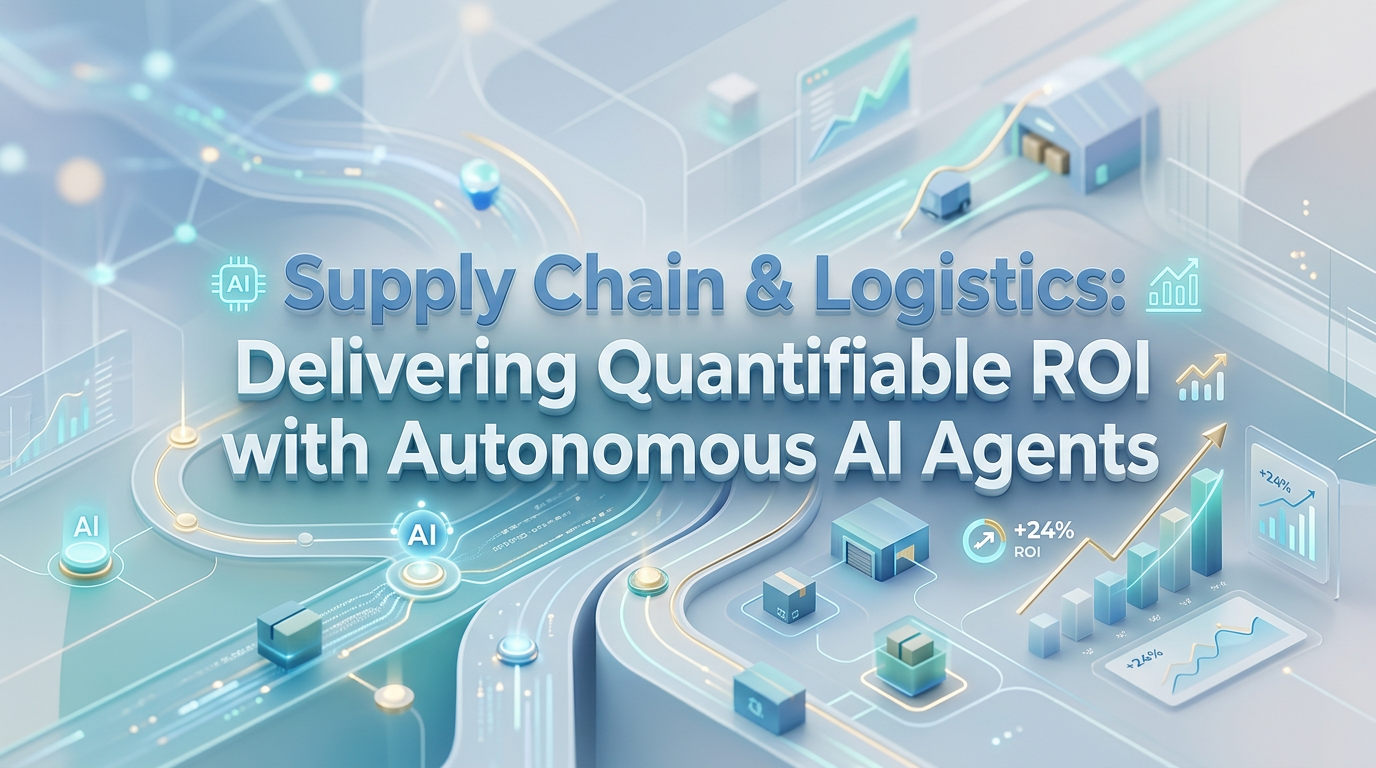
Introduction: The Supply Chain Transformation Imperative
Global supply chains face unprecedented challenges in 2025. From geopolitical disruptions and rising fuel costs to customer expectations for lightning-fast deliveries, logistics companies are under more pressure than ever to optimize every aspect of their operations. Traditional manual processes and legacy systems simply cannot keep pace with the complexity and speed required in modern commerce.
This is where autonomous AI agents come into play. These intelligent software systems are fundamentally transforming how supply chains operate, making real-time decisions, automating complex workflows, and delivering measurable return on investment that traditional optimization tools simply cannot match. For organizations willing to embrace this technology, the competitive advantages are substantial and increasingly quantifiable.
This is the kind of system we build under logistics software development: tracking, routing, ops consoles and integrations.
Understanding Autonomous AI Agents in Logistics
Autonomous AI agents are sophisticated artificial intelligence systems capable of perceiving their environment, reasoning about complex situations, and taking independent actions to achieve specific goals without constant human intervention. In the context of supply chain and logistics, these agents go beyond simple automation by making intelligent decisions based on real-time data, historical patterns, and predictive analytics.
Unlike traditional rule-based automation that follows predetermined scripts, autonomous AI agents learn from data, adapt to changing conditions, and continuously improve their decision-making capabilities. They can handle uncertainty, process unstructured information, and coordinate with other systems and humans seamlessly. This makes them particularly valuable in the unpredictable and dynamic environment of modern logistics operations.
At Sapient Code Labs, we specialize in developing custom autonomous AI agent solutions tailored to the unique challenges of supply chain and logistics operations. Our team builds intelligent systems that integrate with existing infrastructure while delivering immediate and measurable ROI.
Key Applications Driving ROI in Supply Chain Operations
Intelligent Demand Forecasting and Inventory Optimization
One of the most significant applications of autonomous AI agents in logistics is demand forecasting and inventory management. These agents analyze vast amounts of data including historical sales patterns, seasonal trends, weather forecasts, economic indicators, social media signals, and even local events to predict demand with remarkable accuracy.
Traditional forecasting methods typically achieve accuracy rates of 70-80%, leading to either stockouts that cost sales and customer trust or overstock situations that tie up capital in warehousing. Autonomous AI agents consistently achieve 90-95% accuracy rates, directly translating to reduced inventory carrying costs and improved product availability.
These agents automatically adjust reorder points, optimize inventory distribution across warehouses, and even negotiate with suppliers in real-time based on predicted demand shifts. The result is typically 20-30% reduction in inventory costs while simultaneously improving service levels by 15-25%.
Dynamic Route Optimization and Fleet Management
Route optimization represents another high-impact application area. Autonomous AI agents process multiple variables simultaneously including real-time traffic conditions, delivery time windows, vehicle capacity, fuel costs, driver schedules, and weather patterns to calculate optimal routes in real-time.
The intelligence goes beyond simple shortest-path algorithms. These agents understand that a slightly longer route might be preferable due to traffic patterns at specific times, or that combining certain deliveries can reduce total miles while meeting all time windows. They also learn from historical data to anticipate congestion and adjust proactively.
Organizations implementing autonomous route optimization typically see 15-25% reduction in fuel costs, 10-20% improvement in on-time deliveries, and 20-30% increase in daily deliveries per vehicle. When applied across a large fleet, these improvements translate to millions of dollars in annual savings.
Autonomous Warehouse Operations
Warehouse operations are experiencing a profound transformation through autonomous AI agents working alongside robotics and automated systems. These agents coordinate inbound receiving, inventory storage, order picking, packing, and outbound shipping with unprecedented efficiency.
They dynamically allocate warehouse space based on velocity of items, optimize pick paths to minimize travel time, and coordinate multiple robots and workers to maximize throughput. They also detect anomalies in real-time, such as damaged products or inventory discrepancies, allowing immediate corrective action.
The ops UI and APIs usually ship as web application development with real-time channels where needed.
The ROI in warehouse operations is substantial: 30-50% improvement in order fulfillment speed, 40-60% reduction in picking errors, and 20-35% reduction in labor costs through optimized workforce scheduling and task allocation.
Supplier Collaboration and Risk Management
Autonomous AI agents are transforming supplier relationship management by continuously monitoring supplier performance, predicting potential disruptions, and automatically triggering mitigation actions. These agents track delivery times, quality metrics, pricing trends, and even news about supplier financial health or operational issues.
When risks are detected, autonomous agents can automatically reroute orders to alternative suppliers, adjust safety stock levels, or escalate issues to human managers with recommended actions. This proactive approach to risk management prevents small issues from becoming major supply chain disruptions.
Organizations using autonomous supplier management systems typically see 25-40% reduction in supply chain disruptions and 50-70% faster response times when disruptions do occur.
Quantifying the ROI: Real Numbers That Matter
One of the most compelling aspects of autonomous AI agents is the tangible, measurable ROI they deliver. Unlike some technology investments where benefits are difficult to quantify, autonomous agents in supply chain operations produce clear, measurable improvements that directly impact the bottom line.
Cost Reduction Metrics
Organizations implementing autonomous AI agents across their supply chain operations consistently report significant cost reductions. Inventory carrying costs typically decrease by 20-30% through better demand forecasting and optimized stock levels. Transportation costs reduce by 15-25% through route optimization and load consolidation. Labor costs decrease by 15-30% through automation of routine tasks and improved workforce scheduling.
These cost reductions compound across the operation. A mid-sized logistics company might see $2-5 million in annual savings from autonomous AI implementation, while large enterprises often achieve savings exceeding $20-50 million.
Revenue Enhancement
Beyond cost savings, autonomous AI agents drive revenue growth through improved service levels. Better availability means fewer stockouts and lost sales. Faster, more reliable delivery increases customer satisfaction and loyalty. The ability to offer premium services like same-day delivery or precise delivery windows becomes economically viable.
Organizations typically see 5-15% increases in revenue due to improved service levels and customer retention. Given that customer acquisition costs are typically 5-25 times higher than retention costs, this improvement in customer loyalty has profound long-term value.
If you're piloting one corridor or fleet first, start from a published MVP cost breakdown before a multi-site rollout.
Implementation Timeline and Payback Period
One of the common misconceptions about autonomous AI agents is that they require massive, multi-year implementation projects. In reality, modern autonomous AI solutions can begin delivering value within weeks of implementation. Most organizations see positive ROI within 6-12 months, with full payback typically achieved within 18-24 months.
The key is starting with high-impact use cases that deliver quick wins while building toward more comprehensive transformation. A phased approach allows organizations to prove value and build internal capabilities while continuously expanding the scope of autonomous operations.
Implementation Best Practices for Maximum ROI
Successfully implementing autonomous AI agents in supply chain operations requires careful planning and execution. Organizations that achieve the best results typically follow several key principles.
Start with Clear Objectives
Before implementing any autonomous AI solution, organizations must define clear, measurable objectives. Whether the focus is reducing transportation costs by 20% or improving on-time delivery to 98%, having specific goals enables better solution design and makes ROI measurement straightforward.
Ensure Data Quality and Accessibility
Autonomous AI agents are only as good as the data they can access. Organizations must invest in data quality, ensuring that systems have access to accurate, timely, and comprehensive data. This may require data integration from multiple sources including ERP systems, transportation management systems, IoT sensors, and external data providers.
Maintain Human Oversight
While called autonomous, the most effective implementations maintain appropriate human oversight. Autonomous agents should escalate complex decisions or anomalies to human operators while handling routine operations independently. This hybrid approach combines the speed and scale of AI with human judgment for edge cases.
Choose the Right Implementation Partner
Working with an experienced technology partner like Sapient Code Labs can significantly accelerate time-to-value. Our team brings deep expertise in both AI technology and supply chain operations, enabling us to build solutions that address real business challenges while integrating seamlessly with existing systems.
The Future of Autonomous AI in Logistics
The trajectory of autonomous AI in supply chain and logistics points toward increasingly sophisticated capabilities. As the technology matures, we can expect agents that handle more complex decision-making, coordinate across entire global supply networks, and continuously learn from outcomes to improve performance.
Emerging capabilities include autonomous negotiation with suppliers and carriers, predictive maintenance of logistics assets, and even more granular personalization of supply chain operations to individual customer requirements. Organizations that establish capabilities now will be positioned to take advantage of these advances as they emerge.
Conclusion: Your Path to Quantifiable ROI
The transformation of supply chain and logistics operations through autonomous AI agents is not a distant future possibility—it is happening now, and organizations that act decisively are already capturing significant competitive advantages. The ROI is real, measurable, and substantial.
From reduced inventory costs and optimized transportation to improved customer service and faster response to disruptions, autonomous AI agents deliver tangible results that directly impact profitability. The technology is mature, implementation approaches are proven, and the competitive cost of waiting continues to increase.
At Sapient Code Labs, we help organizations navigate this transformation with custom AI solutions designed for their specific challenges and opportunities. Our expertise in both artificial intelligence and supply chain operations enables us to deliver solutions that create real business value.
The question is no longer whether autonomous AI agents will transform supply chain operations, but how quickly your organization can implement these capabilities to start capturing the measurable ROI that is available today.
If you're serious about logistics software, a Scoping Sprint ($2,300, two weeks) gets you a prototype, technical plan and fixed quote — or contact us directly.