Introduction
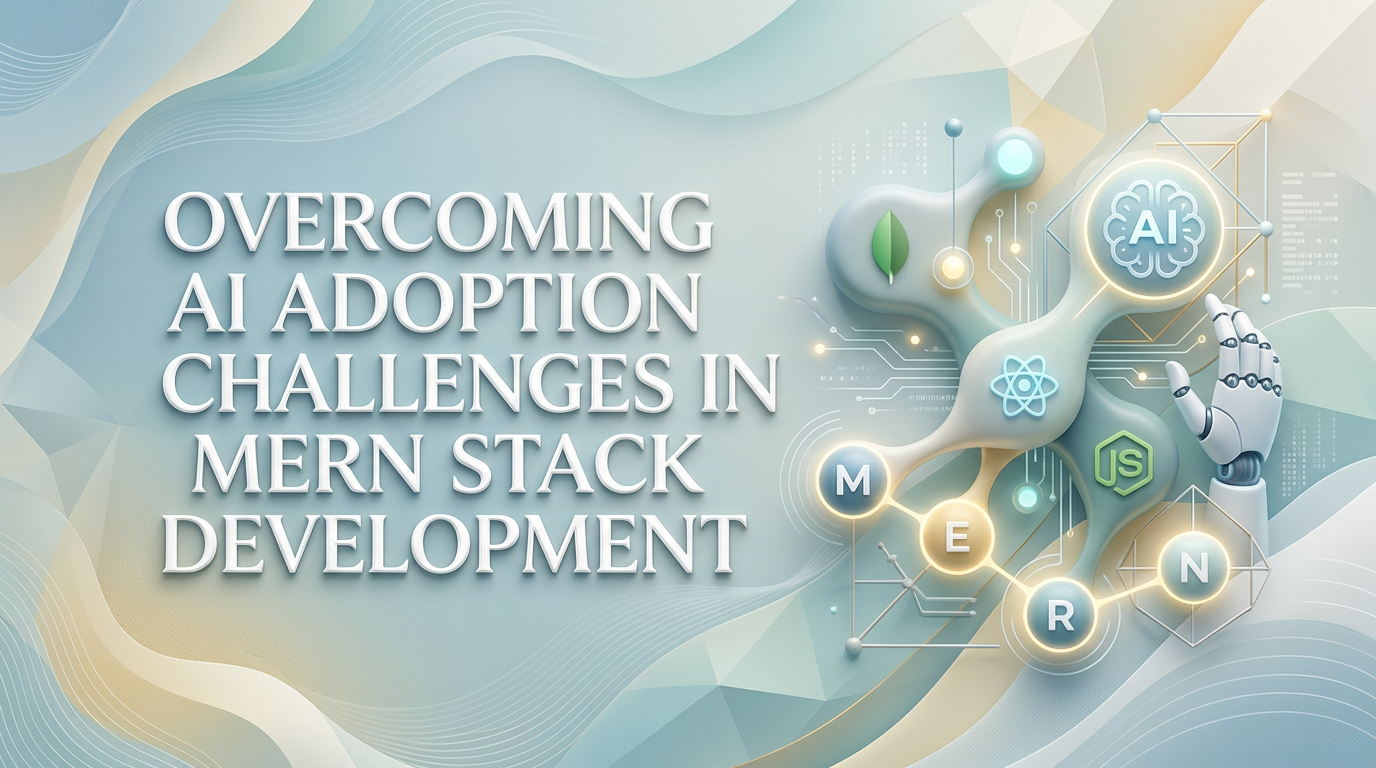
The MERN stack (MongoDB, Express.js, React, Node.js) has become one of the most popular technology stacks for building modern web applications. As artificial intelligence continues to transform the software development landscape, developers and organizations using MERN stack are increasingly seeking ways to integrate AI capabilities into their applications. However, this integration presents unique challenges that require careful planning and execution.
In this comprehensive guide, we will explore the common obstacles faced when adopting AI in MERN stack development and provide practical solutions to overcome them. Whether you are a startup looking to build an AI-powered MVP or an enterprise seeking to enhance your existing MERN applications, understanding these challenges is crucial for successful AI integration.
Understanding AI Integration in MERN Stack
The MERN stack provides a robust foundation for building full-stack JavaScript applications. When combined with AI capabilities, developers can create intelligent applications that offer enhanced user experiences, automated workflows, and data-driven insights. However, the integration of AI into this JavaScript-centric ecosystem requires navigating several technical and operational challenges.
AI integration in MERN stack development typically involves incorporating machine learning models, natural language processing capabilities, computer vision features, or predictive analytics into applications built with MongoDB for data storage, Express.js for backend framework, React for frontend interface, and Node.js for server-side execution.
Major Challenges in AI Adoption for MERN Stack
1. Technical Complexity and Integration Hurdles
One of the primary challenges developers face is the technical complexity of integrating AI models into a JavaScript-based environment. While Python has traditionally been the dominant language for AI and machine learning, MERN stack relies on JavaScript and Node.js. This mismatch often requires additional layers or middleware to connect Python-based AI services with JavaScript applications.
The solution involves leveraging AI-as-a-Service platforms and APIs that provide pre-built models accessible via RESTful endpoints. Services like Google Cloud AI, AWS AI, Azure Cognitive Services, and specialized AI APIs allow MERN developers to integrate powerful AI capabilities without deep expertise in model training or optimization.
2. Performance and Scalability Concerns
AI models, especially deep learning networks, can be computationally intensive. Running these models within a Node.js environment or making numerous API calls to AI services can significantly impact application performance and response times. This challenge becomes particularly acute when building real-time applications that require instant responses.
To address performance concerns, developers should consider implementing asynchronous processing for AI tasks, using WebSockets for real-time communication, and employing caching mechanisms for frequently requested predictions. Additionally, edge computing and serverless architectures can help offload computational stress from the main application server.
3. Data Management and Quality
AI models are only as good as the data they process. MERN stack applications often deal with unstructured data stored in MongoDB, which presents challenges for AI integration. Ensuring data quality, proper labeling, and preprocessing becomes critical for achieving accurate AI predictions.
Implementing robust data pipelines that include data cleaning, transformation, and feature engineering is essential. MongoDB's flexible schema allows for storing diverse data types, but developers must establish consistent data structures and validation rules to maintain the quality required for effective AI processing.
4. Security and Privacy Considerations
When integrating AI into web applications, security and privacy become paramount concerns. AI systems often process sensitive user data, and ensuring compliance with regulations like GDPR, CCPA, and other data protection laws is essential. Additionally, AI models themselves can be vulnerable to adversarial attacks and model inversion attacks.
Developers should implement end-to-end encryption for data in transit and at rest, employ secure authentication mechanisms, and follow the principle of least privilege when granting AI service access. Regular security audits and vulnerability assessments help identify and address potential weaknesses in AI-integrated applications.
5. Skill Gap and Learning Curve
MERN stack developers typically possess strong JavaScript skills but may lack expertise in machine learning, data science, and AI implementation. This skill gap can slow down AI adoption and lead to suboptimal implementations. Conversely, data scientists may not be familiar with MERN stack development patterns and best practices.
Addressing this challenge requires investment in team training and cross-skilling. Organizations should consider partnering with AI specialists or consulting firms during initial AI implementation phases. Additionally, the emergence of low-code and no-code AI platforms is making it easier for JavaScript developers to incorporate AI capabilities without deep ML expertise.
6. Cost Management
AI integration can significantly increase development and operational costs. API-based AI services often charge per request or per computation, which can quickly escalate with increased usage. Training and maintaining custom models requires substantial computational resources and expertise.
Cost optimization strategies include implementing efficient API usage patterns, using batch processing for non-time-sensitive AI tasks, selecting the appropriate tier of AI services based on actual requirements, and considering open-source alternatives for certain use cases. Careful monitoring and optimization of AI spending is essential for sustainable implementation.
Best Practices for Successful AI Integration in MERN Stack
Start with Clear Objectives
Before diving into AI integration, define clear business objectives and use cases. Understand what problems AI should solve in your application and establish measurable success criteria. Starting with well-defined goals helps in selecting the right AI technologies and prevents feature bloat.
Choose the Right AI Approach
Evaluate whether your application requires custom machine learning models or if pre-built AI APIs and services can meet your needs. For most MERN stack applications, starting with cloud-based AI services and gradually building custom capabilities as requirements evolve is a practical approach.
Implement Robust Error Handling
AI systems can fail or produce unexpected results. Implement comprehensive error handling, fallback mechanisms, and user-friendly error messages. Ensure graceful degradation when AI services are unavailable or produce unreliable results.
Focus on User Experience
AI features should enhance, not complicate, the user experience. Implement AI capabilities thoughtfully, providing users with control over AI-assisted features and maintaining transparency about when AI is being used.
Continuous Monitoring and Optimization
AI models require ongoing monitoring and refinement. Track performance metrics, collect user feedback, and continuously improve AI accuracy and relevance. Regular model retraining and updates help maintain effectiveness over time.
Future Trends and Opportunities
The landscape of AI in MERN stack development is evolving rapidly. Several trends are shaping the future of this integration. The emergence of JavaScript-based machine learning libraries like TensorFlow.js is enabling direct execution of ML models in browsers and Node.js environments, reducing reliance on external APIs.
Serverless AI architectures are gaining traction, offering scalable and cost-effective solutions for AI integration. Additionally, the growth of no-code AI platforms is democratizing AI development, allowing MERN developers to incorporate intelligent features without extensive ML expertise.
As large language models and generative AI continue to advance, new possibilities are opening up for creating conversational interfaces, automated content generation, and intelligent automation within MERN stack applications. Organizations that successfully navigate the current challenges will be well-positioned to leverage these emerging opportunities.
Conclusion
Overcoming AI adoption challenges in MERN stack development requires a strategic approach that addresses technical complexity, performance concerns, data management, security, skill gaps, and cost considerations. By understanding these challenges and implementing the best practices outlined in this guide, developers and organizations can successfully integrate AI capabilities into their MERN applications.
The key to successful AI integration lies in starting with clear objectives, choosing the right tools and approaches, and maintaining a focus on user experience. As the ecosystem continues to evolve, MERN stack developers have access to an increasing array of resources and platforms that make AI integration more accessible than ever before.
At Sapient Code Labs, we specialize in helping businesses navigate the complexities of AI integration in modern web development. Our expertise in MERN stack development combined with cutting-edge AI capabilities enables us to build intelligent, scalable, and secure applications that drive real business value.