The Evolution of Enterprise AI: From Prediction to Action
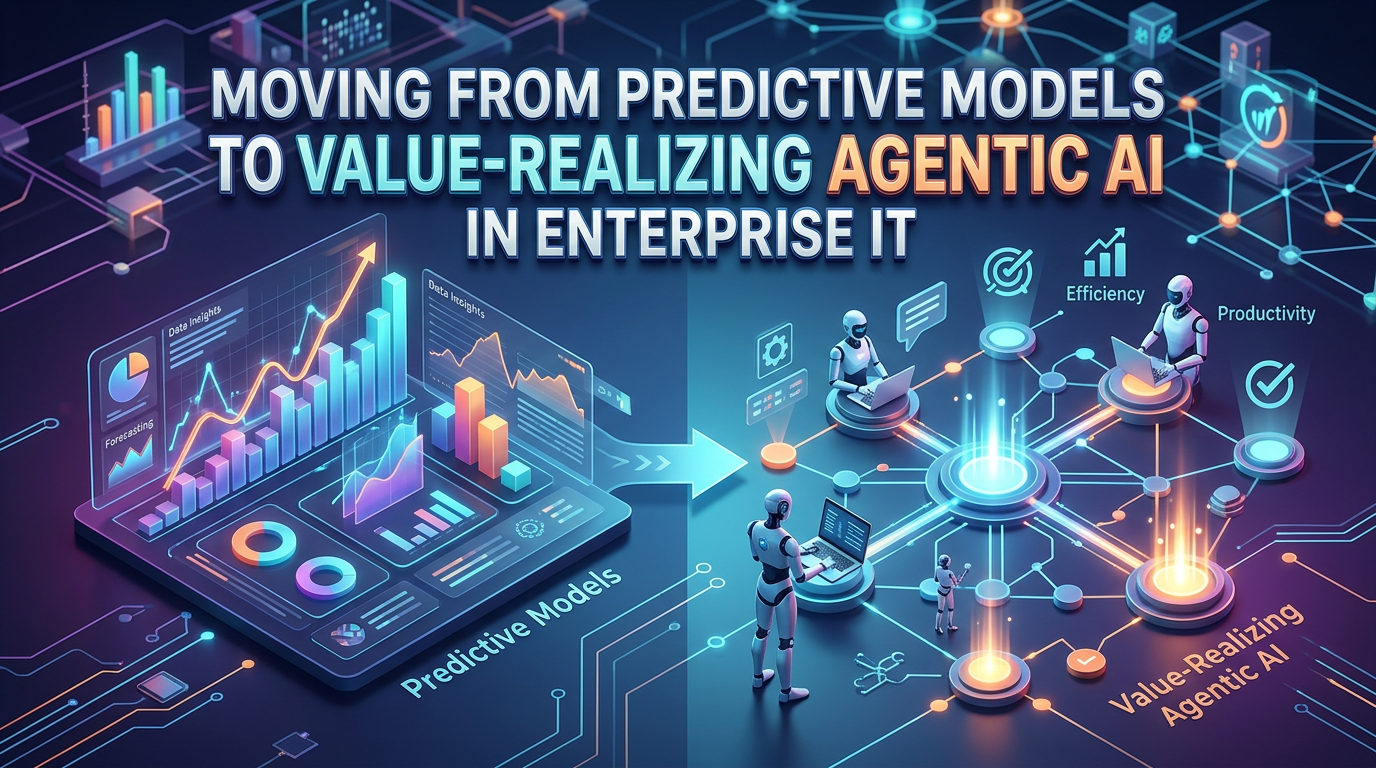
For the past decade, enterprise IT departments have relied heavily on predictive models to forecast trends, anticipate customer behavior, and optimize operations. These models have served organizations well, providing valuable insights that inform decision-making and strategic planning. However, the technological landscape is undergoing a fundamental transformation. The emergence of agentic AI represents a paradigm shift that moves beyond mere prediction to enable autonomous action, continuous learning, and tangible value realization.
Sapient Code Labs has witnessed this evolution firsthand across numerous enterprise implementations. Organizations that once celebrated the accuracy of their predictive models are now asking a more ambitious question: not just what will happen, but what can our AI systems accomplish on our behalf? This article explores the critical transition from predictive models to value-realizing agentic AI in enterprise IT, examining the strategic imperative, implementation considerations, and transformative potential for modern businesses.
Production agents need auth, audit, evaluation and integration — that's AI agentic development.
Understanding Predictive Models in Enterprise Context
Predictive models represent a category of artificial intelligence that analyzes historical data to forecast future outcomes. In enterprise environments, these models have powered applications ranging from demand forecasting and customer churn prediction to risk assessment and equipment failure anticipation. Machine learning algorithms examine patterns in historical datasets, identifying correlations and trends that enable probabilistic predictions about future events.
The value proposition of predictive models is well-established. Enterprises have deployed these systems to optimize inventory management, personalize marketing campaigns, detect fraudulent transactions, and improve resource allocation. Financial institutions use predictive models to assess creditworthiness, while healthcare organizations employ them to identify patients at risk for specific conditions. The insights generated by these models have informed strategic decisions and operational improvements across virtually every industry vertical.
However, predictive models possess inherent limitations that constrain their business impact. First, they operate in a reactive mode, analyzing past data to generate forecasts rather than taking autonomous action. Second, their outputs require human interpretation and intervention to translate into business outcomes. Third, predictive models typically operate in isolation, addressing specific use cases without the capability to coordinate complex, multi-step processes. Finally, these models often suffer from model drift, requiring continuous retraining as underlying data distributions shift over time.
Introducing Agentic AI: The Next Frontier
Agentic AI represents a fundamentally different approach to artificial intelligence in enterprise settings. Unlike predictive models that generate outputs for human consumption, agentic AI systems are designed to perceive their environment, reason about complex situations, and take autonomous actions to achieve defined objectives. These systems combine large language models with reasoning frameworks, memory mechanisms, and tool-use capabilities to operate as intelligent agents within enterprise workflows.
The core distinguishing characteristic of agentic AI is its capacity for autonomous action. Rather than simply predicting what might happen, agentic systems can execute tasks, make decisions within defined parameters, and adapt their behavior based on feedback. An agentic AI system doesn't merely forecast that a customer might churn; it can proactively engage with the customer, address concerns, and implement retention strategies without human intervention for routine cases.
Modern agentic AI architectures incorporate several sophisticated capabilities that enable enterprise-grade deployment. Reasoning engines allow these systems to break down complex tasks into manageable steps, evaluate multiple options, and select optimal courses of action. Memory systems provide context retention across interactions, enabling personalized and contextually aware responses. Tool integration allows agentic AI to interact with enterprise systems, execute transactions, and access relevant data sources. Guardrails and governance frameworks ensure that autonomous actions operate within acceptable risk boundaries.
The Strategic Imperative for Value Realization
Enterprise leaders are increasingly recognizing that predictive models, while valuable, deliver value primarily through insights that inform human decisions. Agentic AI, by contrast, enables direct value capture by automating actions that previously required human judgment and intervention. This distinction has profound implications for organizational efficiency, customer experience, and competitive positioning.
The economic argument for agentic AI is compelling. When predictive models identify an opportunity or risk, the organization must still deploy human resources to act on that insight. This creates a bottleneck between insight generation and value realization. Agentic AI collapses this timeline by enabling immediate, scalable action. Consider a supply chain scenario: a predictive model might forecast inventory shortages at specific locations, but human planners must then determine responses and execute orders. An agentic system can autonomously initiate procurement processes, reroute shipments, and adjust production schedules in near real-time.
Customer experience represents another domain where agentic AI delivers transformative potential. Traditional AI systems can predict customer needs and preferences, but responding to those insights typically requires human agents. Agentic AI enables proactive, personalized engagement at scale. These systems can autonomously manage customer interactions across touchpoints, resolving issues, providing support, and anticipating needs without the latency and inconsistency inherent in human-managed processes.
We treat the surrounding product as end-to-end product development, not a separate science project.
Operational excellence benefits similarly from agentic capabilities. Enterprise IT environments generate continuous streams of events, alerts, and anomalies that require rapid response. While predictive models can identify potential issues before they occur, agentic systems can implement preventive measures, orchestrate remediation workflows, and maintain system health autonomously. This shift from reactive monitoring to proactive management represents a fundamental improvement in operational reliability and efficiency.
Key Differences: Predictive Models vs Agentic AI
Understanding the distinctions between predictive models and agentic AI is essential for organizations planning their AI evolution. These differences span technical architecture, operational characteristics, and business impact.
Mode of Operation: Predictive models operate in an analytical mode, processing data to generate outputs that humans interpret and act upon. Agentic AI operates in an action-oriented mode, taking autonomous steps to accomplish defined objectives without requiring human intervention for each decision.
Context Handling: Traditional predictive models typically analyze structured data within narrow feature sets. Agentic AI systems can process unstructured information, maintain conversational context, and integrate information from diverse sources to inform comprehensive responses.
Adaptation Mechanisms: Predictive models require periodic retraining to maintain accuracy as data distributions evolve. Agentic AI systems can implement continuous learning, adjusting their behavior based on feedback and evolving circumstances without explicit retraining cycles.
Integration Complexity: Predictive models typically integrate with enterprise systems through batch processing and API calls for inference. Agentic AI requires more sophisticated integration patterns, including event-driven architectures, state management, and secure tool execution frameworks.
Governance Requirements: The autonomous nature of agentic AI demands more robust governance frameworks. Organizations must establish clear boundaries for agent actions, implement comprehensive audit trails, and define escalation protocols for situations requiring human oversight.
Implementing the Transition: Strategic Considerations
Organizations embarking on the transition from predictive models to agentic AI should approach the journey strategically, building on existing AI investments while developing new capabilities required for autonomous systems. Success requires careful attention to technical infrastructure, organizational readiness, and governance frameworks.
Use our SaaS development cost guide to budget the product shell around the models.
Technical readiness forms the foundation for agentic AI deployment. These systems require robust integration capabilities to interact with enterprise applications, data sources, and workflow tools. Organizations should evaluate their integration infrastructure, ensuring APIs are well-defined, security frameworks are appropriate for autonomous operations, and monitoring capabilities can track agent activities comprehensively. Cloud-native architectures often provide the flexibility and scalability that agentic deployments require.
Data strategy becomes even more critical in agentic contexts. While predictive models require historical data for training, agentic systems need access to real-time information, enterprise knowledge bases, and operational systems. Organizations should assess their data architecture, ensuring that agentic systems can access relevant data sources securely while maintaining appropriate data governance controls.
Organizational readiness encompasses human capital, process adaptation, and cultural readiness. Agentic AI fundamentally changes how humans and machines collaborate, requiring new roles, updated processes, and shifted responsibilities. Training programs, change management initiatives, and clear communication about the role of autonomous systems are essential for successful adoption.
Governance frameworks must evolve to address the unique characteristics of agentic AI. Traditional AI governance often focuses on model accuracy, bias detection, and regulatory compliance for analytical outputs. Agentic governance must additionally address action boundaries, escalation protocols, error handling, and accountability structures for autonomous decisions. Establishing these frameworks before deployment prevents governance gaps that could create operational or regulatory exposure.
Realizing Value: Enterprise Use Cases
The transition to agentic AI enables value realization across enterprise functions. Several high-impact use cases demonstrate the transformative potential of autonomous AI systems.
In customer service operations, agentic AI can manage initial customer interactions autonomously, resolving routine inquiries without human intervention while intelligently escalating complex issues. These systems can access customer history, analyze context, and implement resolution strategies, delivering consistent and immediate responses that improve customer satisfaction while reducing service costs.
IT operations represent another high-value application domain. Agentic AI systems can monitor infrastructure health, identify anomalies, and implement remediation actions autonomously. When issues arise that exceed defined autonomy boundaries, these systems can gather relevant context, prepare recommendations, and facilitate rapid human escalation. The result is improved system reliability and faster incident resolution.
Business process automation benefits significantly from agentic capabilities. Where traditional automation follows rigid rules, agentic systems can handle exceptions, make context-appropriate decisions, and adapt workflows based on evolving circumstances. This flexibility enables automation of processes that were previously too complex for deterministic automation approaches.
Enterprise security operations leverage agentic AI for threat detection, analysis, and response. These systems can identify potential security incidents, assess their severity, implement initial containment measures, and coordinate human analyst engagement for complex threats. The autonomous response capability significantly reduces threat dwell time and potential damage.
Conclusion: Embracing the Agentic Future
The transition from predictive models to value-realizing agentic AI represents a defining opportunity for enterprise IT. While predictive models have delivered significant value by illuminating future possibilities, agentic AI enables organizations to capture that value directly through autonomous action. This evolution is not merely a technical upgrade; it represents a fundamental reimagining of how artificial intelligence contributes to business outcomes.
Organizations that successfully navigate this transition will benefit from improved operational efficiency, enhanced customer experiences, and accelerated innovation cycles. The competitive advantage will accrue to enterprises that effectively deploy agentic capabilities while maintaining appropriate governance and human oversight. The journey requires strategic planning, technical investment, and organizational adaptation, but the potential rewards justify the effort.
Sapient Code Labs remains committed to guiding enterprises through this transformation, leveraging deep expertise in AI development, integration, and governance to help organizations realize the full potential of agentic AI. The future of enterprise intelligence is agentic, and the time to begin the transition is now.
Ready to ship production AI agents? Run a Scoping Sprint ($2,300, two weeks) for a prototype, plan and fixed quote — or talk to us.