Introduction: The AI Integration Challenge
As artificial intelligence continues to transform business operations, organizations face a critical challenge: integrating AI capabilities into their existing software ecosystems without disrupting current workflows. Many enterprises have invested heavily in legacy systems, custom applications, and specialized tools over the years. Now, they must find ways to augment these systems with AI functionality while navigating complex technical landscapes.
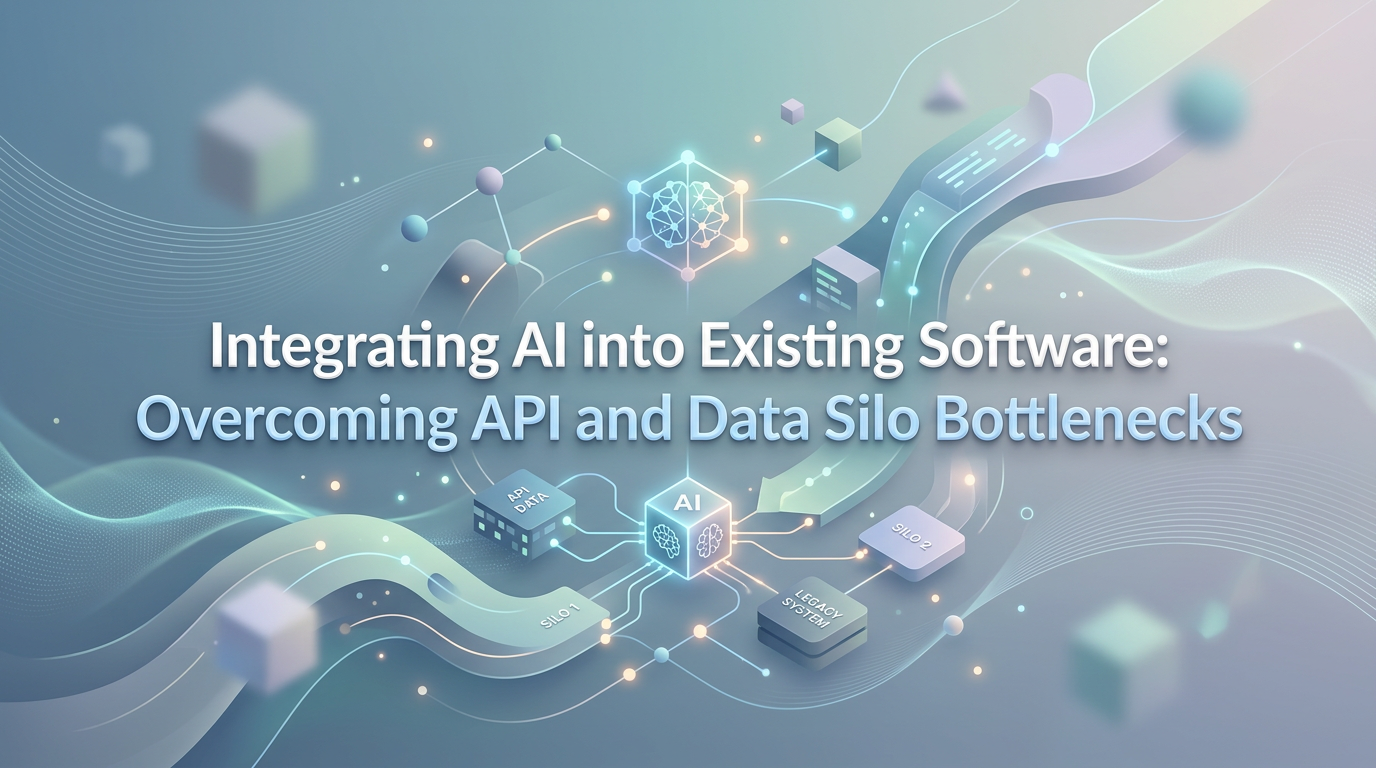
The journey toward AI integration is rarely straightforward. Organizations quickly discover that their existing infrastructure presents significant obstacles, particularly around API limitations and data silos. These challenges can stall AI initiatives, increase development costs, and delay the realization of AI's potential benefits. Understanding these barriers—and how to overcome them—is essential for any organization seeking to leverage AI effectively.
Sapient Code Labs has helped numerous clients navigate these integration challenges, developing strategies that maximize existing infrastructure investments while enabling powerful AI capabilities. This guide explores the common bottlenecks organizations face and provides actionable approaches to overcome them.
Understanding API Bottlenecks in AI Integration
Application Programming Interfaces serve as the connective tissue between AI services and existing software systems. When integrating AI capabilities—whether machine learning models, natural language processing tools, or predictive analytics—organizations typically rely on APIs to facilitate communication between systems. However, API limitations frequently become primary bottlenecks that hinder effective AI integration.
Rate Limits and Throughput Constraints
Most AI service providers impose rate limits on their APIs, restricting the number of requests that can be made within a given time period. These limits exist to prevent abuse and ensure fair resource allocation, but they can significantly constrain AI-powered features in production environments. For example, a customer service chatbot handling thousands of concurrent users may exceed API rate limits during peak periods, resulting in degraded user experiences or failed requests.
Organizations must implement robust request management strategies, including request queuing, caching mechanisms, and load balancing. Building intelligent request throttlers that prioritize critical operations can help maintain service quality while respecting API constraints.
Latency and Response Times
AI inference often requires substantial computational resources, resulting in response times that may not meet real-time application requirements. When AI services are hosted remotely, network latency compounds this issue. Users expect instantaneous responses, but AI processing times can range from milliseconds to several seconds depending on model complexity.
Mitigation strategies include deploying AI models closer to the application layer through edge computing, optimizing model inference through quantization and pruning techniques, and implementing asynchronous processing patterns where immediate responses aren't required.
API Versioning and Compatibility
AI service providers regularly update their APIs, introducing new features, deprecating older endpoints, and modifying response formats. These changes can break existing integrations, requiring development teams to continuously update and test their implementations. Organizations with multiple AI integrations face compounding complexity when each service follows different versioning strategies.
Implementing abstraction layers that isolate core application logic from specific API implementations can reduce the impact of provider changes. This approach allows organizations to swap AI providers or update integrations without significant refactoring of the overall system.
Breaking Down Data Silos for AI Implementation
Data silos represent perhaps the most significant barrier to successful AI integration. These isolated data repositories—often created departmental systems, legacy databases, or disconnected cloud services—prevent the data flow necessary for effective AI model training and inference. AI systems require comprehensive, integrated data to deliver accurate insights and predictions.
The Challenge of Fragmented Data
In many organizations, customer data might exist across multiple systems: CRM platforms, marketing automation tools, customer support databases, and transaction systems. Each system may use different data formats, naming conventions, and storage mechanisms. When AI models need to access comprehensive customer profiles, this fragmentation becomes a major obstacle.
Data unification efforts typically involve establishing data governance frameworks, implementing data transformation pipelines, and creating unified data repositories. These foundational investments are essential for AI systems to function effectively.
Data Quality and Consistency
Even when data can be aggregated from multiple sources, quality issues often emerge as significant barriers. Inconsistent data entry practices, duplicate records, missing values, and outdated information can severely impact AI model performance. Models trained on poor-quality data produce unreliable outputs, undermining confidence in AI initiatives.
Organizations must invest in data cleansing processes, implement validation rules at data entry points, and establish ongoing data quality monitoring. These efforts should be treated as continuous processes rather than one-time projects, as data quality requires ongoing attention.
Security and Access Controls
Data silos often exist partly due to security concerns and access control requirements. Different departments may have legitimate concerns about data exposure, regulatory compliance, or competitive sensitivity. AI systems that require cross-functional data access must navigate these security requirements carefully.
Implementing fine-grained access controls, data anonymization techniques, and privacy-preserving machine learning approaches can enable AI to derive insights from sensitive data without compromising security. Federated learning and differential privacy represent advanced techniques that allow AI models to train on distributed data without centralizing sensitive information.
Strategic Approaches to AI Integration
Successfully integrating AI into existing software requires a strategic approach that addresses technical challenges while maintaining business continuity. Organizations that treat AI integration as a comprehensive transformation—rather than a simple technology addition—achieve better outcomes.
Building an Integration Architecture
A well-designed integration architecture serves as the foundation for successful AI implementation. This architecture should include:
API Gateway Services that centralize communication with external AI providers, manage authentication, handle rate limiting, and provide logging and monitoring capabilities. An API gateway allows organizations to add AI capabilities without modifying core application logic.
Event-Driven Data Pipelines that enable real-time data flow between systems, supporting AI use cases that require up-to-the-minute information. Message queues and streaming platforms can decouple producers and consumers, improving system resilience and scalability.
Unified Data Layers that aggregate and transform data from multiple sources, providing AI systems with consistent, comprehensive data access. These layers should include data quality checks, validation rules, and governance controls.
Incremental Integration Strategy
Rather than attempting comprehensive AI integration simultaneously, organizations benefit from phased approaches that deliver incremental value while managing risk. Starting with bounded use cases that address specific business problems allows teams to build expertise and demonstrate ROI before expanding AI capabilities.
For example, an organization might begin with AI-powered document classification in a single department, then expand to predictive analytics for inventory management, and eventually implement comprehensive customer intelligence across all touchpoints. Each phase builds organizational capability and validates technical approaches before larger investments.
Hybrid AI Deployment Models
Organizations should evaluate different AI deployment models to find the optimal balance between capability, cost, and control. Cloud-based AI services offer rapid deployment and minimal infrastructure management but introduce dependencies and potential data privacy concerns. On-premises AI deployment provides maximum control and data sovereignty but requires significant infrastructure investment and expertise.
Hybrid approaches that combine cloud AI services for general capabilities with on-premises deployment for sensitive data or real-time inference often provide the best balance. Edge AI—deploying models on local devices—can address latency-sensitive applications while reducing cloud dependency.
Technical Best Practices for Integration Success
Several technical best practices can significantly improve AI integration outcomes. These practices address common failure modes and establish foundations for scalable, maintainable AI implementations.
Robust Error Handling and Fallbacks
AI services can experience outages, return unexpected errors, or produce suboptimal results. Production systems must handle these scenarios gracefully without impacting user experiences. Implementing circuit breaker patterns, fallback to rule-based alternatives, and comprehensive error logging ensures systems remain functional even when AI components fail.
Comprehensive Monitoring and Observability
Effective monitoring of AI integrations requires visibility into both traditional system metrics (response times, error rates, resource utilization) and AI-specific metrics (model accuracy, prediction confidence, data drift). Establishing dashboards and alerting systems that surface issues quickly enables rapid response to problems.
Monitoring should also track business outcomes, connecting AI performance to actual business metrics. This connection validates AI value and identifies opportunities for improvement.
Model Lifecycle Management
AI models require ongoing maintenance and updates to maintain effectiveness. As business conditions change, underlying data evolves, and model performance degrades, organizations must have processes for model retraining, version management, and rollback capabilities. Treating AI models as living systems that require continuous care is essential for long-term success.
Overcoming Organizational and Process Barriers
Beyond technical challenges, organizations must address process and cultural barriers to successful AI integration. These softer challenges often prove more difficult to overcome than technical obstacles.
Skill Development and Team Structure
AI integration requires specialized skills that many organizations lack internally. Data scientists, ML engineers, and AI architects must collaborate effectively with existing development and operations teams. Investing in training, hiring specialized talent, or partnering with external experts can address skill gaps.
Establishing cross-functional teams that combine domain expertise with technical AI capabilities enables more effective integration than siloed organizational structures.
Change Management and Stakeholder Alignment
AI integration often changes workflows, decision-making processes, and job responsibilities. Successful implementations require careful change management that addresses stakeholder concerns, communicates benefits clearly, and provides adequate training. Resistance to AI-powered automation typically stems from fear of job displacement or lack of understanding—addressing these concerns proactively improves adoption.
Governance and Ethical Considerations
Organizations must establish governance frameworks that guide AI development and deployment. These frameworks should address fairness, transparency, accountability, and regulatory compliance. As AI systems make increasingly important decisions, governance becomes essential for maintaining trust and avoiding legal exposure.
Conclusion: Embracing AI Integration as a Strategic Imperative
Integrating AI into existing software systems presents genuine challenges, but these challenges are manageable with the right approaches. API bottlenecks can be addressed through thoughtful architecture, caching strategies, and hybrid deployment models. Data silos can be broken down through comprehensive data governance, quality improvement initiatives, and unified data layers.
The organizations that succeed with AI integration treat it as a strategic transformation rather than a purely technical project. They invest in foundational capabilities—data infrastructure, integration architecture, team skills, and governance frameworks—that enable ongoing AI innovation.
As AI capabilities continue advancing, the competitive advantage will belong to organizations that have established robust integration capabilities. The time to begin this journey is now. By addressing API and data silo challenges systematically, organizations can unlock the full potential of AI while protecting their existing software investments.
Sapient Code Labs specializes in helping organizations navigate complex AI integration challenges. Our team brings extensive experience in building integration architectures, unifying data infrastructure, and deploying AI capabilities that deliver measurable business value. Contact us to explore how we can help accelerate your AI integration initiatives.