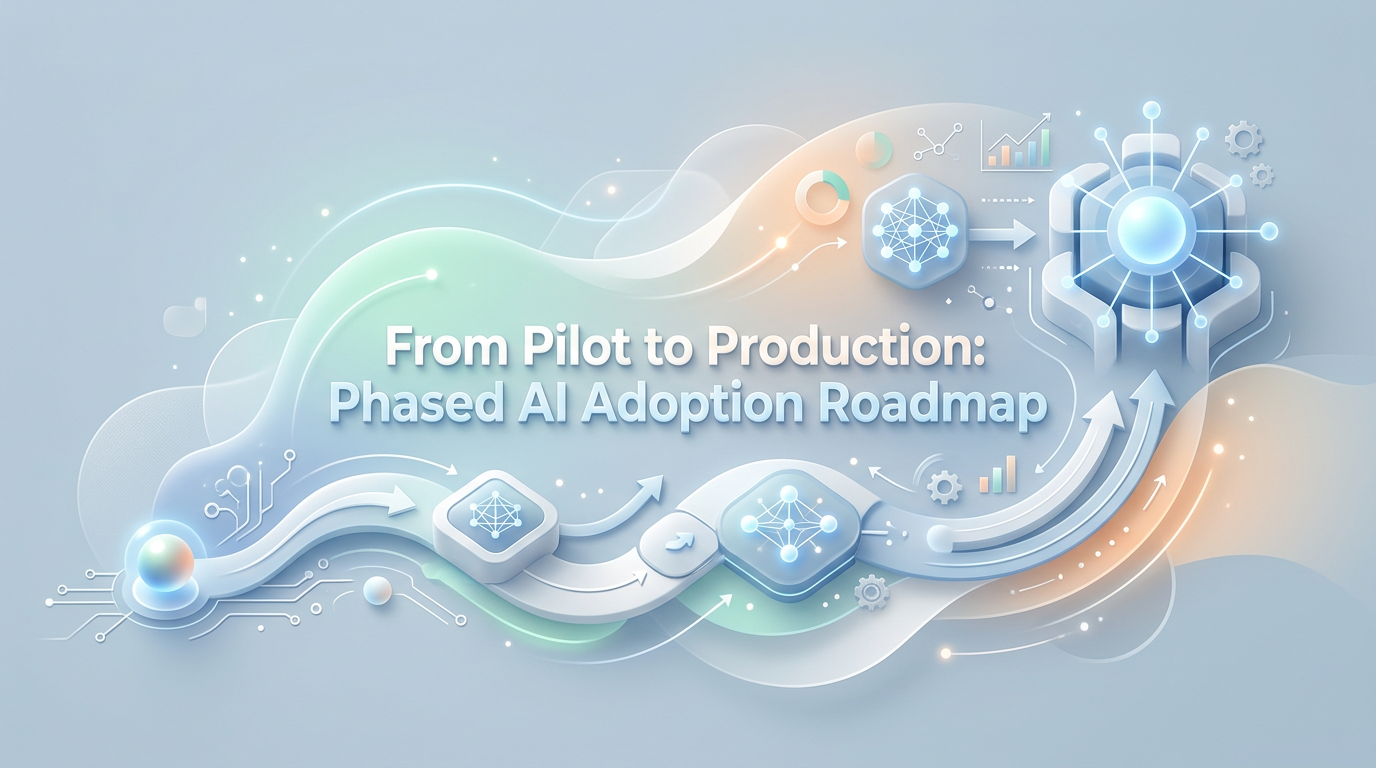
Artificial intelligence has moved from experimental curiosity to business necessity. Organizations across industries are racing to integrate AI capabilities into their operations, yet many struggle to transition from proof-of-concept to full-scale production. The gap between a successful pilot and a deployed, production-ready AI system represents one of the most significant challenges facing enterprises today.
Sapient Code Labs has witnessed countless organizations invest heavily in AI initiatives only to see them stall at the pilot phase. The reality is that scaling AI from laboratory to production environment requires a carefully structured roadmap, cross-functional collaboration, and a deep understanding of both technical and organizational challenges. This comprehensive guide outlines a phased approach to AI adoption that minimizes risk while maximizing return on investment.
Understanding the AI Adoption Challenge
The journey from pilot to production is fraught with complexities that many organizations underestimate. A pilot project typically operates in controlled conditions with limited scope, clean data, and dedicated resources. Production environments, by contrast, demand robust systems that can handle real-world variability, scale to meet demand, and integrate seamlessly with existing infrastructure.
Research indicates that approximately 85% of AI projects fail to deliver on their initial promises, with the transition from pilot to production being the primary point of failure. This staggering statistic underscores the importance of a well-planned adoption roadmap that addresses technical, organizational, and operational concerns at each stage of deployment.
Successful AI adoption is not merely a technology problem—it is a business transformation initiative that requires alignment across departments, buy-in from stakeholders, and a culture willing to embrace data-driven decision making. Organizations that approach AI adoption as a purely technical endeavor often find themselves stuck in endless pilot cycles without ever achieving meaningful business impact.
Phase 1: Assessment and Strategic Planning
Every successful AI adoption journey begins with thorough assessment and strategic planning. This foundational phase establishes the groundwork for all subsequent work and significantly influences the likelihood of success. Organizations that skip this phase in their eagerness to implement AI often pay the price later through misaligned projects, inadequate infrastructure, and unrealistic expectations.
The assessment phase should evaluate multiple dimensions of organizational readiness. Technical readiness includes examining existing data infrastructure, computing resources, and integration capabilities. Organizations must take inventory of their data assets, understanding not just what data they have but also its quality, accessibility, and governance framework. Poor data quality is one of the most common reasons AI pilots fail to translate into production systems.
Organizational readiness encompasses evaluating team skills, change management capabilities, and existing processes that may need adaptation. AI implementation often requires new roles and responsibilities, from data scientists and machine learning engineers to AI ethicists and project managers. Understanding the skills gap helps organizations plan for training, hiring, or partnering with external experts.
Strategic alignment ensures that AI initiatives connect directly to business objectives. Organizations should identify specific use cases where AI can deliver measurable value, whether through cost reduction, revenue growth, improved customer experience, or operational efficiency. These use cases should be prioritized based on business impact, feasibility, and strategic importance.
During this phase, organizations should also establish clear success metrics and key performance indicators. Defining what success looks like before beginning the pilot helps maintain focus and provides objective criteria for evaluating results. Vague goals like "improve efficiency" without specific targets often lead to underwhelming outcomes and difficulty demonstrating value.
Phase 2: Pilot Implementation and Validation
With a solid strategic foundation in place, organizations move to the pilot implementation phase. This stage involves developing and testing AI solutions in controlled environments that mimic production conditions while limiting exposure to risk. The pilot serves as both a technical proof of concept and an organizational learning opportunity.
Pilot projects should be scoped appropriately—ambitious enough to demonstrate meaningful value but constrained enough to manage risk and resource investment. A common mistake is attempting to solve complex, organization-wide problems in the pilot phase. Instead, focus on well-defined use cases with clear boundaries that can deliver measurable results within a reasonable timeframe, typically three to six months.
Technical implementation during the pilot should follow best practices for model development while acknowledging the limited scope. This includes proper data preprocessing, feature engineering, model selection, and validation procedures. Even at the pilot stage, teams should document their work thoroughly and establish version control practices that will support future scaling.
A critical component of pilot implementation is stakeholder engagement. Regular communication with business users, IT teams, and executive sponsors helps maintain buy-in and provides early warning of potential issues. Pilots that operate in isolation often encounter resistance during the scaling phase because stakeholders were not involved in the development process.
Validation goes beyond technical performance metrics. Organizations must evaluate whether the AI solution actually solves the intended business problem and delivers value in realistic scenarios. This requires gathering feedback from end users, analyzing workflow integration, and measuring impact on key performance indicators. A technically excellent model that users reject because it does not fit their workflow has not achieved validation.
The pilot phase should also address operational considerations that will become critical in production. These include monitoring and observability requirements, error handling procedures, documentation for support teams, and initial thinking about maintenance and model updates. Tackling these considerations early prevents nasty surprises during the transition to production.
Phase 3: Scaling and Integration
Successfully validated pilots move to the scaling and integration phase, where solutions expand from limited deployments to organization-wide implementation. This phase presents distinct challenges that differ from pilot development, requiring additional technical capabilities, governance frameworks, and operational processes.
Scaling begins with infrastructure preparation. Production-grade AI systems require robust computing resources that can handle variable workloads, redundant systems that ensure high availability, and monitoring capabilities that provide visibility into system health and performance. Many organizations discover that their pilot infrastructure is inadequate for production demands and must invest in upgrading their technical foundation.
Integration with existing systems represents one of the most complex aspects of scaling AI. Production environments typically include numerous interconnected systems, and adding AI capabilities requires careful orchestration to ensure seamless data flow and consistent user experiences. Application programming interfaces must be designed for reliability and performance, and integration testing must verify that AI components function correctly within the broader system landscape.
Governance becomes essential at scale. Organizations must establish policies and procedures for model management, including version control, performance monitoring, and update procedures. Governance also encompasses ethical considerations, regulatory compliance, and risk management. As AI systems make decisions that affect business outcomes and potentially customers, governance frameworks ensure accountability and transparency.
Security requirements intensify during scaling. Production AI systems become targets for adversarial attacks and must be protected accordingly. This includes securing data pipelines, implementing access controls, encrypting sensitive information, and establishing incident response procedures. Security considerations should be integrated into system design rather than added as an afterthought.
Operational processes must mature to support production AI. This includes establishing service level agreements, defining escalation procedures, creating runbooks for common issues, and building teams responsible for ongoing operations. The transition from project-based development to ongoing operational support requires organizational changes that organizations often underestimate.
Phase 4: Production Optimization and Continuous Improvement
Reaching production is not the finish line—it is the beginning of an ongoing journey. Production AI systems require continuous monitoring, maintenance, and improvement to deliver sustained value. Organizations that treat production deployment as the end of their AI initiative often see performance degrade over time as data drifts, business needs evolve, and competitors advance.
Model monitoring in production must track both technical performance and business outcomes. Technical metrics include prediction accuracy, response times, resource utilization, and system availability. Business metrics connect AI performance to actual business impact, such as conversion rates, customer satisfaction scores, or operational cost savings. Disconnects between technical and business metrics often reveal important insights about real-world system performance.
Model maintenance addresses the inevitable degradation that occurs as conditions change. Data drift, where the underlying data distribution shifts over time, can silently degrade model performance. Regular validation against new data and benchmark performance against original baselines helps identify when models need retraining or replacement. Establishing automated monitoring alerts ensures that teams respond quickly to performance issues.
Continuous improvement involves actively seeking opportunities to enhance AI capabilities. This might include expanding use cases, improving model accuracy, optimizing for new requirements, or integrating additional data sources. Organizations with mature AI practices maintain roadmaps for ongoing enhancement that align with evolving business strategies.
Learning from production operations feeds back into organizational capabilities. Documenting challenges encountered and solutions developed creates institutional knowledge that improves future AI initiatives. Teams should conduct regular retrospectives that identify lessons learned and opportunities for process improvement.
Best Practices for Successful AI Adoption
Throughout the phased adoption journey, certain practices consistently distinguish successful AI implementations from struggling ones. Executive sponsorship proves critical—AI initiatives without visible leadership support struggle to secure resources, navigate organizational resistance, and achieve cross-functional collaboration. Senior leaders must champion AI adoption and demonstrate commitment through resource allocation and personal involvement.
Building multidisciplinary teams brings together the diverse expertise required for AI success. Effective teams include not just technical specialists but also domain experts who understand the business context, project managers who coordinate efforts, and change management professionals who facilitate adoption. Diversity of perspective leads to more robust solutions and smoother implementations.
Embracing iteration over perfection improves outcomes significantly. Rather than seeking the perfect solution upfront, successful organizations prefer to start simple, learn from real-world deployment, and iterate rapidly. This approach reduces risk, accelerates time to value, and builds organizational confidence through demonstrated successes.
Investing in data infrastructure pays dividends across the entire AI adoption journey. Organizations that treat data as a strategic asset and invest in quality, accessibility, and governance create foundations that support multiple AI initiatives. Data platforms that enable self-service access while maintaining appropriate controls accelerate AI development while managing risk.
Partnering with experienced providers can accelerate adoption and reduce risk, particularly for organizations early in their AI journey. External partners bring expertise gained across multiple implementations, proven methodologies, and pre-built components that speed development. However, successful partnerships require clear delineation of responsibilities and intentional knowledge transfer to build internal capabilities.
Conclusion
The journey from pilot to production represents a significant undertaking, but organizations that navigate it successfully gain substantial competitive advantages. AI capabilities that operate at scale can transform operations, enhance customer experiences, and create new value propositions that differentiate market leaders.
Sapient Code Labs specializes in guiding organizations through each phase of the AI adoption journey. Our expertise spans strategic planning, pilot development, production scaling, and ongoing optimization. We understand that successful AI adoption requires more than technical excellence—it demands careful attention to organizational, operational, and strategic considerations that determine whether pilots become production successes.
Whether you are just beginning to explore AI possibilities or struggling to transition pilots into production, our team can help you develop and execute a tailored adoption roadmap. The path from pilot to production may be complex, but with proper planning, expert guidance, and sustained commitment, your organization can realize the transformative potential of artificial intelligence.