The AI Revolution: Why Your Team Matters
The artificial intelligence landscape has transformed dramatically in recent years, making it essential for businesses to strategically build their AI capabilities. Whether you're a startup looking to integrate AI into your products or an established enterprise seeking to modernize your operations, the question of how to build your AI team has become increasingly critical. At Sapient Code Labs, we've helped numerous organizations navigate this crucial decision, and we're here to share insights that can guide your journey.
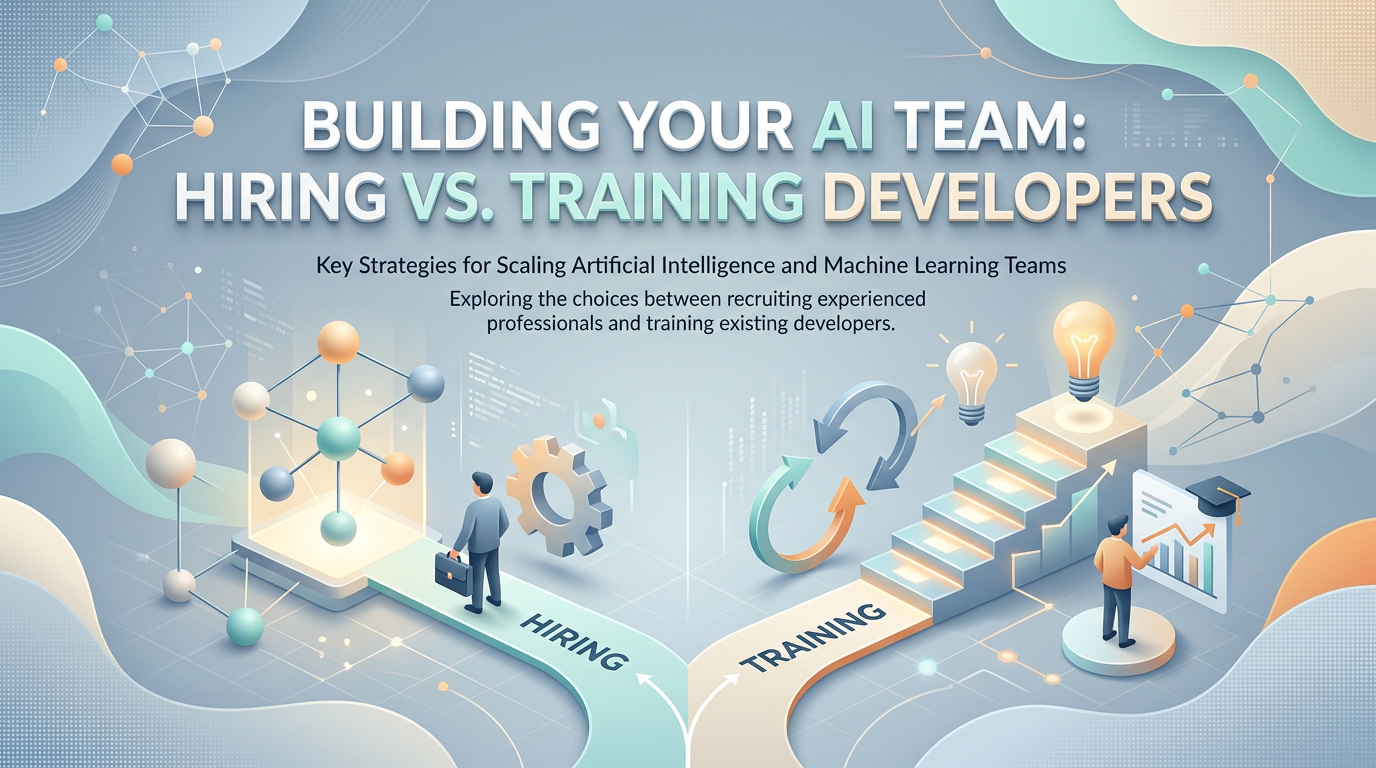
The choice between hiring new AI talent and training your existing development team isn't simply a budget decision—it's a strategic one that will shape your organization's AI capabilities for years to come. Each approach offers distinct advantages and challenges, and the right choice depends on your specific circumstances, timeline, and long-term vision.
When you need capacity while the permanent team forms, hire dedicated developers is the bridge.
Understanding Your AI Requirements
Before diving into the hiring versus training debate, it's essential to clearly define what AI capabilities your organization actually needs. Are you looking to implement machine learning models for data analysis? Do you need natural language processing expertise for customer service automation? Are you building AI-powered products from the ground up?
Understanding your specific requirements will help you determine whether you need senior AI researchers who can architect novel solutions, or whether you need developers who can implement existing AI frameworks and APIs. This distinction is crucial because it directly impacts whether hiring specialized talent or upskilling your current team is the better approach.
Additionally, consider the scope of your AI initiatives. Are you planning a single AI project, or do you envision building a comprehensive AI practice that will grow over time? Organizations with long-term AI ambitions often benefit from a hybrid approach that combines hired expertise with internal capability building.
Option 1: Hiring AI Talent
The Advantages of Hiring
Bringing in experienced AI professionals offers several immediate benefits that can be crucial for organizations moving quickly in the AI space. First and foremost is speed. When you hire experienced AI developers, you gain immediate access to skills and knowledge that would take months or even years to develop internally. This is particularly valuable when you're racing to market with AI-powered features or need to respond quickly to competitive pressures.
Hired AI talent also brings diverse perspectives and experience from working on different projects and industries. They can introduce best practices, modern frameworks, and innovative approaches that your team might not have encountered otherwise. This cross-pollination of ideas often leads to more creative solutions and faster problem-solving when challenges arise.
Furthermore, experienced AI professionals can serve as mentors and leaders, helping to establish AI practices and standards within your organization. They can help build the foundation for future AI initiatives and train other team members along the way.
The Challenges of Hiring
Despite these advantages, hiring AI talent comes with significant challenges that organizations must carefully consider. The most pressing issue is the intense competition for AI talent in the current market. Skilled AI developers are in high demand, and recruiting them often requires competitive salaries that can substantially impact your budget. According to industry reports, AI and machine learning specialists command some of the highest compensation in the technology sector.
Beyond compensation, the hiring process itself can be lengthy and complex. Finding candidates with the right combination of technical skills, industry experience, and cultural fit requires significant time and resources. There's also the risk of hiring someone who looks good on paper but doesn't deliver in practice—a particular concern in AI, where practical implementation skills are just as important as theoretical knowledge.
Another consideration is retention. The demand for AI talent means that hired professionals often have multiple opportunities available. Building an environment where AI talent can thrive and grow is essential for maintaining your team over the long term.
For how delivery runs once people are in place, see how we work.
Option 2: Training Your Existing Developers
The Advantages of Training
Training your existing development team in AI skills offers compelling advantages that make it an attractive option for many organizations. The most significant benefit is cost-effectiveness. While training requires investment in courses, certifications, and time, it generally costs far less than hiring senior AI talent at market rates. This is particularly true for organizations with strong development teams who have the foundation to quickly learn AI concepts.
Another major advantage is retention and loyalty. Developers who receive training and development opportunities from their employer tend to have higher job satisfaction and longer tenure. This is especially important in the AI field, where turnover can be costly and disruptive. When you invest in your team's growth, they're more likely to invest in your organization.
Training also allows for customized learning that aligns precisely with your organization's needs and technology stack. Your team already understands your products, systems, and domain—adding AI skills to this foundation creates professionals who can implement AI solutions that integrate seamlessly with your existing infrastructure.
The Challenges of Training
While training offers substantial benefits, it's important to acknowledge the challenges involved. The most obvious is time. Developing competent AI practitioners takes time, and during the learning curve, your AI initiatives may progress more slowly than if you had hired experienced talent. This delay can be costly in fast-moving markets where being first to market provides significant advantages.
There's also the question of depth versus breadth. While developers can learn to implement AI solutions using existing frameworks and APIs, developing cutting-edge AI algorithms and research-level capabilities typically requires advanced education and years of focused practice. For organizations needing truly novel AI solutions, training alone may not be sufficient.
Additionally, not all developers may be interested in transitioning to AI roles. Motivation and aptitude vary, and attempting to force training on unwilling team members can lead to poor outcomes and dissatisfaction. Successful training programs require participants who are genuinely interested in learning AI concepts and applying them to their work.
The Hybrid Approach: Best of Both Worlds
At Sapient Code Labs, we've found that many organizations achieve the best outcomes by combining hiring and training strategies. This hybrid approach allows you to leverage the immediate expertise of hired AI professionals while building long-term internal capabilities through training.
In practice, this might mean hiring one or two experienced AI leads who can architect your AI solutions and mentor your existing team, while simultaneously investing in training programs for developers who show interest in AI. This creates a sustainable model where knowledge transfer happens organically, and your organization gradually builds deep AI expertise without relying entirely on external hiring.
The hybrid approach also provides flexibility. When you have core AI talent in place, you can tackle immediate projects while your training programs develop. As your internal capabilities grow, you can gradually shift more AI work to your trained team, using hired talent primarily for advanced research and specialized requirements.
Making the Decision: Key Factors to Consider
When deciding between hiring, training, or a hybrid approach, several factors should guide your decision-making process. First, consider your timeline. If you need AI capabilities immediately, hiring experienced talent is likely necessary. If you have more time to develop capabilities, training becomes a more viable option.
Second, evaluate your budget. While training is generally less expensive, it requires sustained investment in learning resources and time. Hiring requires significant upfront costs but can deliver faster returns. Your financial situation and risk tolerance should inform your choice.
Third, assess your existing team's capabilities and culture. A strong development team with solid fundamentals will progress faster in AI training. Additionally, organizational culture that values learning and growth will support successful training initiatives.
Finally, consider your long-term AI strategy. Organizations planning to build comprehensive AI practices will benefit from the hybrid approach, which creates sustainable internal capabilities. Those with limited AI needs may find that hiring project-based AI talent is more appropriate.
Implementation: Getting Started
Regardless of which approach you choose, successful AI team building requires thoughtful implementation. If hiring, invest in a rigorous recruitment process that includes practical assessments and clear evaluation criteria. Look for candidates who not only have technical skills but also demonstrate the ability to communicate complex concepts and collaborate with non-technical stakeholders.
If training, develop a structured learning path that progresses from foundational concepts to practical implementation. Consider formal certifications, online courses, and hands-on projects that allow developers to apply their learning to real business problems. Create opportunities for your trainees to work alongside experienced AI professionals, whether hired externally or engaged as consultants.
Regardless of approach, ensure that your AI team has access to the tools, data, and infrastructure they need to succeed. Even the most talented AI professionals cannot deliver results without proper resources. Budget for computing resources, data access, and the necessary development environment from the beginning.
Conclusion: Building Your AI Future
The decision between hiring AI talent and training existing developers is not a binary one. Both approaches have proven successful for organizations across industries, and the optimal choice depends on your unique circumstances, timeline, and strategic objectives. The most successful AI initiatives often combine elements of both, leveraging hired expertise for immediate impact while building sustainable internal capabilities for the long term.
At Sapient Code Labs, we understand that building an AI team is a significant undertaking that requires careful planning and execution. Whether you're just starting to explore AI integration or looking to scale your existing AI capabilities, our team can help you develop a strategy that aligns with your goals and resources.
The AI revolution is underway, and the teams that succeed will be those that approach team building strategically. By carefully evaluating your options and investing in the right approach for your organization, you can build an AI team that drives innovation and delivers lasting value to your business.
Building this? A Scoping Sprint ($2,300, two weeks) ends with a clickable prototype, a technical plan and a fixed quote — or just start a conversation.