Introduction
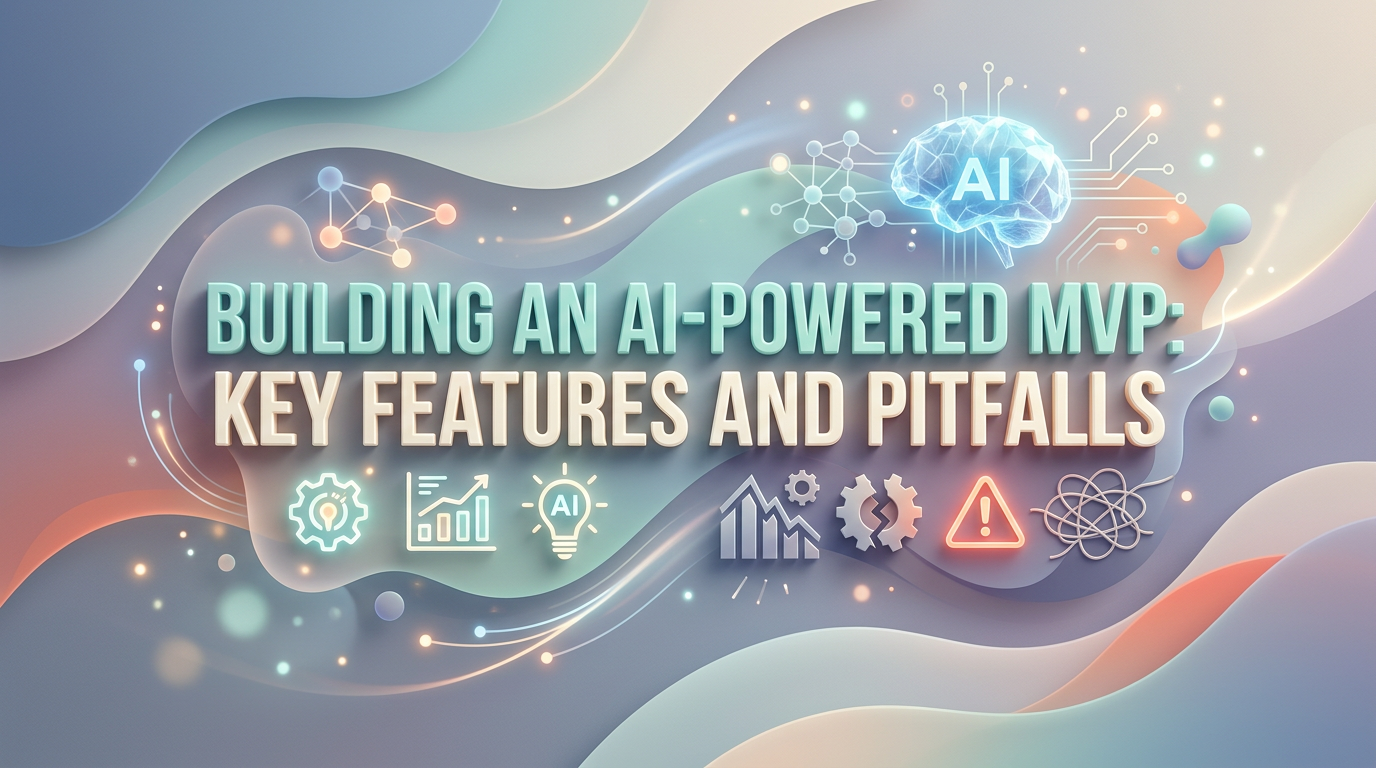
In today's rapidly evolving technological landscape, integrating artificial intelligence into your product has become more accessible than ever before. For startups and established companies alike, building an AI-powered Minimum Viable Product (MVP) represents a strategic approach to validating market demand while minimizing development costs and time-to-market. However, the journey from concept to deployment is filled with unique challenges that differ significantly from traditional software development.
Sapient Code Labs has helped numerous organizations navigate the complexities of AI integration, and we've witnessed both remarkable successes and instructive failures. This comprehensive guide explores the essential features your AI-powered MVP should include, the common pitfalls that derail projects, and proven strategies for building a successful AI-driven product that delivers real value to users.
Prove one valuable workflow first — that's how we run MVP development.
What is an AI-Powered MVP?
An AI-powered Minimum Viable Product is a streamlined version of a software application that incorporates artificial intelligence capabilities to solve specific problems or enhance user experiences. Unlike traditional MVPs that focus purely on core functionality, an AI-powered MVP leverages machine learning, natural language processing, computer vision, or predictive analytics to deliver intelligent features that differentiate your product in the market.
The key distinction lies in the iterative nature of AI development. Unlike conventional software where functionality is deterministic, AI systems learn and improve over time. This fundamental difference shapes every aspect of your MVP development strategy, from data collection to model training and deployment. Understanding this nuance is crucial for setting realistic expectations and building products that can evolve based on user feedback and accumulated data.
Key Features of a Successful AI-Powered MVP
1. Clear Value Proposition with AI Enhancement
Every successful AI-powered MVP begins with a clearly defined value proposition that explains how artificial intelligence enhances the core offering. The AI component should address a specific pain point or significantly improve an existing solution rather than existing as a novelty feature. Whether it's automating customer support through chatbots, personalizing content recommendations, or streamlining data analysis, the AI feature must deliver measurable value that users can immediately recognize.
When defining your value proposition, consider the competitive landscape and identify where AI can create meaningful differentiation. Products that successfully integrate AI typically solve problems that would be impractical or impossible to address through traditional programming alone. This could involve processing vast amounts of unstructured data, recognizing complex patterns, or adapting to individual user behaviors over time.
2. Robust Data Infrastructure
The foundation of any AI-powered product lies in its data infrastructure. Your MVP must have efficient systems for collecting, storing, and processing the data that fuels your AI models. This includes establishing clear data pipelines, implementing appropriate storage solutions, and ensuring data quality through proper validation and cleaning processes.
Data infrastructure planning should account for both current requirements and future scaling needs. As your user base grows and your AI models become more sophisticated, your data systems must be able to handle increased volumes without performance degradation. Cloud-based solutions offer flexibility and scalability, allowing you to adjust resources based on demand while managing costs effectively during the MVP phase.
3. Scalable Model Architecture
While your MVP may start with relatively simple AI models, building with scalability in mind prevents costly rewrites later. Choose model architectures that can evolve with your product requirements, whether that involves upgrading to more sophisticated algorithms or expanding capabilities to handle new use cases. Microservices architecture often proves valuable for AI-powered applications, allowing individual components to be updated or replaced without affecting the entire system.
Consider implementing model versioning from the beginning, which enables you to deploy improvements while maintaining the ability to rollback if issues arise. This approach supports continuous improvement cycles that are essential for AI products, allowing you to test new model versions with subsets of users before full deployment.
4. Transparent AI Explanability
Users increasingly expect transparency about how AI affects their experience. Building explainability into your MVP—showing users how recommendations are generated, what data influences decisions, or why certain outputs are produced—builds trust and encourages adoption. This is particularly important in regulated industries or applications where AI decisions significantly impact users.
Use published numbers for what an MVP actually costs, then add model spend as an explicit line item.
Explainability also aids in debugging and improving your AI systems. When you can understand why your model makes certain predictions, identifying and correcting biases or errors becomes substantially easier. Implement logging and monitoring systems that capture relevant context around AI decisions, providing the information needed for both user transparency and internal analysis.
5. Performance Monitoring and Feedback Loops
An effective AI-powered MVP includes robust monitoring systems that track model performance in production. This goes beyond simple uptime monitoring to include metrics specific to AI behavior—such as prediction accuracy, response relevance, and user satisfaction with AI-generated outputs. Establishing clear performance baselines during development enables you to identify degradation quickly and take corrective action.
Feedback loops allow users to contribute to AI improvement, whether through explicit ratings, implicit behavioral signals, or direct input. Building these mechanisms into your MVP from the start accelerates the iteration cycle and helps your AI models improve based on real-world usage patterns rather than potentially biased training data.
Common Pitfalls to Avoid
1. Overcomplicating the AI Scope
One of the most frequent mistakes in AI-powered MVP development is attempting to do too much with artificial intelligence. Teams often underestimate the complexity of AI systems and overestimate what can be achieved in an MVP timeframe. Starting with a focused, well-defined AI feature that solves a specific problem proves far more successful than attempting to build comprehensive AI capabilities.
Resist the temptation to build advanced features that require extensive research or custom model development. Leverage pre-trained models and proven APIs where possible, focusing your unique development effort on the specific value your product delivers. This approach reduces development time, minimizes technical risk, and allows you to validate your core hypothesis before investing in more sophisticated AI capabilities.
2. Insufficient Training Data Quality
AI models are only as good as the data they're trained on, and many MVP projects fail due to inadequate attention to data quality. Collecting sufficient volumes of relevant, accurate, and representative training data requires careful planning and often more time than anticipated. Poor data quality leads to models that perform badly in production, creating negative user experiences that damage adoption.
Address data quality proactively by establishing clear data collection protocols, implementing validation checks, and planning for continuous data improvement. Consider working with domain experts to ensure your training data accurately represents the real-world scenarios your AI will encounter. If data is limited, explore transfer learning approaches that leverage pre-trained models and adapt them to your specific use case with smaller datasets.
3. Neglecting User Experience Integration
Technical excellence in AI means nothing if users can't effectively interact with your intelligent features. Many teams focus heavily on model performance while neglecting the user experience surrounding AI functionality. The result is powerful technology that users find confusing, frustrating, or simply don't understand how to use.
If the MVP includes agents or tool-use, that slice is AI agentic development.
Design AI interactions with the same care you would apply to any critical user journey. This includes clear onboarding that explains AI capabilities and limitations, intuitive interfaces for providing input and interpreting outputs, and graceful handling of AI errors or uncertainty. Users should always understand when they're interacting with AI and feel in control of their experience.
4. Underestimating Infrastructure Requirements
Running AI models in production demands different infrastructure than traditional applications. Inference—the process of using trained models to generate predictions—requires computational resources that can scale with user demand. Many MVP teams are surprised by the infrastructure costs and complexity required to serve AI features reliably.
Plan for infrastructure needs from the beginning, considering both the computational requirements of model inference and the data pipeline infrastructure needed to feed models with fresh data. Evaluate different deployment options, including cloud-based ML services, containerized deployments, and edge computing approaches, choosing the option that best balances performance, cost, and scalability for your specific requirements.
5. Ignoring Ethical Considerations and Bias
AI systems can perpetuate or amplify biases present in training data, leading to unfair or discriminatory outcomes. MVP teams often overlook ethical considerations in their rush to market, creating products that may cause harm or expose the company to reputational and legal risk. Addressing ethics and bias should be an integral part of your development process, not an afterthought.
Conduct bias audits of your training data and model outputs, involving diverse perspectives in review processes. Implement appropriate safeguards and human oversight for high-stakes decisions, and establish clear guidelines for acceptable AI behavior in your product. Transparency about how your AI works and what limitations exist builds user trust and demonstrates responsible development practices.
Best Practices for AI-Powered MVP Development
Successful AI-powered MVP development requires balancing speed with quality, innovation with practicality, and ambition with realistic constraints. Start with thorough problem validation, ensuring that AI is genuinely the right solution for your identified use case rather than technology looking for an application. Engage with potential users early and often, incorporating their feedback into development priorities.
Adopt agile development practices that accommodate the iterative nature of AI development. Build in time for experimentation, model refinement, and performance optimization—activities that are difficult to plan with precision but essential for success. Maintain close alignment between your data science team and product team to ensure AI development serves actual user needs rather than technical curiosities.
Finally, plan for evolution from the beginning. Your MVP is just the starting point, and your AI capabilities should improve continuously based on user feedback and accumulated data. Architecture decisions that support this evolution, including modular design, robust monitoring, and flexible data infrastructure, pay dividends as your product grows beyond the MVP phase.
Conclusion
Building an AI-powered MVP represents an exciting opportunity to create differentiated products that solve complex problems and deliver exceptional user experiences. By focusing on clear value propositions, robust data infrastructure, scalable architecture, user transparency, and continuous monitoring, you can avoid the common pitfalls that derail many AI initiatives.
The key to success lies in balancing ambition with pragmatism—leveraging AI's transformative potential while maintaining the discipline required for effective MVP development. Start with well-defined, achievable objectives, build on proven technologies, and maintain focus on delivering genuine user value. With careful planning and execution, your AI-powered MVP can become the foundation for a successful, AI-enhanced product that meets real market needs.
At Sapient Code Labs, we specialize in guiding organizations through every stage of AI-powered product development. Our expertise spans from initial concept validation through scalable implementation, ensuring your AI integration delivers measurable business value while managing technical and ethical considerations effectively.
If you're serious about an MVP, a Scoping Sprint ($2,300, two weeks) gets you a prototype, technical plan and fixed quote — or contact us directly.