The GenAI Divide: Understanding the AI Implementation Crisis
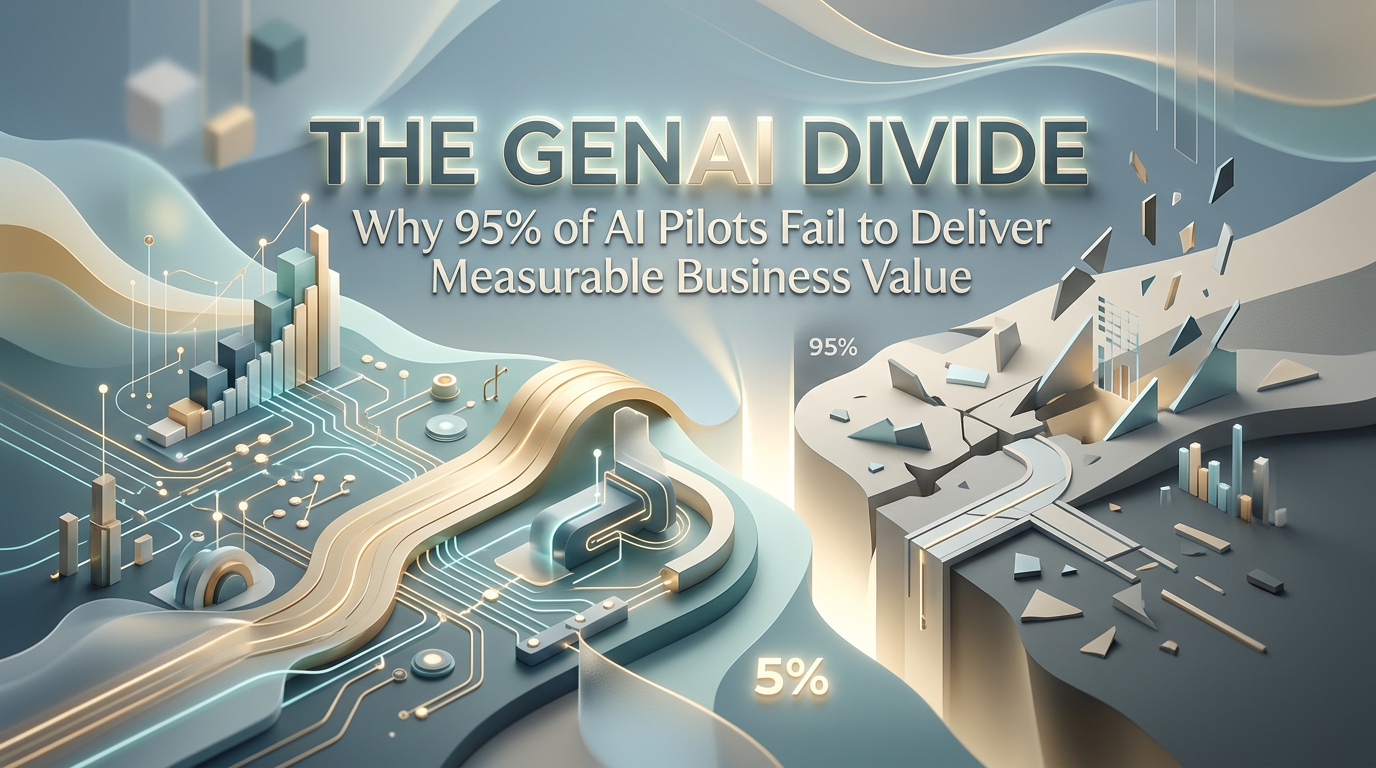
In 2025, organizations across every industry are racing to implement generative AI solutions. Billions of dollars flow into AI initiatives, yet a troubling pattern persists: the vast majority of these projects fail to deliver measurable business value. Industry estimates suggest that anywhere from 80% to 95% of AI pilots never progress beyond the experimental phase. This phenomenon has become known as the GenAI divide—the growing gap between AI potential and actual business impact.
For Sapient Code Labs, working with enterprises seeking to harness AI capabilities, this challenge is familiar territory. The disconnect between ambitious AI promises and disappointing results isn't a reflection of the technology itself, but rather a symptom of fundamental missteps in strategy, execution, and organizational readiness. Understanding why this divide exists is the first step toward bridging it.
Turning this into a shipped product is end-to-end product development.
The Harsh Reality of AI Pilot Failures
When organizations announce AI initiatives, the rhetoric often centers on transformation, disruption, and competitive advantage. However, the day-to-day reality of implementing AI tells a different story. Many companies find themselves stuck in an endless cycle of pilots and proofs of concept, unable to translate technical demonstrations into production systems that drive genuine business outcomes.
The consequences extend beyond wasted investment. Organizations that repeatedly fail with AI initiatives risk developing what experts call "AI fatigue"—a skeptical mindset that can hinder future adoption even when genuinely valuable opportunities arise. This fatigue represents a significant strategic risk in an era where competitors who successfully implement AI are gaining measurable advantages in efficiency, customer experience, and innovation.
At Sapient Code Labs, we've observed that the most successful AI implementations share common characteristics that differentiate them from failed attempts. By understanding the root causes of failure, organizations can proactively address these challenges and position their AI initiatives for success.
Why Most AI Pilots Fall Short: The Core Challenges
Several interconnected factors contribute to the alarmingly high failure rate of AI pilots. Understanding these challenges is essential for any organization seeking to navigate the GenAI divide successfully.
1. Misaligned Business Objectives
Perhaps the most fundamental issue plaguing AI initiatives is the lack of clear alignment between technical capabilities and business outcomes. Many organizations approach AI with a technology-first mindset, implementing solutions because they seem innovative or because competitors are doing so, without clearly defining what business problem they intend to solve.
Successful AI implementations begin with a deep understanding of specific business challenges. Rather than asking "how can we use AI?", organizations must ask "what business problem needs solving, and could AI help?" This seemingly simple shift in perspective dramatically increases the likelihood of success. When AI projects are tied to measurable business KPIs—revenue growth, cost reduction, customer satisfaction improvements—teams have clear targets to optimize toward.
2. Poor Data Foundation
AI systems are only as effective as the data feeding them. Organizations frequently underestimate the complexity of preparing data for AI applications. Legacy systems, siloed data repositories, inconsistent data quality, and inadequate data governance all contribute to unstable foundations for AI initiatives.
The challenge extends beyond technical data infrastructure. Many organizations lack the data literacy necessary to properly evaluate their data assets for AI applications. They may not understand what data they possess, where it resides, how it's maintained, or whether it truly represents the phenomena they want AI to analyze. Building a robust data foundation requires upfront investment in data quality, accessibility, and governance—work that isn't glamorous but is absolutely essential.
3. Underestimating Integration Complexity
AI doesn't exist in isolation. Successful implementation requires integration with existing systems, workflows, and processes. Organizations often underestimate the complexity of these integrations, treating AI as a separate initiative rather than a component of broader business transformation.
If you're still validating, start from a published MVP cost breakdown.
Integration challenges span multiple dimensions: technical compatibility with existing infrastructure, process redesign to incorporate AI outputs, and workflow adjustments to leverage new capabilities. Each of these dimensions requires careful planning and cross-functional collaboration. When organizations treat AI as an isolated technical project, they create artificial barriers that prevent the technology from delivering value within actual business contexts.
4. Insufficient Change Management
Technology alone doesn't create value—people do. Many AI implementations fail not because the technology doesn't work, but because organizational stakeholders don't adopt it effectively. Change management is frequently an afterthought rather than a core component of AI initiative planning.
Successful AI adoption requires addressing human factors comprehensively. This includes training employees to work effectively with AI tools, redesigning roles and responsibilities to incorporate new capabilities, and building organizational trust in AI-driven recommendations. Without deliberate attention to these human elements, even technically excellent AI solutions gather dust because nobody uses them in practice.
5. Unrealistic Expectations and Scope Creep
The excitement surrounding generative AI has created unrealistic expectations about what these technologies can accomplish and how quickly they can deliver results. Organizations sometimes expect AI to solve complex, ambiguous business challenges that require human judgment, when in reality AI excels at well-defined, repetitive tasks.
Scope creep compounds this challenge. Initial pilots that focus on a specific, contained use case gradually expand as stakeholders envision additional applications. While ambition is valuable, unfocused expansion分散 resources and attention, preventing any single initiative from achieving meaningful impact. Maintaining disciplined scope—starting small, proving value, then expanding methodically—is critical to breaking the failure pattern.
Strategic Approaches to Bridge the GenAI Divide
Understanding why AI pilots fail is valuable, but organizations need actionable strategies to improve their chances of success. Based on proven approaches to AI implementation, several key principles can dramatically increase the likelihood of delivering measurable business value.
Start with Business Value, Not Technology
The most successful AI implementations begin with rigorous business case development. Before any technical work begins, organizations should clearly define the specific business outcome they expect AI to influence, establish baseline metrics for comparison, and create a realistic timeline for achieving measurable results.
This approach forces discipline into AI initiatives. Rather than pursuing interesting technical possibilities, teams focus on opportunities where AI has clear advantages over existing approaches and where success can be objectively measured. When business value drives technology selection, implementation decisions become easier to make and easier to justify.
Where AI is involved in the workflow, we implement under AI agentic development.
Invest Heavily in Data Readiness
Organizations should treat data infrastructure as a prerequisite for AI success, not an afterthought. This means conducting thorough data assessments before launching AI initiatives, identifying gaps in data quality or accessibility, and implementing governance frameworks that ensure data remains reliable over time.
The investment in data readiness often exceeds initial expectations, but it pays dividends across the AI lifecycle. Organizations with strong data foundations can iterate faster, experiment more freely, and scale successful pilots more easily. Treating data as a strategic asset rather than a technical convenience transforms AI from a risky experiment into a sustainable capability.
Adopt Modular, Incremental Implementation
Rather than attempting comprehensive transformations, successful AI implementations typically follow a modular approach. Organizations identify specific, contained use cases where AI can demonstrate clear value, implement these focused solutions, measure results rigorously, and then expand methodically based on demonstrated success.
This incremental approach reduces risk dramatically. When individual use cases fail to deliver value, the failure is contained and informsa future attempts. When use cases succeed, they build organizational confidence, generate stakeholder buy-in, and create momentum for expanded adoption. The modular approach also allows organizations to learn and adapt their AI strategies based on real-world feedback rather than theoretical assumptions.
Prioritize Integration and Workflow Design
AI implementation must be approached as a business transformation initiative, not a pure technology project. This means involving operations, customer service, finance, and other business functions from the earliest planning stages. Integration points should be designed deliberately, with clear specifications for how AI outputs will be incorporated into existing workflows.
When business users participate actively in AI implementation, solutions emerge that actually fit their needs. Technical teams gain valuable insights into practical requirements, and business stakeholders develop ownership of AI outcomes. This collaboration ensures that AI implementations enhance rather than disrupt business operations.
Build Organizational AI Capabilities
Sustainable AI success requires building internal capabilities rather than depending entirely on external vendors or consultants. Organizations should invest in developing AI literacy across their workforce, creating centers of excellence that consolidate expertise, and establishing clear governance structures that guide AI adoption responsibly.
Capability building also means developing realistic expectations about AI's strengths and limitations. When organizations understand what AI can and cannot do, they can identify opportunities where AI genuinely adds value rather than forcing technology where it doesn't fit. This maturity in organizational thinking separates successful AI adopters from those trapped in endless pilot cycles.
The Path Forward: From Pilot to Production
The GenAI divide represents both a challenge and an opportunity. Organizations that recognize why most AI pilots fail and systematically address those failure modes position themselves to capture significant value from AI technologies. The key lies in moving beyond the hype-driven approach that characterizes so many failed initiatives and adopting disciplined, business-focused methodologies.
At Sapient Code Labs, we believe that successful AI implementation requires balancing technological ambition with practical execution. Organizations don't need to abandon their AI aspirations—they need to pursue those aspirations with greater rigor, discipline, and attention to the fundamentals that determine real-world success.
The organizations that will thrive in this new era aren't necessarily those with the most sophisticated AI technology or the largest AI budgets. They're the ones that approach AI implementation as a business transformation discipline, with clear objectives, realistic timelines, and unwavering focus on measurable outcomes. The GenAI divide is real, but it's not inevitable. With the right approach, organizations can cross it successfully.
If you're serious about this, a Scoping Sprint ($2,300, two weeks) gets you a prototype, technical plan and fixed quote — or contact us directly.