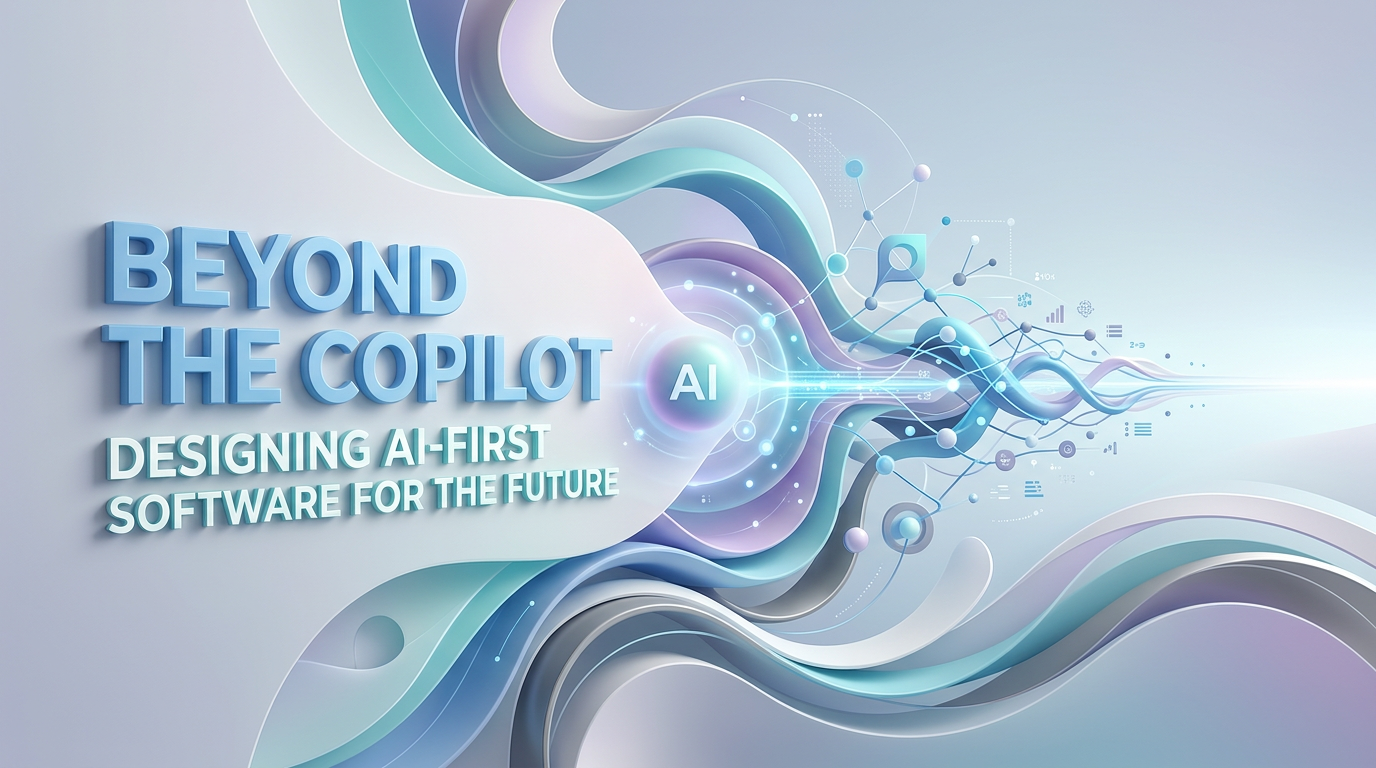
Introduction: The Evolution from Copilot to AI-First Architecture
The software development landscape is undergoing a fundamental transformation. What began as simple code completion tools has evolved into sophisticated AI assistants like GitHub Copilot, but we are now standing at the precipice of an even more dramatic shift. The question is no longer whether AI will transform software development—it is how we can design systems that are fundamentally built around AI capabilities from the ground up.
At Sapient Code Labs, we have witnessed this evolution firsthand. Our teams have moved from treating AI as a helpful sidekick to rethinking entire software architectures around artificial intelligence. This blog post explores what it truly means to design AI-first software, why it matters for your organization in 2025, and how you can begin this transformative journey.
Understanding AI-First Software Design
AI-first software design represents a paradigm shift in how we approach application architecture. Traditional software development follows a deterministic model where developers write explicit instructions for every possible scenario. AI-first design, conversely, embraces probabilistic computing—systems that learn, adapt, and make decisions based on patterns rather than rigid rules.
This approach goes far beyond implementing machine learning models into existing applications. True AI-first software is built with AI as a core architectural principle, much like how cloud-native applications were designed with distributed systems in mind. Every component, from data pipelines to user interfaces, is designed to leverage AI capabilities optimally.
The key differentiator lies in the mental model. When we design AI-first software, we start with the question: "How can AI solve this problem more effectively than traditional code?" rather than "How can we add AI to our existing solution?" This fundamental shift in perspective leads to dramatically different architectural decisions.
The Limitations of Copilot and Code Generation Tools
Before we explore the future, it is essential to understand why current AI assistants, while impressive, represent only a transitional technology. Tools like Copilot have proven invaluable for developer productivity, helping engineers write code faster and reduce boilerplate. However, they remain fundamentally reactive—waiting for developers to write code before offering suggestions.
These tools operate within the boundaries of human-provided context. They analyze existing codebases and predict the next logical code snippet, but they cannot independently plan, execute, or validate complex software tasks. Furthermore, they lack true understanding of business logic, user needs, and system interactions at a holistic level.
Perhaps most importantly, Copilot-style tools do not fundamentally change the software development process. They make individual developers more productive, but they do not transform how we architect, deploy, or maintain software systems. AI-first design, by contrast, reimagines every aspect of the software lifecycle.
Core Principles of AI-First Architecture
Building truly AI-first software requires adherence to several fundamental principles that distinguish it from traditional development approaches.
Autonomous Agent Design represents the cornerstone of AI-first architecture. Rather than building applications that require constant human intervention, AI-first systems incorporate autonomous agents capable of making decisions, executing tasks, and learning from outcomes. These agents operate with varying levels of independence, from narrow task execution to complex workflow orchestration.
Continuous Learning Systems are essential. Traditional software is static after deployment—it performs exactly as programmed. AI-first software, however, continuously improves based on real-world usage patterns, user feedback, and outcome data. This requires robust feedback loops, data collection mechanisms, and model retraining pipelines integrated directly into the application architecture.
Probabilistic Over Deterministic thinking must guide decision-making. Instead of building systems that expect precise inputs and produce exact outputs, AI-first architecture embraces probability and confidence levels. Systems can make informed decisions with partial information, express uncertainty appropriately, and handle ambiguous scenarios gracefully.
Designing for Autonomous Agents
The emergence of autonomous AI agents marks perhaps the most significant advancement in software development since object-oriented programming. These agents differ fundamentally from simple automation scripts or rule-based systems. They possess the ability to understand complex goals, decompose them into manageable tasks, execute those tasks with minimal supervision, and adapt when circumstances change.
Designing software for agentic AI requires new architectural patterns. Agent orchestration frameworks must manage multiple agents working collaboratively, each handling different aspects of complex workflows. Memory systems need to maintain context across extended interactions, enabling agents to build on previous work rather than starting fresh for each request.
Safety and guardrails become paramount in agentic systems. Unlike traditional software where bugs cause failures, autonomous agents can cause cascading effects if not properly constrained. This necessitates robust boundary systems, comprehensive monitoring, and graceful degradation strategies that maintain system integrity even when agents operate unexpectedly.
Intelligent Data Pipelines and Processing
Data forms the foundation of any AI system, and AI-first software requires fundamentally different approaches to data architecture. Static databases and simple ETL pipelines will not suffice when AI capabilities must be woven into every aspect of the application.
Modern AI-first architectures employ intelligent data pipelines that automatically enrich, transform, and prepare data for AI consumption. These pipelines can identify relevant data sources, handle missing or inconsistent information, and maintain data quality at scale without constant human oversight.
Vector databases have emerged as critical components for AI-first applications, enabling efficient similarity search and retrieval-augmented generation. These databases store embeddings—numerical representations of data—that allow AI systems to find related information rapidly, powering capabilities from semantic search to context-aware recommendations.
Human-AI Collaboration Patterns
Despite the move toward autonomy, effective AI-first design recognizes that human oversight remains essential. The challenge lies in creating collaboration patterns that leverage AI capabilities while maintaining appropriate human control and judgment.
Effective human-AI collaboration requires thoughtful interface design. Users must understand when AI is making recommendations versus decisions, and systems must provide meaningful opportunities for human override. Transparency becomes crucial—AI systems should explain their reasoning in terms humans can understand and evaluate.
Trust calibration is equally important. Systems must accurately represent their confidence levels, avoiding both overconfidence that leads to inappropriate automation and excessive uncertainty that undermines utility. This balance requires sophisticated probability modeling and careful attention to user experience.
Implementation Strategies for 2025
Organizations beginning their AI-first journey in 2025 should adopt a measured, strategic approach. Attempting to rebuild everything from scratch risks disruption without commensurate benefit. Instead, identify high-impact areas where AI capabilities can deliver transformative results.
Start with bounded AI systems that operate within well-defined boundaries. Customer service automation, document processing, and data analysis represent excellent starting points—domains where AI can deliver immediate value while remaining contained enough to manage risk effectively.
Invest in the underlying infrastructure that AI-first development requires. This includes robust MLOps platforms for model deployment and monitoring, data infrastructure capable of supporting continuous learning, and observability systems that provide visibility into AI decision-making.
Build cross-functional teams that combine software engineering expertise with AI and machine learning capabilities. AI-first development requires different skills than traditional software engineering, and organizations must cultivate talent that bridges these domains effectively.
Security and Governance in AI-First Systems
The unique characteristics of AI-first software introduce security and governance considerations that extend beyond traditional application security. Adversarial attacks against AI systems, data poisoning, and model inversion represent emerging threats that require new defensive approaches.
Governance frameworks must evolve to address AI-specific concerns. This includes policies around AI model usage, transparency requirements for AI decisions, and accountability structures when AI systems behave unexpectedly. Regulatory compliance will increasingly require demonstrable governance of AI capabilities.
Privacy considerations become more complex when AI systems can infer sensitive information from seemingly innocuous data. Privacy-preserving machine learning techniques, including federated learning and differential privacy, must be integrated into AI-first architectures from the beginning rather than added as afterthoughts.
The Future Beyond 2025
Looking beyond the immediate horizon, AI-first software will continue evolving toward increasingly sophisticated capabilities. Multimodal AI systems that seamlessly process text, images, audio, and video will become standard, enabling applications that understand and interact with the world in richer ways than current systems permit.
Edge AI will grow in importance as models become more efficient and computing devices more powerful. This will enable AI-first applications that operate with minimal latency and reduced cloud dependency, opening possibilities for real-time intelligence in previously impractical contexts.
The distinction between AI-assisted development and AI-first development will continue blurring until they become indistinguishable. Future developers will work with AI systems as partners, each contributing their distinctive capabilities to create software that neither could achieve alone.
Conclusion: Embracing the AI-First Future
The transition to AI-first software design represents one of the most significant technological shifts in computing history. Organizations that embrace this transformation thoughtfully will gain substantial competitive advantages through faster innovation, more intelligent systems, and deeper user engagement.
At Sapient Code Labs, we believe the future belongs to those who design with AI as a foundational principle rather than an optional enhancement. The journey requires investment in new skills, infrastructure, and ways of thinking, but the rewards justify the effort.
The era of AI as a copilot is ending. The era of AI-first architecture is just beginning. Now is the time to prepare your organization for this transformation, building the capabilities and mindset required to thrive in an increasingly intelligent technological landscape.