Introduction
The MERN stack (MongoDB, Express.js, React, and Node.js) has become one of the most popular technology stacks for building modern web applications. Its flexibility, performance, and unified JavaScript language make it a favorite among developers worldwide. However, as user expectations evolve and competition intensifies, integrating artificial intelligence into your MERN applications has become essential for staying ahead.
AI integration can transform your applications from simple functional tools to intelligent platforms that learn, adapt, and provide personalized experiences. Whether you want to add intelligent chatbots, predictive analytics, image recognition, or automated content generation, the right AI tools can dramatically enhance your MERN stack applications.
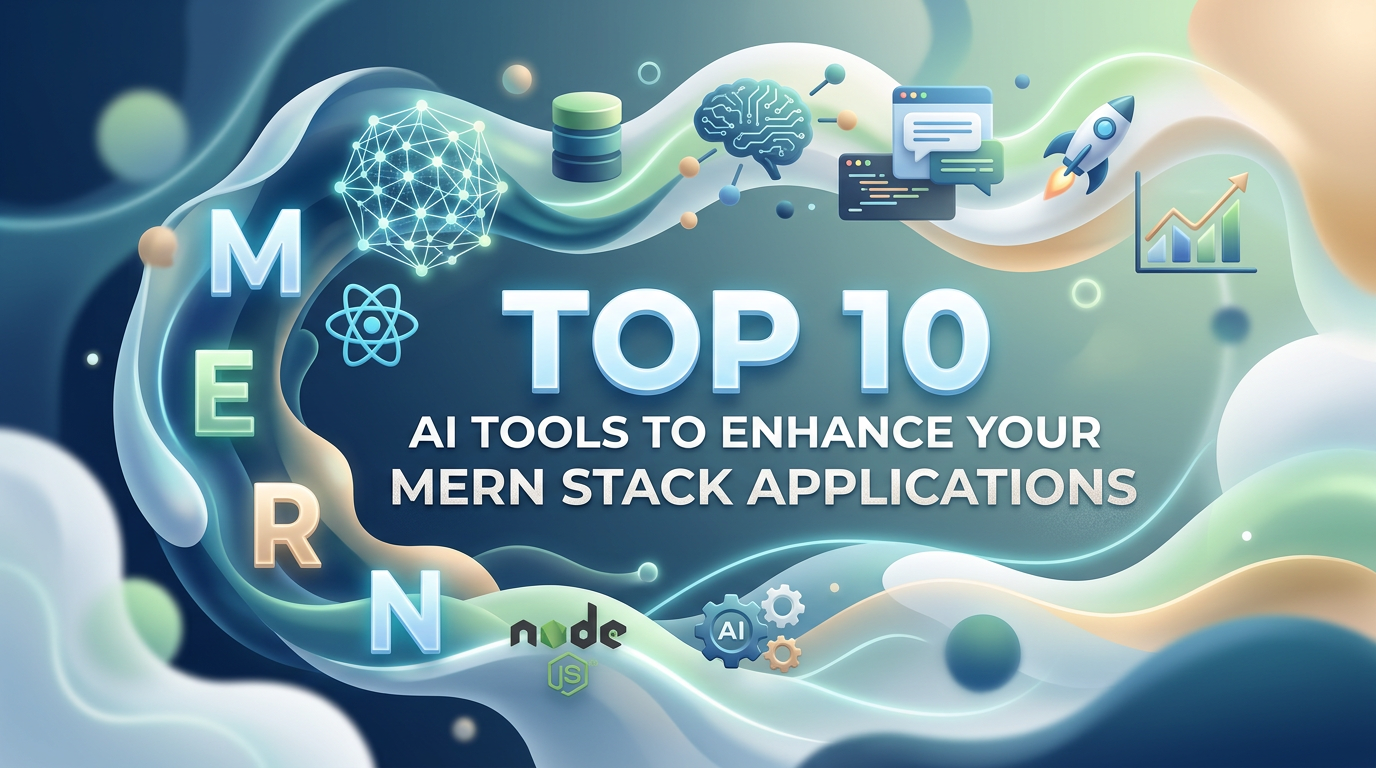
In this comprehensive guide, we'll explore the top 10 AI tools that seamlessly integrate with MERN stack applications. These tools have been selected based on their ease of integration, documentation quality, pricing models, and real-world effectiveness in production environments.
Why Integrate AI into Your MERN Stack Applications?
Before diving into the specific tools, it's crucial to understand why AI integration matters for your MERN applications. Modern users expect intelligent features such as personalized recommendations, natural language interactions, and automated problem-solving. Implementing these features manually would require extensive machine learning expertise and significant development time.
AI tools bridge this gap by providing pre-built models and APIs that developers can integrate without deep ML knowledge. This democratization of AI has made it possible for MERN stack developers to add sophisticated features to their applications in hours rather than months.
Additionally, AI can automate repetitive tasks, improve decision-making processes, and provide valuable insights through data analysis. From enhancing user experience to optimizing backend operations, AI offers numerous benefits that directly impact business outcomes.
Top 10 AI Tools for MERN Stack Applications
1. OpenAI API (GPT Models)
OpenAI's GPT models have revolutionized how we interact with applications. For MERN stack developers, the OpenAI API offers powerful natural language processing capabilities that can be easily integrated into both frontend and backend components.
Key Features:
- Advanced text generation and completion
- Conversational AI and chatbot capabilities
- Code generation and debugging assistance
- Sentiment analysis and text classification
- Multilingual support
Integration with MERN: You can integrate OpenAI API in your Node.js backend using the official SDK or REST API. For React frontend, you can create custom hooks to manage API calls efficiently. The API works exceptionally well for building intelligent chatbots, content generation features, and automated customer support systems.
2. TensorFlow.js
TensorFlow.js brings machine learning directly to the browser and Node.js environment, making it an excellent choice for MERN stack developers who want to run ML models without server-side processing.
Key Features:
- Pre-trained models available for immediate use
- Train models directly in the browser
- Support for transfer learning
- Hardware acceleration via WebGL
- Comprehensive model gallery
Integration with MERN: TensorFlow.js integrates perfectly with React for client-side ML tasks like image classification, pose detection, and gesture recognition. For Node.js applications, you can use the same library with additional performance optimizations. This tool is ideal for building interactive features that require real-time ML processing.
3. Vercel AI SDK
Vercel AI SDK is specifically designed for building AI-powered streaming user interfaces with React and Next.js. It provides a unified API for working with various LLM providers, making it perfect for MERN stack developers.
Key Features:
- Streaming responses for real-time UI updates
- Support for multiple LLM providers (OpenAI, Anthropic, Cohere)
- React hooks for easy integration
- Message history management
- TypeScript support
Integration with MERN: While traditionally associated with Next.js, Vercel AI SDK works seamlessly with any React application. You can use it to build real-time chat interfaces, AI-powered search results, and dynamic content generation features. The streaming capability significantly improves user experience by showing responses as they're generated.
4. LangChain.js
LangChain.js is an open-source framework specifically designed for building applications with large language models. It provides a robust abstraction layer that simplifies complex LLM operations for developers.
Key Features:
- Chain multiple LLM calls together
- Built-in memory for conversation context
- Vector database integration (Pinecone, Weaviate, MongoDB)
- Agent frameworks for autonomous tasks
- Prompt templates and management
Integration with MERN: LangChain.js integrates beautifully with Node.js backends in MERN applications. You can use it to build sophisticated RAG (Retrieval Augmented Generation) systems, document QA applications, and autonomous agents. Its compatibility with MongoDB makes it particularly powerful for MERN developers.
5. Hugging Face Inference API
Hugging Face offers one of the largest collections of pre-trained machine learning models through their Inference API. This platform provides access to thousands of models for various AI tasks without requiring local deployment.
Key Features:
- Access to 500,000+ models
- Support for text, image, audio, and video processing
- Zero-setup deployment
- Model fine-tuning capabilities
- Community-driven model zoo
Integration with MERN: The Hugging Face Inference API can be called from your Node.js backend or React frontend using simple HTTP requests. Popular use cases include sentiment analysis, text summarization, image generation, and speech recognition. The API is particularly valuable for tasks where you need specific ML capabilities without building models from scratch.
6. Anthropic Claude API
Anthropic's Claude API provides access to Claude, an AI assistant known for its helpful, harmless, and honest responses. It's particularly valued for its extended context window and strong reasoning capabilities.
Key Features:
- 200K token context window
- Excellent code understanding and generation
- Strong ethical guidelines
- Vision capabilities for image analysis
- Tool use and function calling
Integration with MERN: Claude API integrates with Node.js using the official Anthropic SDK. It's excellent for building intelligent coding assistants within your MERN applications, document processing systems, and complex reasoning tasks. The extended context window makes it ideal for analyzing large documents or maintaining long conversations.
7. Cohere API
Cohere provides enterprise-grade LLMs and NLP tools designed for business applications. Their API offers robust text generation, classification, and embedding capabilities optimized for production use.
Key Features:
- High-quality text generation
- Powerful text classification and clustering
- Semantic search with embeddings
- Enterprise security and compliance
- Low latency for production applications
Integration with MERN: Cohere's API integrates easily with Node.js backends. The embedding capabilities are particularly useful for building semantic search systems, recommendation engines, and content categorization features in your MERN applications. Their enterprise focus ensures reliability for business-critical applications.
8. AssemblyAI
AssemblyAI specializes in audio intelligence and speech-to-text capabilities. Their API provides accurate transcription, speaker detection, and audio analysis features.
Key Features:
- Real-time and asynchronous speech-to-text
- Speaker diarization (who spoke when)
- Audio intelligence (topics, sentiments, PII detection)
- Summarization of audio content
- Support for multiple languages
Integration with MERN: AssemblyAI can be integrated into your Node.js backend for processing audio files uploaded by users. In React applications, you can build voice-enabled interfaces, transcription services, and audio analytics dashboards. This tool is perfect for building podcast platforms, meeting transcription services, or voice-controlled applications.
9. Google Cloud AI Platform
Google Cloud AI Platform offers a comprehensive suite of AI and ML services that can be integrated into MERN applications. From pre-trained APIs to custom model training, Google Cloud provides enterprise-grade solutions.
Key Features:
- Vision AI for image analysis
- Natural Language API for text processing
- Speech-to-Text and Text-to-Speech APIs
- Vertex AI for custom ML models
- AutoML for no-code model training
Integration with MERN: Google Cloud AI services integrate via their client libraries in Node.js. You can easily add image recognition, language translation, and speech capabilities to your applications. The platform scales automatically, making it suitable for applications of any size.
10. Azure AI Services
Microsoft Azure AI Services provides a robust set of cognitive services that integrate seamlessly with MERN stack applications. With enterprise-grade security and global availability, Azure is ideal for business applications.
Key Features:
- Azure OpenAI Service (GPT models on Azure)
- Azure Computer Vision
- Azure Speech Service
- Azure Language Understanding (LUIS)
- Azure Form Recognizer
Integration with MERN: Azure AI services integrate with Node.js through the Azure SDK. The Azure OpenAI Service is particularly attractive as it provides OpenAI models with enterprise compliance, security, and regional availability. This is an excellent choice for organizations already using Microsoft ecosystem tools.
How to Choose the Right AI Tool for Your MERN Application
Selecting the appropriate AI tool depends on several factors specific to your project requirements. Consider the following criteria when making your decision:
1. Use Case Alignment: Different tools excel at different tasks. If you need conversational AI, OpenAI or Claude would be ideal. For semantic search, Cohere embeddings work excellently. Match the tool's strengths to your specific requirements.
2. Integration Complexity: Consider your team's expertise and available development time. Tools with official Node.js SDKs and comprehensive documentation will reduce integration complexity significantly.
3. Cost Considerations: AI services typically charge based on usage (API calls, compute time, or tokens). Evaluate pricing models and estimate costs for your expected user base. Some tools offer generous free tiers suitable for development and testing.
4. Scalability Requirements: Ensure the chosen tool can handle your application's projected growth. Managed services like Google Cloud AI and Azure AI offer automatic scaling, while self-hosted solutions require additional infrastructure planning.
5. Data Privacy and Compliance: For applications handling sensitive data, verify that the AI provider meets required compliance standards (GDPR, HIPAA, SOC 2, etc.).
Best Practices for AI Integration in MERN Applications
When integrating AI into your MERN stack applications, following best practices ensures optimal performance, maintainability, and user experience:
Implement Proper Error Handling: AI APIs can occasionally fail or return unexpected results. Implement robust error handling, retry mechanisms, and user-friendly fallback options to maintain application reliability.
Optimize API Calls: Reduce latency by implementing caching strategies, using appropriate API parameters, and considering client-side processing when feasible (like TensorFlow.js).
Secure Your API Keys: Never expose AI service credentials in client-side code. Use environment variables and server-side proxy endpoints to protect your keys.
Monitor Usage and Costs: Implement logging and monitoring to track AI API usage, response times, and associated costs. Set up alerts for unusual patterns or spending thresholds.
Provide Progressive Enhancement: Design your application so that AI features enhance the experience without being critical path requirements. This ensures the application remains functional even during AI service interruptions.
Conclusion
Integrating AI into your MERN stack applications no longer requires specialized machine learning expertise. The tools and APIs discussed in this guide provide powerful capabilities that can be implemented by any MERN stack developer willing to learn a few new APIs.
From natural language processing with OpenAI and Claude to machine learning in the browser with TensorFlow.js, and from speech recognition with AssemblyAI to enterprise AI services from Google Cloud and Microsoft Azure, there's an AI tool for every use case and budget.
As AI technology continues to evolve rapidly, staying informed about the latest tools and best practices will help you build more intelligent, responsive, and valuable applications. Start small, experiment with one AI integration, and gradually expand as you understand the capabilities and limitations of these powerful tools.
The future of web development is intelligent, and with these AI tools, MERN stack developers are well-equipped to build the next generation of smart applications.