Introduction: The Scaling Challenge for Growing Startups
Every successful startup eventually faces a critical inflection point: the moment when rapid user growth overwhelms existing systems and threatens to collapse under its own success. What worked beautifully for 1,000 users often crumbles when that number climbs to 100,000 or beyond. This scaling challenge has sent many promising companies spiraling into technical debt, service outages, and disappointed customers.
Enter artificial intelligence—a transformative force that is fundamentally changing how startups approach enterprise-scale software development. AI is no longer a luxury reserved for tech giants; it has become an essential toolkit for growing companies seeking to scale efficiently without sacrificing quality or user experience. At Sapient Code Labs, we've witnessed firsthand how AI-powered solutions are democratizing enterprise-grade performance for startups at every growth stage.
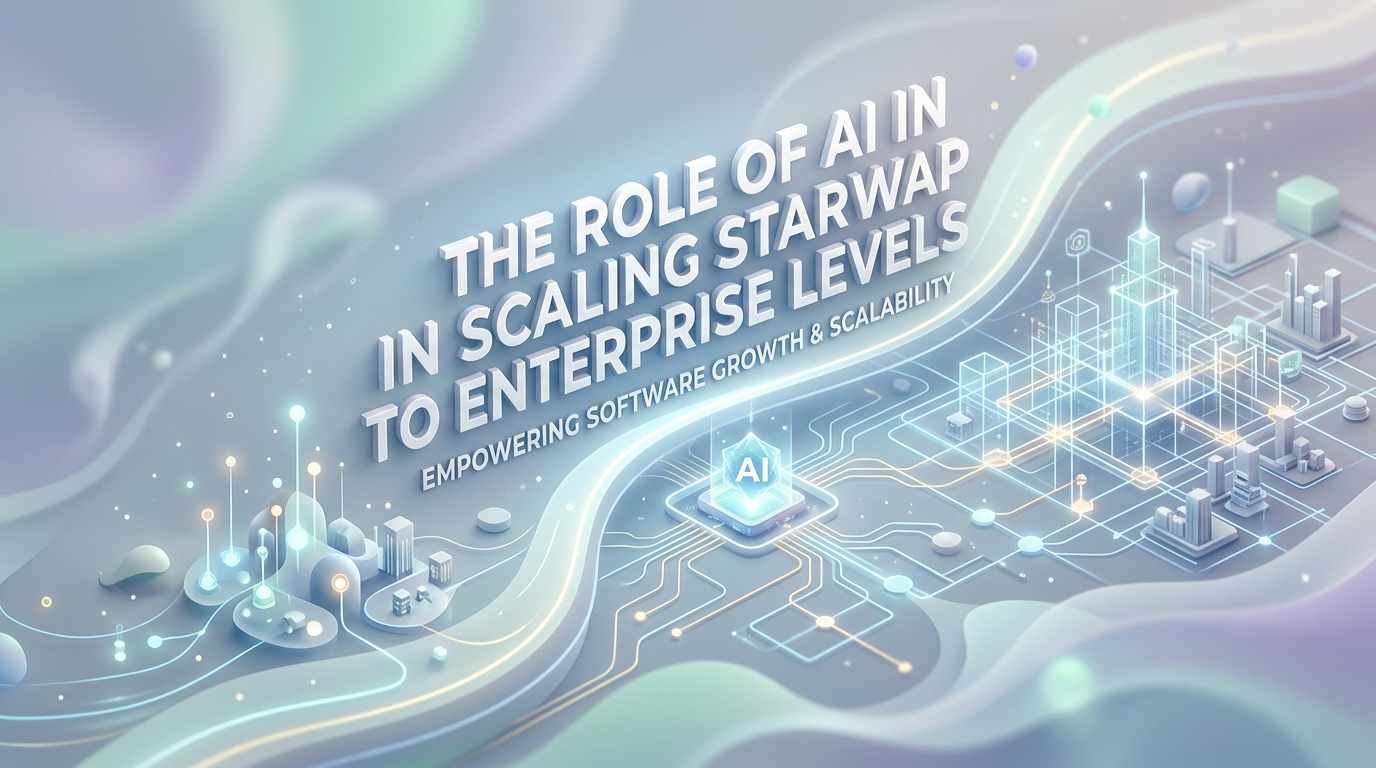
This comprehensive guide explores the multifaceted role of AI in scaling startup software to enterprise levels, examining the technologies, strategies, and best practices that modern development teams are leveraging to achieve sustainable growth.
Understanding the Scaling Imperative
Before diving into AI solutions, it's crucial to understand what scaling actually means in the context of software development. Scaling isn't simply about handling more users—it's about maintaining performance, reliability, and user experience while accommodating growth across multiple dimensions: data volume, transaction frequency, geographic distribution, and feature complexity.
Traditional scaling approaches often involve throwing hardware at the problem, implementing complex microservices architectures, or hiring entire teams dedicated to infrastructure management. While these approaches have merit, they come with significant costs, complexity, and operational overhead. AI offers a fundamentally different paradigm—one where software systems become intelligent enough to adapt, optimize, and scale themselves with minimal human intervention.
AI-Powered Infrastructure Optimization
One of the most immediate applications of AI in scaling startup software lies in infrastructure optimization. Modern AI systems can analyze usage patterns, predict traffic spikes, and automatically allocate resources to meet demand in real-time. This dynamic resource management eliminates the need for over-provisioning while preventing the service degradations that occur when demand outpaces capacity.
Machine learning algorithms can identify inefficiencies in cloud resource allocation, suggesting right-sizing recommendations that can reduce infrastructure costs by 30-50% while improving performance. These systems learn from historical data to predict seasonal fluctuations, marketing campaign impacts, and organic growth trends, enabling proactive scaling rather than reactive crisis management.
Container orchestration platforms enhanced with AI can automatically distribute workloads across available resources, balance traffic loads, and recover from failures without human intervention. This autonomous management capability is essential for startups that lack dedicated DevOps teams but need enterprise-grade reliability.
Automated Testing and Quality Assurance at Scale
As software systems grow in complexity, traditional testing approaches become unsustainable. Manual testing cannot keep pace with continuous deployment cycles, and conventional automated testing often lacks the intelligence to identify subtle regressions or predict the impact of code changes on system behavior.
AI-powered testing frameworks are revolutionizing quality assurance by generating intelligent test cases, identifying high-risk code paths, and prioritizing test execution based on potential impact. These systems use historical data to identify which tests are most likely to catch bugs in specific code changes, dramatically reducing test execution time while improving bug detection rates.
Visual regression testing powered by computer vision can detect UI changes that might escape traditional functional tests, ensuring that user experience remains consistent as systems evolve. Similarly, AI-driven performance testing can simulate realistic user loads, identify bottlenecks, and predict system behavior under stress conditions.
Intelligent Data Management and Processing
Enterprise-level software generates enormous volumes of data, and managing this data effectively is crucial for both performance and business intelligence. AI transforms data management from a bottleneck into a competitive advantage through intelligent indexing, automated data partitioning, and predictive caching strategies.
Query optimization powered by machine learning can analyze billions of query patterns to automatically optimize database performance. These systems learn which queries benefit from which indexes, how to partition data for optimal access patterns, and when to implement caching layers—all without manual intervention.
Data pipeline automation enables startups to process streaming data at scale, implementing real-time analytics and personalization features that would otherwise require dedicated engineering teams. AI can automatically detect data quality issues, suggest corrections, and adapt processing logic as data patterns evolve.
AI-Driven Customer Experience Scaling
Scaling user experience is perhaps the most visible challenge in growth-stage startups. As user bases expand, maintaining personalized, responsive interactions becomes increasingly difficult. AI provides solutions at every layer of the customer experience stack.
Intelligent chatbots and support automation can handle exponential growth in customer inquiries without proportional increases in support staff. Modern AI conversational systems understand context, escalate appropriately, and continuously learn from interactions to improve response quality. This enables startups to provide enterprise-level support while maintaining the agility and personalization that define great user experiences.
Recommendation engines and personalization systems powered by AI enable businesses to deliver tailored experiences at scale. These systems analyze user behavior in real-time, adapting content, product suggestions, and interface elements to individual preferences without the engineering overhead of building and maintaining rule-based personalization systems.
AI-powered content delivery networks can optimize media delivery based on user location, device capabilities, and network conditions, ensuring consistent experience quality across diverse user populations.
Predictive Analytics for Proactive Scaling
Traditional scaling approaches are inherently reactive—systems scale after problems occur. AI enables a proactive paradigm where systems predict and prevent scaling issues before they impact users.
Predictive analytics models analyze historical patterns to forecast resource needs days or weeks in advance. These predictions account for seasonal trends, marketing campaigns, product launches, and organic growth trajectories, enabling teams to prepare infrastructure proactively.
Anomaly detection systems continuously monitor system behavior, identifying deviations that might indicate emerging issues. By catching problems in their infancy, teams can address root causes before they cascade into user-impacting incidents.
Capacity planning AI can model the impact of various growth scenarios, helping stakeholders understand infrastructure requirements and budget accordingly. These models become more accurate over time as they learn from actual system behavior and business outcomes.
Security at Enterprise Scale
Security scaling presents unique challenges—threats become more sophisticated as attack surfaces expand, and the cost of security breaches grows with user trust and regulatory requirements. AI has emerged as an essential layer in enterprise security architectures.
Machine learning-based threat detection can identify patterns that indicate malicious activity, even in previously unknown attack vectors. These systems analyze network traffic, user behavior, and system logs to detect anomalies that would escape rule-based security systems.
Automated vulnerability scanning and penetration testing powered by AI can continuously assess system security posture, prioritizing findings based on actual exploitability rather than theoretical severity. This enables security teams to focus on the most critical issues without drowning in false positives.
Identity and access management systems enhanced with AI can detect credential compromise, identify insider threats, and adapt access policies based on contextual risk factors. This intelligent approach to security enables organizations to balance protection with user convenience.
Implementation Strategies for AI-Powered Scaling
Adopting AI for scaling requires thoughtful implementation strategies that balance immediate needs with long-term architecture decisions. At Sapient Code Labs, we recommend a phased approach that delivers incremental value while building toward comprehensive AI integration.
Start with high-impact, low-complexity use cases such as automated infrastructure monitoring, intelligent alerting, and basic performance optimization. These initial implementations build organizational confidence and generate data that informs more sophisticated AI applications.
Invest in data infrastructure early. AI systems are only as effective as the data they can access. Building robust data collection, storage, and processing pipelines early in the scaling journey pays dividends as AI adoption matures.
Choose AI platforms and tools that integrate with existing development workflows. The best AI solutions enhance rather than replace existing processes, integrating seamlessly with CI/CD pipelines, monitoring systems, and development tools.
Build internal expertise gradually. While AI can provide significant automation, human oversight remains essential for strategic decisions, edge case handling, and continuous improvement. Develop team capabilities alongside technological capabilities.
Conclusion: The AI-Powered Scaling Future
The journey from startup to enterprise is no longer a linear path marked by incremental infrastructure upgrades and ever-larger engineering teams. AI has fundamentally transformed what's possible, enabling even early-stage companies to deliver enterprise-grade experiences while maintaining the agility that drives innovation.
At Sapient Code Labs, we believe AI-powered scaling represents the future of software development. By embracing these technologies thoughtfully and strategically, growing companies can achieve sustainable growth without sacrificing the user experiences and operational excellence that made them successful in the first place.
The organizations that thrive in the coming decade will be those that view AI not as a technical luxury but as a core component of their growth strategy. Whether you're just beginning to grapple with scaling challenges or looking to optimize your enterprise operations, AI offers powerful tools to transform how you build, deploy, and operate software at scale.