Introduction: The Customer Support Crisis
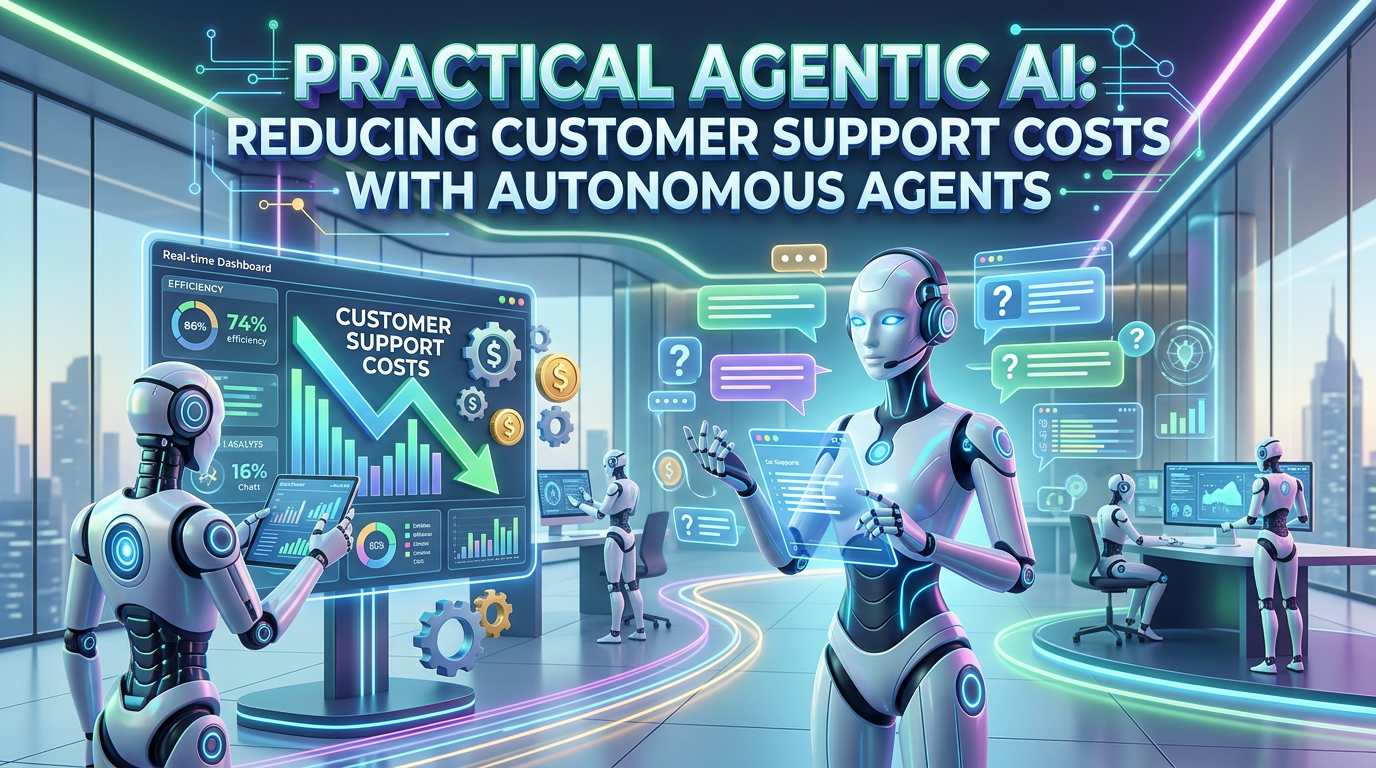
Customer support has always been the backbone of customer retention, yet it remains one of the most expensive operational areas for businesses. Between staffing costs, training expenses, turnover rates, and the challenge of scaling during peak periods, companies are constantly searching for solutions that can deliver exceptional support without breaking the bank. Enter Agentic AI—a revolutionary approach that's transforming how businesses handle customer interactions.
Agentic AI refers to autonomous AI systems that can perceive their environment, make decisions, and take actions to achieve specific goals without constant human intervention. Unlike traditional chatbots that follow rigid scripts, Agentic AI agents can understand context, learn from interactions, and handle complex customer issues independently. For Sapient Code Labs, implementing these systems has helped clients reduce customer support costs by up to 70% while simultaneously improving customer satisfaction scores.
Production agents need auth, audit, evaluation and integration — that's AI agentic development.
Understanding Agentic AI in Customer Support
At its core, Agentic AI combines large language models with reasoning capabilities, tool use, and persistent memory to create AI agents that function like skilled human support representatives. These agents don't just respond to queries—they understand intent, access relevant information from multiple sources, execute solutions, and follow through to ensure issues are resolved.
What sets Agentic AI apart from conventional automation is its ability to handle ambiguity and complexity. A traditional FAQ bot might struggle with a customer who describes their issue in vague terms or has a problem that spans multiple systems. An autonomous agent, however, can ask clarifying questions, access databases across your organization, and coordinate solutions that previously required human intervention.
Modern AI agents can understand sentiment, recognize when a situation requires escalation to a human agent, and maintain context across multiple interactions. They work around the clock, handling thousands of conversations simultaneously without the fatigue or inconsistency that affects human agents.
The True Cost of Traditional Customer Support
To appreciate the value of Agentic AI, we must first understand what traditional customer support truly costs. The visible expenses—agent salaries, training programs, infrastructure, and software licenses—are only the beginning. Hidden costs often exceed these visible expenses significantly.
Agent Turnover: The customer support industry experiences turnover rates of 30-45% annually. Each departed agent represents recruitment costs, training investments of 4-8 weeks, and the productivity loss during the learning curve. Companies spend an average of $4,000-$10,000 replacing a single support agent.
Scale Limitations: During product launches, seasonal peaks, or viral moments, traditional support teams simply cannot scale fast enough. The resulting response delays lead to customer frustration, lost sales, and reputational damage that far exceeds the cost of the support operation itself.
Inconsistency: Human agents, no matter how well-trained, provide inconsistent experiences. Knowledge gaps, mood variations, and interpretation differences mean that identical issues may receive different resolutions. This inconsistency erodes customer trust and increases escalation rates.
Opportunity Cost: Your most experienced support agents—the ones capable of providing strategic insights and handling complex issues—are often bogged down handling routine queries that could be automated. This misallocation of talent represents a significant hidden cost.
How Agentic AI Reduces Support Costs
Agentic AI addresses these cost drivers through several interconnected mechanisms that work together to create exponential savings.
Immediate Response, Zero Wait Times: AI agents handle thousands of conversations simultaneously, eliminating queue times entirely. Customers receive instant responses regardless of time of day or volume spikes. This immediate response capability alone can reduce average handling costs by 40-60%.
Intelligent Triage and Routing: Not every customer issue requires the same level of expertise. Agentic AI can accurately categorize and prioritize incoming requests, handling straightforward issues autonomously while intelligently escalating complex problems to human agents. This ensures your skilled agents focus on high-value interactions.
Consistent, Accurate Information: AI agents draw from your entire knowledge base, providing consistent answers that reflect your current policies and procedures. They eliminate the variation that comes from individual agent knowledge gaps and ensure every customer receives accurate information.
We treat the surrounding product as end-to-end product development, not a separate science project.
Continuous Learning and Improvement: Unlike human agents who require formal training programs, AI agents continuously improve through every interaction. They learn from successful resolutions, adapt to new products and policies automatically, and never forget best practices.
Multilingual Support Without Markup: AI agents communicate fluently in dozens of languages without the premium pricing typically associated with multilingual support teams. This enables global support operations at local costs.
Key Features of Effective AI Support Agents
Not all AI implementations are created equal. The most effective Agentic AI systems share several critical characteristics that distinguish them from basic chatbots.
Contextual Understanding: Effective AI agents understand the full context of customer interactions—not just the current message, but the history of the relationship, previous support tickets, and relevant account information. This contextual awareness enables personalized, relevant responses.
Tool Integration: Autonomous agents can execute actions across your tech stack. They can process refunds, update account information, check order status, schedule appointments, and more—all within the conversation. This action capability transforms support from information provision to problem resolution.
Safe Escalation: The best AI agents recognize their limitations. They detect when a situation requires human empathy, legal considerations, or specialized expertise and seamlessly transfer the conversation with full context to a human agent.
Self-Correction Capabilities: When an AI agent makes an error—or when a customer indicates dissatisfaction—it can acknowledge the issue, correct its approach, and learn from the interaction to prevent similar issues in the future.
Compliance and Security: Enterprise-grade AI agents maintain strict data handling protocols, ensuring sensitive customer information remains protected while still providing personalized support.
Implementation Best Practices
Successfully deploying Agentic AI requires strategic planning and thoughtful execution. Based on our experience helping clients implement these systems, we've identified several best practices that separate successful implementations from costly failures.
Start with High-Volume, Low-Complexity Queries: Begin by automating the most frequent, straightforward queries that currently consume your agents' time. This approach delivers immediate ROI while your team builds confidence and expertise with the technology.
Invest in Knowledge Base Quality: AI agents are only as good as the information they can access. Before deployment, audit and organize your knowledge base, ensuring information is accurate, comprehensive, and structured for AI consumption.
Use our SaaS development cost guide to budget the product shell around the models.
Design the Human-AI Handoff: Define clear criteria for when AI should escalate to human agents. Map out the information that must transfer during handoffs to ensure seamless customer experiences. This human-AI collaboration model often delivers better results than full automation.
Implement Feedback Loops: Create mechanisms for customers and human agents to provide feedback on AI performance. Use this feedback to continuously improve agent capabilities and identify gaps in coverage.
Monitor Performance Metrics: Track resolution rates, escalation rates, customer satisfaction scores, and cost per interaction. These metrics will guide optimization efforts and demonstrate ROI to stakeholders.
Measuring ROI and Success
Proving the value of Agentic AI requires robust measurement across multiple dimensions. Companies that track the right metrics can demonstrate clear ROI and identify opportunities for further optimization.
Cost Reduction Metrics: Measure cost per interaction before and after implementation, tracking savings from reduced agent handling time, lower escalation rates, and decreased need for agent staffing. Most clients see cost reductions of 40-70% within the first year.
Customer Satisfaction: Monitor CSAT scores, NPS, and customer effort scores to ensure automation improves—not harms—the customer experience. The best implementations maintain or improve satisfaction while reducing costs.
Operational Efficiency: Track metrics like average handling time, first contact resolution rate, and queue times. These operational metrics reveal how AI agents are improving overall support efficiency.
Agent Productivity: Measure how your human agents' time is reallocated. When AI handles routine queries, your team can focus on complex issues, high-value customers, and strategic initiatives that drive business growth.
The Future of AI in Customer Support
Agentic AI is not a static technology—it continues evolving at a rapid pace. Looking ahead to 2026 and beyond, we anticipate several developments that will further enhance these capabilities.
AI agents will become increasingly proactive, reaching out to customers before issues escalate based on behavioral signals and predictive analytics. Multimodal capabilities will enable agents to process and generate text, voice, and visual content seamlessly. Deeper integration with enterprise systems will allow AI agents to not just recommend actions but execute complex workflows across multiple platforms.
Perhaps most significantly, the boundary between support and other business functions will blur. AI agents will handle not just reactive support but proactive customer success activities, upselling, and retention efforts—transforming support from a cost center to a revenue driver.
Conclusion
The transformation of customer support through Agentic AI is not a distant future possibility—it's happening now, and companies that embrace this technology are already seeing dramatic reductions in costs while improving customer satisfaction. The key lies in thoughtful implementation that augments human capabilities rather than simply replacing them.
For businesses ready to transform their support operations, the path forward is clear: start with high-volume, repetitive queries, invest in knowledge infrastructure, design effective human-AI collaboration, and measure obsessively. With the right approach, Agentic AI can reduce support costs by 50-70% while delivering faster, more consistent, and more personalized customer experiences.
At Sapient Code Labs, we specialize in helping businesses navigate this transformation. Our team has implemented Agentic AI solutions across industries, from e-commerce to financial services, delivering measurable results within months of deployment. Whether you're exploring your first AI implementation or looking to optimize an existing system, our expertise can help you achieve sustainable cost reduction while elevating the customer experience.
Building production AI agents? A Scoping Sprint ($2,300, two weeks) ends with a clickable prototype, a technical plan and a fixed quote — or just start a conversation.