Introduction: The Rise of Intelligent Automation
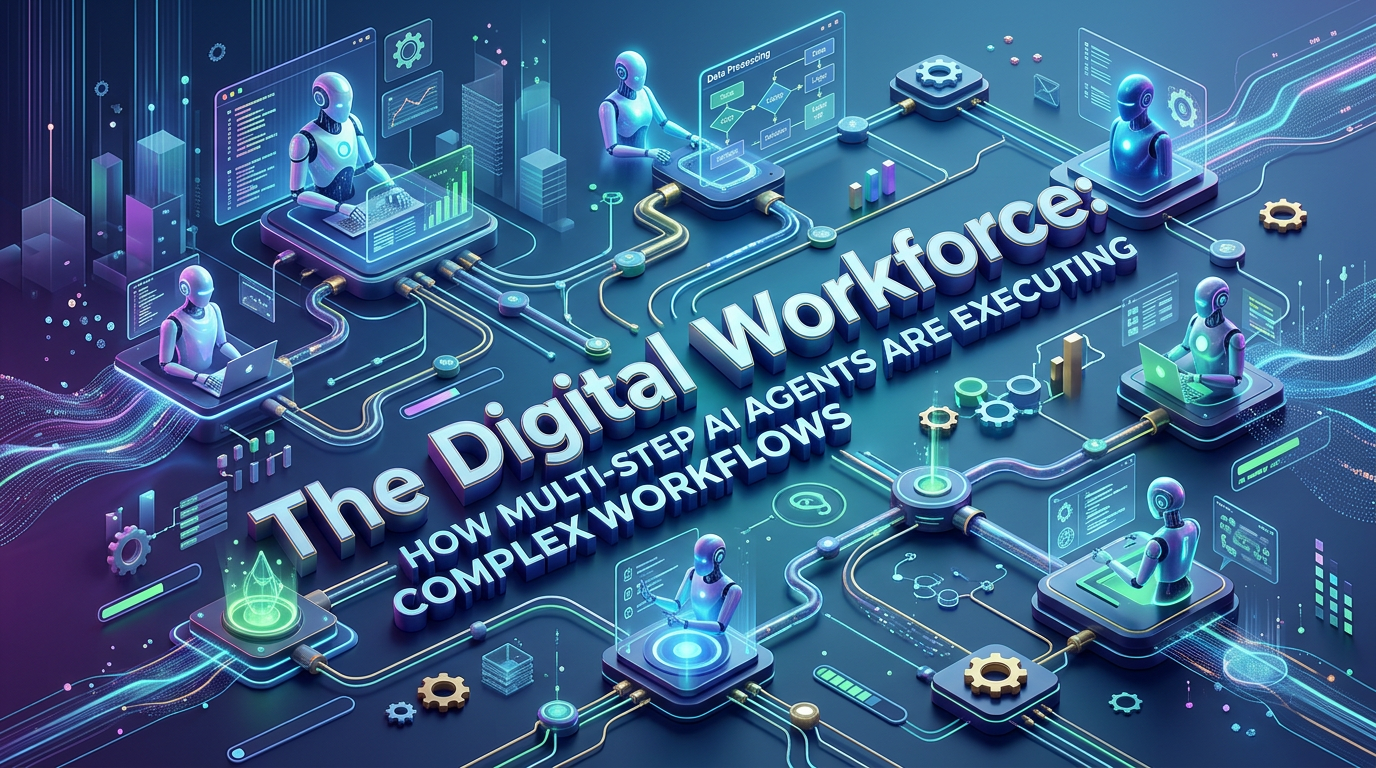
The landscape of business operations is undergoing a profound transformation. Organizations are no longer satisfied with simple automation scripts that perform repetitive tasks in a linear fashion. Instead, they are embracing a new generation of artificial intelligence systems capable of reasoning, adapting, and executing multi-step workflows with minimal human intervention. These systems represent the emergence of what we call the digital workforce — a collection of AI agents working in concert to handle complex business processes that traditionally required human intelligence.
Multi-step AI agents represent a fundamental shift from traditional automation. Unlike rule-based systems that follow predetermined paths, these intelligent agents can make decisions, handle exceptions, learn from outcomes, and collaborate with other agents to accomplish goals that span multiple systems and require diverse skill sets. This evolution is reshaping how companies approach everything from customer service and data analysis to software development and supply chain management.
Understanding Multi-Step AI Agents
At their core, multi-step AI agents are sophisticated software systems designed to break down complex objectives into manageable sequences of actions. Unlike simple chatbots or basic automation tools, these agents possess the capability to understand context, maintain state across multiple interactions, and dynamically adjust their approach based on intermediate results.
A multi-step AI agent typically operates through a cycle of perception, reasoning, and action. The agent perceives its environment through various inputs — which could be user requests, API responses, database queries, or data from connected systems. It then reasons about the best course of action, drawing on large language models, trained algorithms, and built-in knowledge bases. Finally, it takes action, whether that means querying a database, sending a notification, updating a record, or delegating a subtask to another agent.
What distinguishes multi-step agents from their simpler counterparts is their ability to handle long-running workflows that may span hours, days, or even weeks. An agent processing an insurance claim, for example, might need to gather documents from multiple sources, verify information across different systems, assess risk using multiple models, generate reports, and coordinate with human reviewers — all while maintaining context and handling exceptions gracefully.
How Multi-Step Agents Execute Complex Workflows
The execution of complex workflows by AI agents follows a sophisticated architecture that combines several key capabilities. Understanding these mechanisms is essential for organizations looking to implement these systems effectively.
Task Decomposition and Planning
When presented with a complex objective, multi-step AI agents first break down the task into smaller, manageable subtasks. This process, known as task decomposition, allows the agent to create a roadmap for accomplishing the overall goal. The agent identifies dependencies between tasks, determines the optimal sequence of operations, and allocates appropriate resources to each subtask.
For instance, when processing a loan application, an agent might decompose the task into identity verification, credit history analysis, employment verification, property appraisal coordination, risk assessment, and final approval routing. Each of these subtasks may involve multiple steps themselves, creating a hierarchical workflow structure.
State Management and Memory
Complex workflows require maintaining context across multiple steps and potentially long time periods. Multi-step AI agents employ sophisticated state management mechanisms to track progress, store intermediate results, and preserve relevant information throughout the workflow. This persistent memory allows agents to handle interruptions, recover from failures, and maintain coherent behavior across extended operations.
Modern implementations often utilize vector databases and retrieval-augmented generation (RAG) techniques to maintain semantic memory, allowing agents to access relevant historical context and make informed decisions based on accumulated knowledge.
Tool Use and System Integration
The true power of multi-step AI agents emerges from their ability to interact with external systems and tools. Through carefully designed APIs and integrations, agents can query databases, call external services, manipulate files, send communications, and perform virtually any action that can be programmatically executed.
This tool-use capability transforms AI agents from passive responders into active participants in business processes. An agent can autonomously gather data from a CRM system, cross-reference it with information from an ERP system, analyze the combined dataset using analytical tools, and then update records in both systems based on its findings.
Error Handling and Exception Management
Complex workflows inevitably encounter errors, missing information, and unexpected conditions. Multi-step AI agents are designed with robust error handling mechanisms that allow them to respond appropriately to various failure modes. Rather than simply failing outright, these agents can attempt alternative approaches, escalate issues to human operators when necessary, and gracefully recover from errors to complete the overall objective.
This resilience is critical for enterprise deployments where workflow failures can have significant operational and financial consequences.
Key Technologies Enabling AI Agent Workflows
The emergence of capable multi-step AI agents is built upon several technological advances that have converged to make these systems practical and powerful.
Large Language Models as Reasoning Engines
The foundation of modern AI agents is the large language model (LLM). These models provide the reasoning capability that allows agents to understand complex instructions, make judgments about appropriate actions, and generate contextually appropriate responses. Models like GPT-4 and their successors have demonstrated remarkable capabilities in zero-shot and few-shot learning, enabling agents to handle novel situations without explicit programming for every contingency.
Agent Frameworks and Orchestration
Specialized frameworks have emerged to facilitate the development and deployment of AI agents. These frameworks provide abstractions for common agent patterns, including conversation management, tool calling, memory management, and multi-agent collaboration. Popular frameworks such as LangChain, AutoGen, and custom implementations from major AI providers give developers the building blocks needed to construct sophisticated agent systems.
Vector Databases and Knowledge Retrieval
Effective AI agents require access to relevant information beyond their training data. Vector databases enable semantic search across large document collections, allowing agents to retrieve contextually relevant information to inform their decisions. This capability is essential for grounding agent responses in organizational knowledge and ensuring accuracy across specialized domains.
Real-World Applications and Use Cases
Multi-step AI agents are finding applications across virtually every industry and functional area. Organizations are discovering that these systems can handle increasingly complex processes while maintaining quality and efficiency.
Customer Service and Support
AI agents are transforming customer service by handling end-to-end resolution of support tickets. Rather than simply providing scripted responses, modern agents can investigate issues across multiple systems, identify root causes, propose solutions, implement fixes where possible, and follow up to ensure satisfaction. These agents can handle multi-turn conversations that span hours or days, maintaining context and providing consistent updates to customers.
Software Development and DevOps
In software development, AI agents are automating complex workflows including code review, testing, deployment, and incident response. These agents can analyze code changes, identify potential issues, suggest improvements, execute test suites, and manage deployment pipelines. When incidents occur, AI agents can gather relevant logs and metrics, analyze the situation, and either resolve the issue automatically or prepare detailed briefings for human engineers.
Financial Services and Compliance
The financial services industry has embraced AI agents for their ability to handle complex, regulated processes. Agents can process loan applications by gathering required documentation, verifying information across multiple data sources, assess credit risk using multiple models, ensure regulatory compliance, and generate required disclosures. The ability of agents to maintain detailed audit trails and make consistent decisions makes them particularly valuable in this highly regulated environment.
Human Resources and Employee Lifecycle
HR departments are deploying AI agents to handle employee onboarding, benefits administration, and performance management processes. These agents can guide new hires through required paperwork, coordinate with IT for equipment provisioning, schedule training sessions, and answer benefits questions — all while maintaining a personalized experience that adapts to each employee's needs and preferences.
Benefits for Business Operations
The adoption of multi-step AI agents delivers substantial benefits across multiple dimensions of business operations.
Operational Efficiency
AI agents can process tasks continuously, 24 hours a day, 7 days a week, without the limitations of human attention and stamina. They can handle spikes in demand by scaling horizontally, processing multiple concurrent workflows without the need to hire additional staff. This efficiency translates directly into cost savings and improved throughput.
Consistency and Quality
While human workers may vary in their approach based on fatigue, mood, or experience level, AI agents apply consistent processes and decision criteria across every interaction. This consistency improves quality, reduces errors, and ensures that established best practices are followed uniformly.
Scalability
Multi-step AI agents can scale rapidly to handle increased workload without the delays associated with hiring and training new employees. This scalability is particularly valuable for organizations experiencing rapid growth or seasonal fluctuations in demand.
Employee Satisfaction
By handling routine and repetitive tasks, AI agents free human employees to focus on more strategic, creative, and fulfilling work. This shift can improve employee satisfaction, reduce turnover, and allow organizations to make better use of their skilled talent.
Implementation Considerations
Successfully deploying multi-step AI agents requires careful planning and consideration of several factors.
Process Analysis and Design
Before implementing AI agents, organizations should thoroughly analyze their existing workflows to identify processes suitable for automation. Not all processes are equally suited for agent-based automation. Ideal candidates are those that are rule-defined, high-volume, time-consuming, and prone to human error.
Human-in-the-Loop Design
Even the most capable AI agents benefit from human oversight, particularly for high-stakes decisions. Organizations should design appropriate checkpoints where human review is required or where agents can seek clarification when encountering ambiguous situations.
Security and Governance
AI agents often handle sensitive data and perform privileged operations. Robust security measures, including proper authentication, authorization, and audit logging, are essential. Organizations should also establish governance frameworks that define acceptable agent behaviors and provide mechanisms for monitoring and control.
Monitoring and Continuous Improvement
Deploying AI agents is not a set-and-forget endeavor. Organizations need robust monitoring to track agent performance, identify issues, and gather feedback for continuous improvement. This includes metrics on task completion rates, error rates, processing times, and user satisfaction.
The Future of Digital Workforces
We are only at the beginning of the AI agent revolution. As capabilities continue to advance, we can expect agents to become more capable, more autonomous, and more deeply integrated into business operations. Future agents will likely feature improved reasoning capabilities, better memory and context management, and enhanced ability to collaborate with both humans and other agents.
The concept of digital workforces — collections of specialized AI agents working together to handle complex organizational functions — will become increasingly prevalent. These digital workforces will complement human teams, handling the routine while humans focus on strategy, innovation, and relationship-building.
Conclusion
Multi-step AI agents represent a transformative technology that is reshaping how organizations approach automation and workforce management. By combining advanced AI capabilities with robust workflow orchestration, these agents can handle complex tasks that previously required significant human intervention. The benefits — including improved efficiency, consistency, scalability, and employee satisfaction — make them an attractive option for organizations looking to modernize their operations.
As the technology continues to mature, we can expect to see even more sophisticated applications and deeper integration into business processes. Organizations that embrace this technology thoughtfully and strategically will be well-positioned to compete in an increasingly digital economy. The digital workforce is no longer a futuristic concept — it is a present reality that is delivering measurable value across industries.
For businesses ready to explore how multi-step AI agents can transform their operations, the time to act is now. The technology is mature, the benefits are clear, and the competitive advantages of early adoption are substantial.