Introduction: The AI Revolution for Startup MVPs
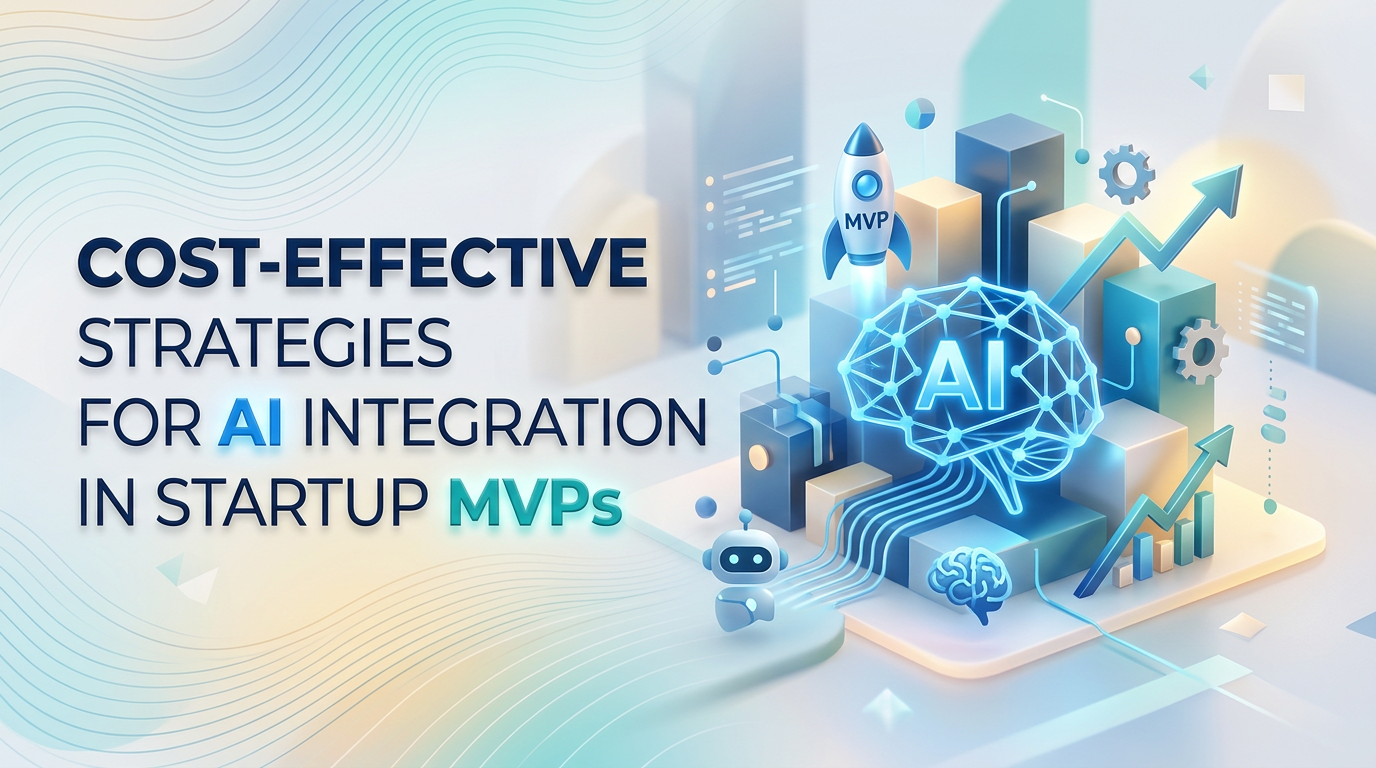
Artificial intelligence has transformed from a luxury technology reserved for enterprise corporations into an accessible tool that startups can leverage to compete in today's digital marketplace. For emerging businesses building Minimum Viable Products (MVPs), integrating AI capabilities can differentiate your offering, automate critical processes, and deliver personalized experiences that customers increasingly expect. However, the perception that AI development requires massive budgets often discourages founders from exploring these transformative technologies.
The reality is far more encouraging. With the right strategies, startups can integrate powerful AI capabilities into their MVPs without draining their limited resources. The key lies in understanding the landscape of available tools, choosing the right implementation approach, and scaling AI features thoughtfully as your product gains traction. This comprehensive guide explores proven cost-effective strategies that Sapient Code Labs recommends for startups seeking to harness AI in their MVP development journey.
Prove one valuable workflow first — that's how we run MVP development.
Understanding the True Cost of AI Integration
Before diving into strategies, it's essential to understand what you're actually paying for when integrating AI into your MVP. Traditional AI development involves several cost components that can quickly add up: data collection and preparation, model training, infrastructure setup, ongoing maintenance, and specialized talent acquisition. Each of these elements can represent significant expenditure if not approached strategically.
However, the AI landscape has evolved dramatically in recent years. The emergence of pre-trained models, cloud-based AI services, and open-source frameworks has democratized access to sophisticated AI capabilities. Modern startups can now leverage enterprise-grade AI technology through pay-as-you-go models, eliminating the need for massive upfront investments. Understanding these shifting dynamics is the first step toward cost-effective AI integration.
The most successful startup MVPs treat AI not as a massive engineering undertaking but as an enhancement layer built atop proven platforms and services. This approach allows founders to focus on their core product value proposition while still delivering intelligent features that resonate with users.
Leveraging AI APIs and Pre-Built Services
One of the most powerful cost-effective strategies for AI integration involves utilizing Application Programming Interfaces (APIs) offered by major technology companies. These services provide pre-trained, production-ready AI models that you can integrate directly into your application with minimal development overhead. Companies like Google, Amazon, Microsoft, and OpenAI offer AI capabilities through accessible APIs that handle the complex model training and infrastructure internally.
The beauty of API-based AI integration lies in its scalability and predictability. Most providers offer generous free tiers suitable for MVP development, with pricing that scales alongside your user base. Whether you need natural language processing for chatbots, image recognition capabilities, speech-to-text functionality, or recommendation engines, established APIs can deliver these features without requiring your team to become machine learning experts.
For example, integrating sentiment analysis to gauge customer feedback requires only a few API calls rather than training a custom model from scratch. Similarly, implementing intelligent document processing or automated translation services becomes straightforward when leveraging existing solutions. This approach dramatically reduces development time while providing reliable, enterprise-grade results.
Embracing Open Source AI Frameworks
Open source AI frameworks represent another avenue for cost-effective integration, particularly for startups with technical teams capable of implementing custom solutions. Libraries like TensorFlow, PyTorch, and Hugging Face provide access to state-of-the-art machine learning models that can be fine-tuned for specific use cases without the recurring costs associated with commercial APIs.
The open source route requires more technical expertise but offers greater flexibility and control. Startups can customize models to their exact needs, avoid vendor lock-in, and potentially reduce long-term costs as their usage scales. Many successful AI products began with open source foundations before potentially transitioning to commercial solutions as they matured.
Use published numbers for what an MVP actually costs, then add model spend as an explicit line item.
However, it's important to honestly assess your team's capabilities before pursuing this path. While open source reduces licensing costs, it introduces complexity in model deployment, maintenance, and optimization. The total cost of ownership may not always be lower than API-based solutions, especially for teams without deep machine learning expertise.
Implementing Phased AI Rollouts
Strategic timing represents one of the most underutilized cost-saving approaches in AI integration. Rather than attempting to implement comprehensive AI capabilities from day one, successful startups often pursue phased rollouts that align AI features with product development stages and user feedback.
Beginning with simpler AI features allows you to validate market demand before investing in more sophisticated capabilities. A chatbot that handles basic FAQs costs far less to implement than an advanced conversational AI system, yet both can deliver value to early users. By starting small, you gather crucial data about how users interact with AI features, informing future development decisions.
This phased approach also spreads development costs over time, preserving capital during the critical early stages of startup growth. As your MVP gains traction and generates revenue, you can reinvest in more advanced AI features. This strategy aligns your AI investment with actual business progress rather than speculative future needs.
Focusing on High-Impact, Low-Complexity Features
Not all AI features require equal investment to deliver value. Some capabilities offer substantial user experience improvements through relatively straightforward implementations. Understanding which AI features provide the best return on investment helps startups allocate resources effectively.
Recommendation engines, for instance, can significantly enhance user engagement with implementation complexity that varies widely based on sophistication requirements. Simple collaborative filtering approaches can deliver meaningful results, while more advanced deep learning models require substantially more resources. Similarly, automated categorization, content personalization, and basic predictive analytics often provide immediate value without requiring cutting-edge AI technology.
The key is identifying AI features that directly support your core value proposition. If your MVP solves a specific problem, look for AI capabilities that enhance that solution rather than adding unrelated features. This focused approach ensures every dollar spent on AI development contributes tangibly to user satisfaction and product differentiation.
Utilizing Transfer Learning and Fine-Tuning
Transfer learning represents a powerful technique that dramatically reduces the cost and complexity of implementing custom AI solutions. Rather than training models from scratch, which requires massive datasets and significant computational resources, transfer learning allows you to start with pre-trained models and adapt them to your specific needs.
If the MVP includes agents or tool-use, that slice is AI agentic development.
This approach has democratized custom AI development. A startup building a product classifier, for instance, can take an existing image recognition model and fine-tune it with a relatively small dataset of product images specific to their domain. The model leverages knowledge from millions of general images while learning the nuances of your specific application.
The computational requirements for fine-tuning are typically a fraction of training from scratch, making this approach accessible to startups without massive infrastructure budgets. Many cloud providers offer dedicated tools and pricing specifically designed for transfer learning workflows, further reducing barriers to implementation.
Choosing the Right Cloud Infrastructure
Cloud infrastructure decisions significantly impact the cost-effectiveness of AI integration. Major cloud providers offer specialized AI services that can reduce both development time and operational costs. However, navigating the various options and pricing models requires careful consideration.
Serverless computing, for example, allows you to run AI inference without maintaining dedicated servers, scaling automatically with demand and charging only for actual usage. This approach eliminates the need to provision infrastructure for peak loads that may occur infrequently, potentially saving substantial amounts during MVP development when traffic patterns remain unpredictable.
Additionally, most cloud providers offer startup programs with credits, reduced pricing, and dedicated support for emerging companies. These programs can significantly offset AI infrastructure costs during critical early stages. Researching and leveraging these opportunities should be a priority for budget-conscious startups.
Measuring and Optimizing AI ROI
Implementing AI cost-effectively requires ongoing attention to return on investment. Features that seemed worthwhile during development may prove less valuable than anticipated, while unexpected opportunities may emerge. Establishing clear metrics for AI feature success allows you to make informed decisions about continued investment or optimization.
Key metrics to track include development costs versus delivered value, user engagement with AI features, operational costs of running AI components, and maintenance overhead. Regular analysis of these metrics reveals opportunities for optimization, whether through more efficient algorithms, improved infrastructure utilization, or strategic feature adjustments.
Remember that AI integration is not a one-time project but an evolving capability. The most successful startups continuously evaluate their AI investments, scaling features that deliver value while retiring or simplifying those that don't justify their costs.
Conclusion: Strategic AI Integration Within Reach
The path to integrating AI into your startup MVP doesn't require massive budgets or teams of PhD researchers. By leveraging pre-built APIs, exploring open source frameworks, implementing phased rollouts, and focusing on high-impact features, startups can deliver intelligent experiences that compete with far better-funded competitors.
The key principles remain consistent: start with clear understanding of your needs, choose approaches that match your technical capabilities, scale investments with your business growth, and continuously measure the impact of AI features on user satisfaction and business outcomes. With these strategies, cost-effective AI integration becomes not just a possibility but a practical reality for startups committed to building intelligent products.
As AI technology continues to evolve and become more accessible, the opportunities for startups will only expand. Those who develop competencies in strategic AI integration now will be well-positioned to leverage future advancements as they emerge. The time to begin your AI integration journey is today, and with the right approach, your MVP can benefit from intelligent capabilities that drive real value for your users and your business.
Ready to ship this? Run a Scoping Sprint ($2,300, two weeks) for a prototype, plan and fixed quote — or talk to us.