Introduction to AI Agents in Sales
The landscape of sales and business development has undergone a dramatic transformation in recent years. Companies are increasingly turning to artificial intelligence to streamline their processes, reduce manual workloads, and improve conversion rates. At the forefront of this revolution are AI agents—intelligent software systems capable of autonomously handling complex sales tasks that traditionally required human intervention.
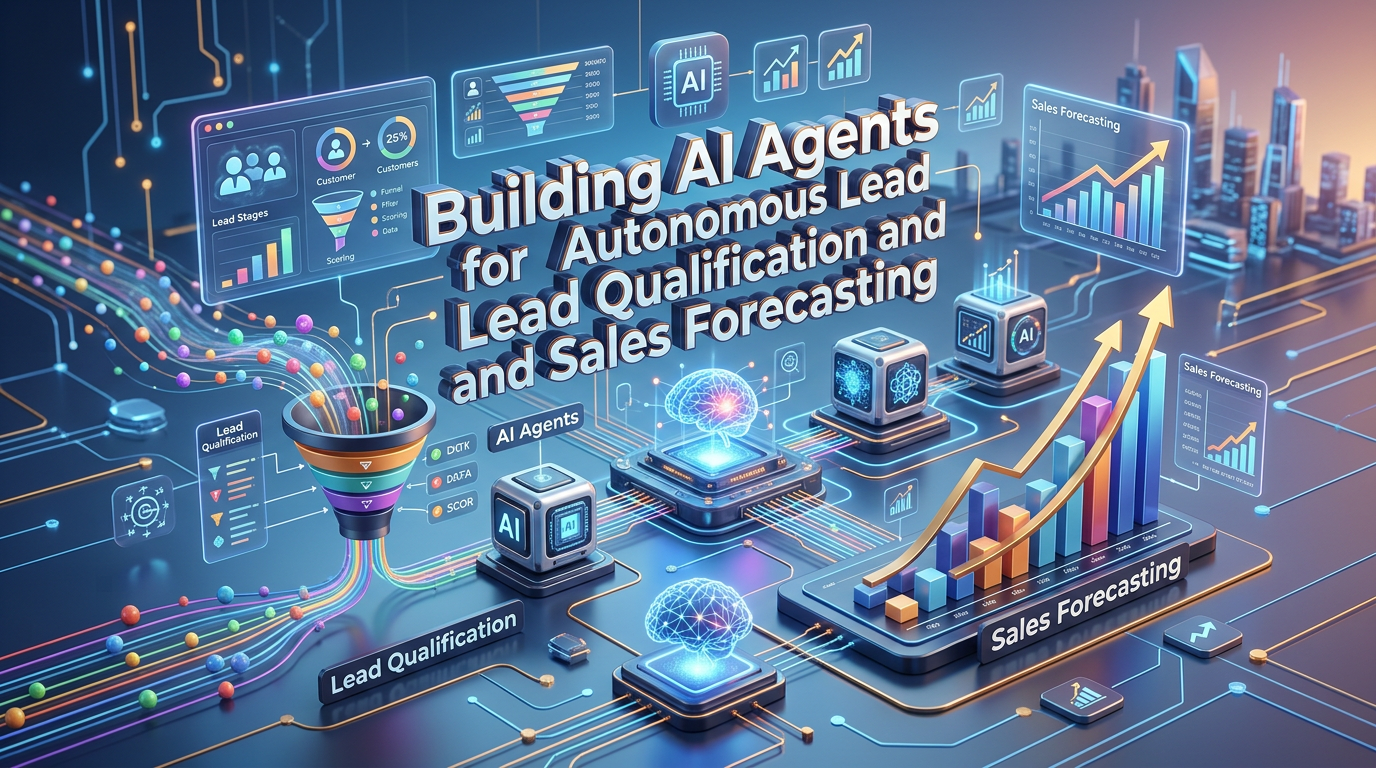
Building AI agents for autonomous lead qualification and sales forecasting represents one of the most impactful applications of artificial intelligence in modern business. These intelligent systems can analyze vast amounts of data, identify patterns, and make decisions that drive revenue growth while freeing up sales teams to focus on high-value relationship building.
Production agents need auth, audit, evaluation and integration — that's AI agentic development.
Sapient Code Labs specializes in developing cutting-edge AI solutions that help businesses automate their sales processes. In this comprehensive guide, we will explore the architecture, implementation, and benefits of AI-powered lead qualification and forecasting systems.
Understanding AI Agents in Sales Context
An AI agent in the sales context is a software system that utilizes machine learning, natural language processing, and predictive analytics to perform specific sales-related tasks autonomously. Unlike traditional automation tools that follow rigid rules, AI agents can learn from data, adapt to changing circumstances, and make intelligent decisions based on contextual information.
These agents operate on a foundation of sophisticated algorithms that enable them to process both structured and unstructured data. They can analyze customer interactions, understand intent, and respond appropriately—all without human intervention. The key differentiator is their ability to handle ambiguity and make nuanced decisions that would typically require human judgment.
AI agents for sales applications typically fall into several categories: lead scoring agents that evaluate and rank prospects, conversational agents that engage with potential customers, forecasting agents that predict future sales performance, and recommendation agents that suggest next-best actions for sales teams.
Autonomous Lead Qualification: How It Works
Lead qualification is the process of determining whether a potential customer is likely to become a paying customer. Traditionally, this involved manual research, phone calls, and email exchanges—processes that are time-consuming and often inconsistent. AI agents transform this by automating the entire qualification workflow while maintaining (or even improving) accuracy.
The autonomous lead qualification process begins with data ingestion. AI agents collect data from multiple sources including website interactions, email communications, social media activity, firmographic data, and CRM records. This data is then processed through machine learning models that extract relevant features and patterns.
Natural language processing plays a crucial role in autonomous qualification. AI agents can analyze written communications, understand intent, and identify buying signals. They can interpret responses to marketing campaigns, assess engagement levels, and determine the readiness of a lead to progress through the sales funnel.
The scoring mechanism uses these insights to assign a qualification score to each lead. This score considers multiple factors including demographic fit, behavioral signals, engagement history, and predictive attributes. The system continuously refines its scoring model based on outcomes, improving accuracy over time.
Perhaps most importantly, autonomous AI agents can engage in two-way conversations with leads through chatbots and email automation. They can answer questions, provide relevant information, and even handle objections—all while maintaining a natural, human-like interaction style.
Sales Forecasting with Artificial Intelligence
Sales forecasting is critical for business planning, resource allocation, and financial management. Traditional forecasting methods often rely on historical data and simple statistical models that fail to capture the complexity of modern sales cycles. AI-powered forecasting agents revolutionize this process by incorporating multiple data sources and advanced predictive techniques.
We treat the surrounding product as end-to-end product development, not a separate science project.
Machine learning models for sales forecasting analyze historical sales data alongside external factors such as economic indicators, market trends, seasonal patterns, and competitive activities. These models can identify non-linear relationships and complex patterns that human analysts might miss.
The forecasting process typically involves several stages. First, the system ingests and cleans historical sales data. Then, it identifies relevant features that influence sales outcomes. Advanced algorithms then build predictive models that estimate future sales with configurable time horizons—whether next month, next quarter, or next year.
One of the key advantages of AI forecasting is its ability to provide confidence intervals. Rather than offering a single number, AI systems can provide ranges that account for uncertainty, helping businesses plan for various scenarios. This probabilistic approach gives leadership teams better information for strategic decisions.
AI forecasting agents also excel at identifying potential risks and opportunities. They can flag deals that are likely to stall, identify accounts showing signs of churn, and highlight emerging opportunities that might otherwise go unnoticed.
Key Technologies and Architecture
Building effective AI agents for sales requires a carefully designed technology stack. At the foundation are robust data infrastructure and management systems. High-quality data is essential for training accurate machine learning models, so organizations must invest in data pipelines that ensure consistency, completeness, and freshness.
Machine learning frameworks form the core of AI agent capabilities. Modern ML platforms provide the tools necessary to develop, train, and deploy models at scale. For sales applications, common approaches include gradient boosting models, neural networks, and ensemble methods that combine multiple techniques for improved accuracy.
Natural language processing capabilities enable AI agents to understand and generate human language. This includes text classification, sentiment analysis, entity extraction, and language generation. For conversational AI applications, sophisticated dialogue management systems enable natural, multi-turn conversations.
Integration capabilities are critical for practical deployment. AI agents must seamlessly connect with existing business systems including CRM platforms, marketing automation tools, email systems, and data warehouses. API-first architectures and robust integration frameworks ensure smooth data flow and system interoperability.
Scalability and reliability considerations are essential for production deployments. Cloud-native architectures enable AI agents to handle variable workloads while maintaining performance. Monitoring and observability tools ensure that issues are detected and addressed quickly.
Use our SaaS development cost guide to budget the product shell around the models.
Implementation Best Practices
Successful implementation of AI agents for sales requires careful planning and execution. The journey typically begins with clearly defined objectives. Organizations should identify specific use cases and success metrics before beginning development. Whether the goal is improving conversion rates, reducing qualification time, or increasing forecast accuracy, having clear targets guides the development process.
Data quality cannot be overstated. Before deploying AI agents, organizations should assess their data landscape and address any gaps or inconsistencies. This might involve cleaning existing records, implementing data governance policies, or integrating additional data sources.
A phased approach to implementation often yields the best results. Starting with a pilot program allows teams to validate the technology, refine processes, and build confidence before broader deployment. This also provides valuable feedback that can inform future development.
Change management and training are frequently overlooked but critical success factors. Sales teams need to understand how AI agents augment their work rather than replace them. Clear communication about the role of AI, along with training on new workflows and tools, helps ensure adoption and maximizes the value of AI investments.
Continuous improvement through feedback loops ensures that AI agents deliver lasting value. Systems should be designed to capture feedback from users and incorporate it into model retraining. Regular performance reviews help identify areas for optimization and ensure that the system continues to meet evolving business needs.
Benefits for Business Growth
The implementation of AI agents for lead qualification and sales forecasting delivers substantial benefits across multiple dimensions. Perhaps most immediately visible is the dramatic improvement in efficiency. Sales teams spend significantly less time on qualification activities, allowing them to focus on high-value interactions with qualified prospects.
Conversion rates typically improve as AI agents identify and prioritize leads with the highest potential. By applying consistent, data-driven criteria to lead scoring, organizations ensure that sales resources are directed toward the most promising opportunities. This optimization leads to shorter sales cycles and improved win rates.
Sales forecasting accuracy sees significant improvements with AI-powered systems. More accurate forecasts enable better planning for inventory, staffing, and financial management. The ability to identify risks and opportunities early helps organizations respond proactively to changing market conditions.
Beyond operational improvements, AI agents provide valuable insights that inform strategic decisions. The patterns and trends identified by AI systems can reveal opportunities for product development, market expansion, and competitive positioning.
Conclusion
Building AI agents for autonomous lead qualification and sales forecasting represents a significant opportunity for organizations looking to accelerate growth and improve operational efficiency. These intelligent systems transform how businesses identify, engage, and convert prospects while providing the predictive insights needed for strategic planning.
The technology required to implement these solutions is mature and accessible. Organizations that invest in building robust AI agents position themselves for sustained competitive advantage in an increasingly digital marketplace.
As AI capabilities continue to evolve, the potential applications in sales will only expand. Early adopters who develop expertise in this area now will be well-positioned to capitalize on future advances.
Sapient Code Labs has extensive experience developing custom AI solutions for sales automation. Our team of experts can help you design and implement AI agents tailored to your specific business requirements. Contact us today to explore how intelligent automation can transform your sales operations.
Ready to ship production AI agents? Run a Scoping Sprint ($2,300, two weeks) for a prototype, plan and fixed quote — or talk to us.