EventSphere · Mobile & Web application development
Event Planning Marketplace: How EventSphere Was Built
EventSphere is a four-sided marketplace we built for event planning: planners on one side, and venues, vendors and talent on the other three. Planners search and shortlist, message directly to check availability, and book and pay through the platform.
If you are researching event marketplaces or planning to build one, the write-up below is the useful part. It covers why four sides is genuinely harder than two, where these platforms actually fail, what the build costs, and when the answer is not to build one at all.

Marketplace for
Event Planners,
Talents & Venues
+ Frontend: NextJS
+ Backend: Node.js
+ Database: MongoDB
+ Hosting: AWS
+ 3rd party services: AWS S3, AWS SES, Stripe Payment Gateway, Google Maps

Client App
Event Planners
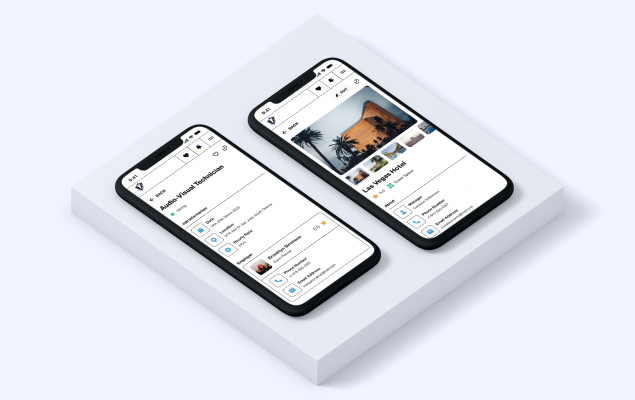
+ Easily discover venues, vendors, and talents based on your event requirements and locations.
+ Communicate directly with shortlisted talents, venues, and vendors to confirm availability and specific event needs.
+ Securely hire and manage event-related services through integrated Stripe payments.
Venues
+ Showcase your venue with rich media, detailed descriptions, and precise location tagging using Google Maps.
+ Receive bookings and manage your availability calendar efficiently.
+ Engage directly with event planners and vendors through real-time messaging and email notifications via AWS SES.

Web App
Vendors
+ Highlight your services and specialties with detailed profiles and portfolios.
+ Receive inquiries, respond promptly, and manage bookings seamlessly.
+ Secure financial transactions via integrated Stripe payments.
Talents
+ Create a professional profile featuring your expertise, availability, and previous work.
+ Receive booking requests and communicate directly with event planners to clarify expectations and deliverables.
+ Benefit from secure and timely payments using the integrated payment system powered by Stripe.


Four sides is not two sides twice
Most marketplace writing assumes buyers and sellers. An event platform has a planner looking for services, and three different kinds of supply that behave nothing alike.
- Venues are fixed inventory with hard capacity and calendar conflicts. A double booking is a catastrophe, not a bug.
- Vendors such as catering or production are capacity-based. They can often take two jobs in a weekend but not three, and they price per event rather than per slot.
- Talent is a single person who can be in exactly one place. Availability is binary and personal.
Each needs a different profile, a different availability model and a different booking flow. Building one supply-side abstraction that covers all three is the first design trap, and it produces a system where nothing fits properly. EventSphere models them separately, and that is why the search and booking experience differs by type.
It runs on Next.js with a Node and MongoDB backend on AWS, using S3 for media, SES for mail, Google Maps for location search and Stripe for payments.
Discovery is the product, not a feature
A planner is not browsing. They have a date, a place, a budget and a specific need, and the platform either surfaces the right handful of options or it does not get used again.
That makes search harder than a keyword box. It is filtering on availability for a specific date, distance from a venue that may itself not be booked yet, capacity, and budget, across three supply types with different attributes. Location search sits on Google Maps, but the ranking logic underneath is where the work is.
The failure mode is a planner who searches, gets forty results with no way to tell them apart, and goes back to the spreadsheet of contacts they already had. Every marketplace competes with a spreadsheet, and the spreadsheet is free.
Messaging, and the leak every marketplace has
Planners need to talk to suppliers before booking, because event requirements are specific and rarely fit a listing. So messaging is essential. It is also where your revenue goes to die, because two parties who have made contact can finish the deal by phone and cut you out.
There is no technical fix for this, and anyone selling you one is wrong. What works is making the platform worth staying inside: the contract, the deposit, the payment protection, the cancellation terms and the record of what was agreed. People route around a platform that is only an introduction service. They stay inside one that holds the agreement.
Decide early how much of that you are building, because it changes the scope considerably.
Payments when money moves between several parties
One event can involve a venue, a caterer and a performer, each paid separately, often on different schedules, sometimes with a deposit now and the balance later. EventSphere handles payments through Stripe.
The architecture question underneath is who is the merchant of record and when money is released, and it is expensive to change once you have live suppliers and transaction history. Our guide to marketplace payment splits covers the charge types in full, including why a single basket spanning several suppliers needs separate charges and transfers rather than the simpler default, and why holding funds until an event is confirmed changes the design.
Cold start, which is the actual reason these fail
An event marketplace with no venues is useless to planners, and one with no planners is a waste of time for venues. Every marketplace has this problem and event platforms have it in a particularly awkward form, because supply is intensely local. Solving it in one city gets you nothing in the next one.
The launches that work almost always pick one city, recruit supply manually before any planner sees the product, and accept that the founders are doing sales rather than the software doing it. Budget for that period. It is longer than anyone plans for, and no feature shortens it.
If you cannot describe how the first fifty suppliers get onto the platform, the build is premature.
What it costs to build
A four-sided marketplace with search, messaging, calendars and split payments sits in the upper half of our published marketplace range of $15,000 to $150,000+, and a sensible first release sits well below the top of it.
The way to spend less is to narrow the sides rather than thin the features. One supply type done properly, with real availability and real payments, beats three done partially. You can add venues in month six once planners are actually booking talent. Our MVP cost guide prices the pieces at our published rate of about $20 per hour for a senior team.
When not to build one
If the transaction is rare and high value, such as a wedding venue booked once in a lifetime, the economics are unforgiving: acquisition costs are high and nobody comes back. Repeat categories, like corporate events or regular production work, support a marketplace far better.
And if what you actually need is a booking tool for your own venues or your own roster rather than an open market, build that instead. It is a fraction of the cost and it will work in month one rather than month twelve.
If a marketplace is genuinely the right shape, this is marketplace development and services marketplace development, and it is work we have shipped. A Scoping Sprint is $2,300 and two weeks, ending with a clickable prototype, an architecture plan and a fixed quote for your version. Or just start a conversation.