Introduction: The Promise and Reality of Enterprise AI Agents
Enterprise organizations across industries are racing to adopt AI agents to automate complex workflows, enhance customer experiences, and drive operational efficiency. The initial pilots often show remarkable promise—demonstrating capabilities that seem ready to revolutionize business operations. Yet despite significant investment and enthusiasm, a concerning pattern emerges: the vast majority of these pilot projects never make it to full production deployment.
This phenomenon, known as the pilot-to-production gap, represents one of the most significant challenges facing enterprise AI adoption today. Organizations invest substantial resources in proof-of-concept demonstrations, only to find their AI agents stalling at the threshold of production deployment. Understanding why this gap exists—and more importantly, how to bridge it—has become critical for organizations seeking to realize the true value of their AI investments.
Production agents need auth, audit, evaluation and integration — that's AI agentic development.
Understanding the Pilot-to-Production Gap
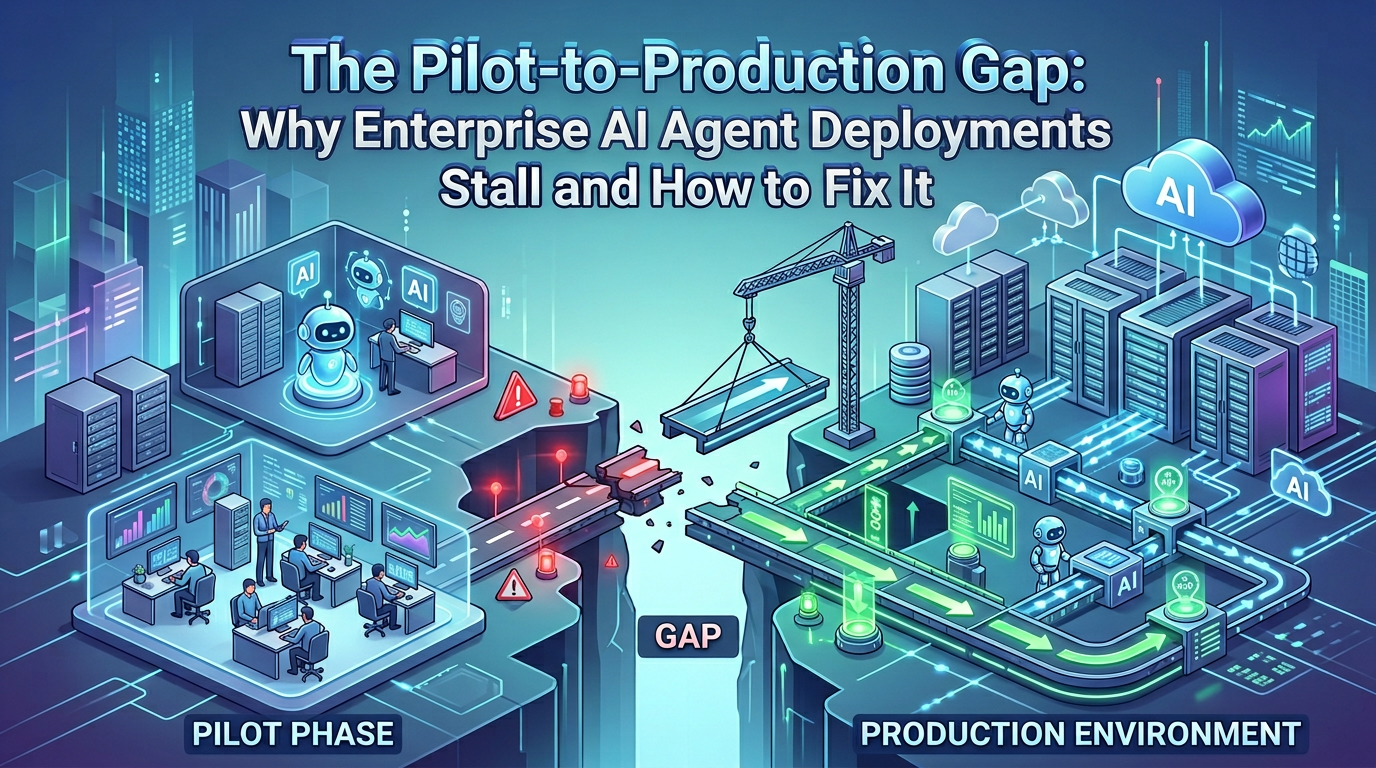
The pilot-to-production gap refers to the distance between a successful AI agent pilot project and its deployment as a fully operational system within an organization's production environment. While pilots are conducted under controlled conditions with limited scope, production environments present a vastly different landscape filled with complexity, scale, and real-world unpredictability.
Industry research consistently shows that fewer than 15% of enterprise AI pilots successfully transition to production. This statistic represents not just wasted investment but a fundamental barrier to achieving meaningful ROI from AI technology. The gap isn't merely technical—it encompasses organizational, operational, and strategic dimensions that require holistic addressing.
Key Reasons Why Enterprise AI Agent Deployments Stall
1. Technical Complexity and Integration Challenges
One of the primary culprits behind stalled deployments is the dramatic difference between pilot environments and production systems. Pilot projects typically operate in clean, controlled environments with simplified data sources and limited integration points. Production environments, by contrast, demand integration with multiple legacy systems, diverse data formats, and existing business workflows.
AI agents in production must handle real-time data streams, maintain consistency across distributed databases, and operate reliably alongside human workers and automated systems. The technical debt accumulated during rapid pilot development often becomes apparent only when attempting production deployment, revealing performance bottlenecks, security vulnerabilities, and scalability limitations that were invisible in controlled testing environments.
2. Data Quality and Availability Issues
AI agents are only as effective as the data they consume, and production environments expose data quality issues that pilots rarely encounter. Inconsistent data formats, missing fields, duplicate records, and outdated information can severely impact agent performance. Furthermore, data silos across departments prevent AI agents from accessing the comprehensive information needed for accurate decision-making.
Governance adds another layer of complexity. Production AI agents must comply with data protection regulations, industry standards, and internal policies. Establishing proper data lineage, implementing access controls, and ensuring audit trails require significant effort that many organizations underestimate during pilot phases.
3. Scalability and Performance Requirements
A pilot handling hundreds of requests differs dramatically from a production system serving thousands of concurrent users. Performance expectations in production are far stricter—response times must be consistent, uptime must approach 99.9%, and the system must handle traffic spikes without degradation.
Many AI agent architectures designed for pilots simply cannot scale to meet enterprise demands. Infrastructure decisions made during pilot development may prove inadequate when facing production workloads. Load testing in controlled environments rarely captures the true complexity of production traffic patterns, leading to performance issues that surface only after deployment.
We treat the surrounding product as end-to-end product development, not a separate science project.
4. Organizational and Cultural Barriers
Technical challenges often overshadow equally critical organizational barriers. Resistance from employees who fear job displacement or feel threatened by AI collaboration creates friction. Departments may lack the skills needed to manage and maintain AI systems, creating dependency on external vendors or specialized teams.
Additionally, unclear ownership and accountability structures stall deployments. Who is responsible when an AI agent makes an error? How are decisions audited? These questions often remain unanswered until production deployment forces organizations to confront them, delaying timelines significantly.
5. Security and Compliance Concerns
Enterprise environments demand rigorous security postures that pilot projects typically don't address. AI agents processing sensitive business data must implement robust authentication, authorization, encryption, and monitoring mechanisms. The attack surface presented by AI systems—particularly those with language interfaces—introduces novel security considerations that traditional security teams may not fully understand.
Compliance requirements vary by industry and jurisdiction, adding layers of complexity. Financial services face different regulations than healthcare or manufacturing. Ensuring AI agents meet all applicable requirements while maintaining functionality requires careful planning and often significant architectural changes.
How to Bridge the Pilot-to-Production Gap
Adopt a Production-First Architecture Approach
Rather than treating production deployment as an afterthought, organizations should design for production from the beginning. This means establishing scalability requirements, security protocols, and integration patterns during the pilot phase itself. Using modular architectures that separate core logic from integration layers enables easier adaptation to production environments.
Implementing robust observability from day one provides visibility into system behavior, enabling proactive identification of issues before they impact operations. Logging, monitoring, and alerting infrastructure should mirror production requirements even during pilot phases.
Invest in Data Infrastructure
Addressing data quality issues requires upfront investment in data governance and infrastructure. Organizations should establish clear data ownership, implement data quality monitoring, and create pipelines that clean and normalize information before it reaches AI agents. Building a unified data layer that provides consistent access across systems reduces integration complexity.
Use our SaaS development cost guide to budget the product shell around the models.
Data pipelines designed for production should include validation checks, error handling, and recovery mechanisms. These operational concerns often receive insufficient attention during pilot development but become critical in production environments.
Implement Robust Testing and Validation
Production deployment requires comprehensive testing that goes beyond pilot demonstrations. Load testing should simulate realistic traffic patterns, including peak loads and unusual scenarios. Integration testing must verify proper operation with all connected systems. Security testing should identify vulnerabilities before attackers can exploit them.
Establishing clear acceptance criteria before deployment helps ensure readiness. These criteria should include performance benchmarks, reliability targets, security requirements, and user satisfaction metrics. Regular review against these criteria identifies gaps requiring attention before production launch.
Build Cross-Functional Teams
Successful production deployment requires collaboration across multiple disciplines. Building cross-functional teams that include AI specialists, software engineers, operations staff, security experts, and business stakeholders ensures all perspectives are considered. These teams should own the deployment process end-to-end, reducing handoff delays and accountability gaps.
Investing in training and skill development prepares existing staff to work alongside AI agents effectively. Creating documentation, runbooks, and operational procedures ensures knowledge transfer beyond specialized team members.
Start with High-Value, Low-Risk Use Cases
Choosing the right pilot project significantly impacts production success. Selecting use cases that deliver measurable business value while presenting limited risk enables organizations to build experience and confidence. High-stakes, complex deployments often face greater resistance and scrutiny, making incremental success more valuable.
As teams gain experience with production operations, they can tackle increasingly complex deployments. This progressive approach builds organizational capability while demonstrating value that justifies further investment.
The Path Forward: From Pilot to Production
Closing the pilot-to-production gap requires acknowledging that enterprise AI deployment is fundamentally a business challenge, not merely a technical one. Organizations must approach AI adoption with the same rigor applied to other major enterprise initiatives—clear ownership, defined success criteria, adequate resources, and realistic timelines.
The organizations most successful at production AI deployment treat pilots as learning opportunities rather than final demonstrations. They build operational capabilities alongside technical capabilities, addressing governance, security, and organizational readiness as integral parts of the deployment process.
Conclusion
The pilot-to-production gap represents a significant obstacle to enterprise AI success, but it's not an insurmountable one. By understanding the common pitfalls and implementing systematic approaches to address them, organizations can dramatically improve their success rates. The key lies in treating production deployment as a comprehensive organizational challenge rather than a narrow technical problem.
Organizations that successfully bridge this gap position themselves to capture substantial value from AI technology—operational efficiency, enhanced customer experiences, and competitive advantages that become increasingly difficult for laggards to replicate. The journey from pilot to production may be challenging, but the rewards justify the effort.
Building production AI agents? A Scoping Sprint ($2,300, two weeks) ends with a clickable prototype, a technical plan and a fixed quote — or just start a conversation.