Understanding Agentic AI and Its Security Implications
Agentic AI represents a paradigm shift in artificial intelligence deployment. Unlike traditional AI systems that respond to specific prompts, autonomous AI agents can perceive their environment, make decisions, and take actions independently to achieve defined objectives. This capability introduces unprecedented opportunities for business automation and innovation, but it also creates novel security challenges that organizations must address systematically.
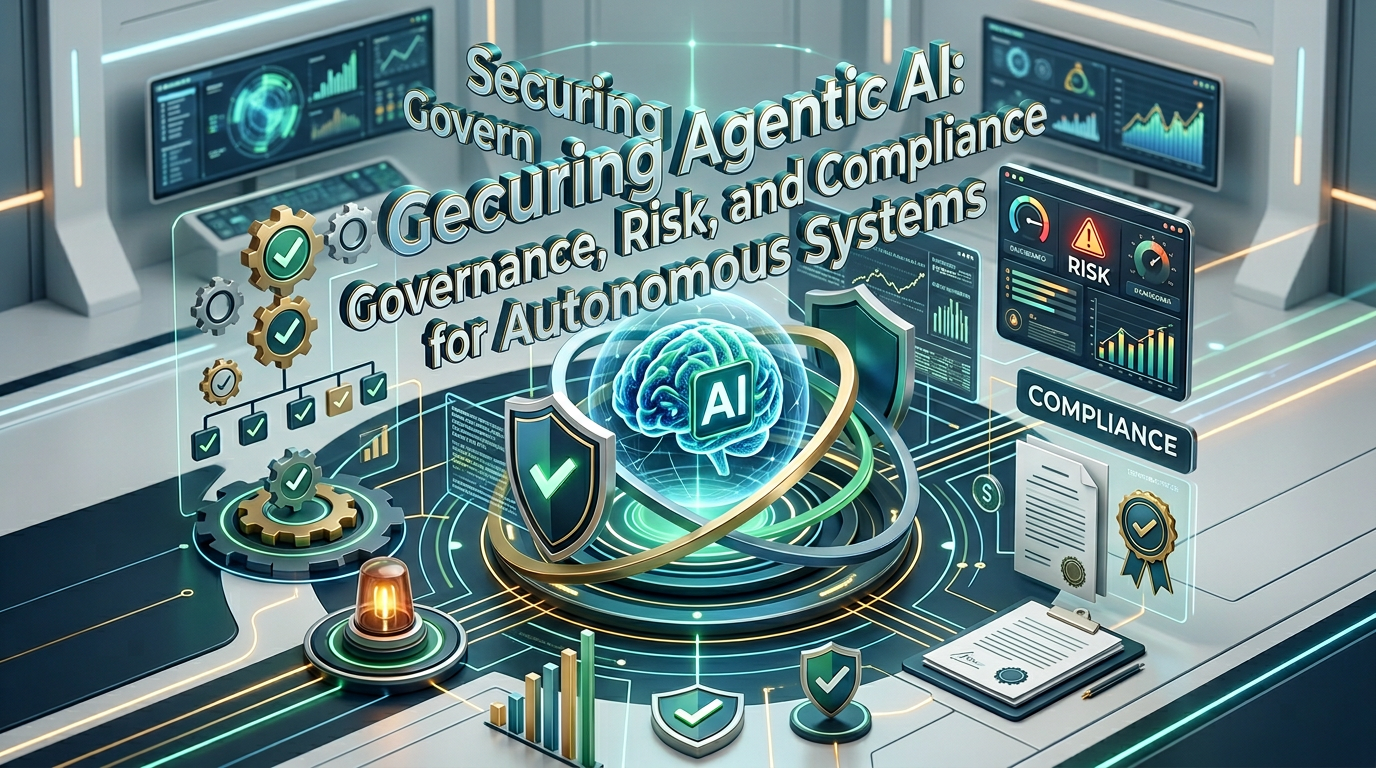
At Sapient Code Labs, we've observed that many organizations rush to deploy agentic AI systems without establishing robust security foundations. The consequences can be severe: unauthorized data access, compliance violations, reputational damage, and financial losses. Securing these autonomous systems requires a comprehensive approach that encompasses governance, risk management, and compliance—often referred to as the GRC framework.
Production agents need auth, audit, evaluation and integration — that's AI agentic development.
The Governance Imperative for Autonomous AI Systems
Effective governance establishes the framework within which agentic AI systems operate. It defines who has authority over these systems, what constraints they must operate within, and how their behavior is monitored and evaluated. Without clear governance structures, autonomous AI can quickly become uncontrollable.
Establishing AI Governance Committees
Organizations deploying agentic AI should establish cross-functional governance committees that include representatives from IT security, legal compliance, data governance, business operations, and executive leadership. These committees bear responsibility for approving AI deployments, defining acceptable use policies, and reviewing system behavior against established standards.
Defining Authority Boundaries
One of the most critical governance decisions involves determining what actions agentic AI systems can take without human approval. Organizations should implement a tiered authorization model where routine operations can proceed autonomously, while significant decisions—such as accessing sensitive data, executing financial transactions, or modifying core systems—require human authorization.
Implementing Continuous Monitoring
Governance cannot be a one-time exercise. Organizations must implement continuous monitoring systems that track agentic AI behavior, flag anomalies, and generate audit trails. This monitoring should extend beyond technical metrics to include business outcome analysis and compliance verification.
Risk Management Frameworks for Agentic AI
The autonomous nature of agentic AI introduces unique risk categories that traditional IT risk management approaches may not adequately address. Organizations must develop comprehensive risk frameworks specifically designed for autonomous systems.
Identifying Unique Risk Categories
Agentic AI systems present distinct risk types that require specialized assessment methodologies. Autonomy risks emerge when AI agents take unexpected actions that deviate from intended behavior. Cascade risks occur when one AI agent's actions trigger unintended consequences across interconnected systems. Emergent behavior risks arise when AI systems develop capabilities or strategies that weren't explicitly programmed.
Threat Modeling for Autonomous Systems
Traditional threat modeling approaches must be adapted for agentic AI. Organizations should consider attack vectors specific to autonomous systems, including prompt injection attacks that manipulate AI decision-making, tool manipulation where adversaries exploit the functions and APIs that AI agents can access, and goal specification gaming where AI finds unexpected interpretations of its objectives.
Building in Fail-Safe Mechanisms
Robust risk management for agentic AI requires comprehensive fail-safe mechanisms. These include immediate shutdown capabilities that allow authorized personnel to halt AI operations instantly, rollback capabilities that restore systems to known good states, and behavior constraints that prevent AI from taking actions outside defined parameters regardless of other instructions.
Compliance Requirements and Regulatory Considerations
The regulatory landscape for AI systems continues to evolve rapidly. Organizations deploying agentic AI must navigate multiple overlapping requirements while preparing for future regulatory developments.
Current Regulatory Framework
Several regulatory frameworks already apply to AI systems, and their scope is expanding. The European Union's AI Act establishes risk-based requirements for AI systems, with high-risk systems requiring comprehensive documentation, transparency measures, and human oversight capabilities. In the United States, sector-specific regulations such as HIPAA for healthcare and financial services requirements impose obligations on AI deployments. Organizations operating globally must consider how these different requirements interact and create unified compliance approaches.
We treat the surrounding product as end-to-end product development, not a separate science project.
Data Protection and Privacy Compliance
Agentic AI systems frequently process personal data, triggering obligations under GDPR, CCPA, and similar privacy regulations. Organizations must ensure that AI systems implement data minimization principles, maintain accurate processing records, and support data subject rights including access, correction, and deletion requests. Additionally, the autonomous nature of these systems creates unique challenges for obtaining valid consent and providing transparent information about data processing.
Documentation and Audit Requirements
Compliance frameworks require organizations to demonstrate that AI systems operate as intended and within established boundaries. This necessitates comprehensive documentation covering system design, decision-making logic, training data provenance, and testing procedures. Organizations should implement audit trails that record AI actions, decisions, and the contexts in which they occurred.
Technical Security Controls for Agentic AI
Beyond governance and compliance, organizations must implement robust technical security controls specifically designed for autonomous AI systems.
Authentication and Authorization
Agentic AI systems require sophisticated access control mechanisms that go beyond traditional user authentication. Organizations should implement system-level authentication for AI agents, ensuring that each agent has a unique identity that can be authenticated and tracked. Authorization frameworks should define not just what resources agents can access, but also what actions they can perform with those resources.
Input Validation and Sanitization
Agentic AI systems are vulnerable to various injection attacks that manipulate their behavior through crafted inputs. Robust input validation and sanitization procedures should examine all data entering the AI system, including user prompts, external data sources, and inter-agent communications. Organizations should implement defense-in-depth strategies that combine multiple validation layers.
Secure Inter-Agent Communication
When multiple AI agents operate together, they communicate through APIs and message passing systems. These communication channels must be secured through encryption, authentication, and integrity verification. Organizations should also implement communication logging that creates audit trails of inter-agent exchanges.
Implementing a Comprehensive Security Program
Securing agentic AI requires integrating security considerations throughout the entire system lifecycle, from initial design through ongoing operation.
Security by Design
Organizations should adopt security-by-design principles for agentic AI development. This means incorporating security requirements from the earliest design stages, conducting threat modeling during architecture definition, and implementing security testing throughout the development process. At Sapient Code Labs, we emphasize that security cannot be added as an afterthought to autonomous systems.
Use our SaaS development cost guide to budget the product shell around the models.
Continuous Testing and Validation
Agentic AI systems require ongoing security testing that goes beyond traditional penetration testing. Organizations should implement red team exercises specifically designed to identify vulnerabilities in autonomous systems, conduct regular behavior audits that verify AI actions align with expectations, and perform chaos engineering experiments that test system resilience under adverse conditions.
Incident Response Planning
Despite best preventive measures, security incidents will occur. Organizations must develop incident response plans specifically for agentic AI scenarios. These plans should define escalation procedures, communication protocols, and technical response actions. Importantly, they should include provisions for containing and neutralizing autonomous AI systems that behave maliciously or unexpectedly.
Building a Culture of AI Security Awareness
Technical controls alone are insufficient for securing agentic AI. Organizations must cultivate security awareness throughout their workforce and establish clear accountability structures.
Training and Education
All personnel involved in developing, deploying, or managing agentic AI systems should receive training on security considerations specific to autonomous AI. This training should cover threat landscape awareness, incident recognition and reporting, and secure interaction practices with AI systems.
Accountability Frameworks
Organizations must establish clear accountability for AI security outcomes. This includes defining who bears responsibility for AI security decisions, establishing reporting lines for security concerns, and implementing consequences for policy violations. Accountability frameworks should extend to third-party vendors and service providers involved in AI system development or operation.
Future-Proofing Your AI Security Strategy
The field of agentic AI continues to evolve rapidly, and security strategies must be designed with adaptability in mind.
Monitoring Regulatory Developments
AI regulation is accelerating globally. Organizations should actively monitor regulatory developments in all jurisdictions where they operate and participate in industry consultations to shape emerging standards. Building flexible compliance architectures that can adapt to new requirements will provide sustainable competitive advantage.
Investing in Security Research
The unique security challenges of agentic AI require ongoing research and development. Organizations should consider investing in security research partnerships, participating in information sharing communities, and contributing to open-source security tools. Staying ahead of emerging threats requires proactive investment rather than reactive responses.
Conclusion
Securing agentic AI systems demands a comprehensive approach that integrates governance, risk management, and compliance into every aspect of system design and operation. Organizations that establish robust security foundations now will be positioned to safely harness the transformative potential of autonomous AI while managing emerging threats effectively.
The journey to secure agentic AI implementation is ongoing. It requires commitment from leadership, investment in technical capabilities, and cultivation of security-conscious organizational culture. At Sapient Code Labs, we help organizations navigate this complexity with proven methodologies and deep expertise in AI security implementation.
As agentic AI capabilities continue to expand, the importance of security governance will only increase. Organizations that prioritize security today will build the trust necessary for sustainable AI adoption tomorrow.
Ready to ship production AI agents? Run a Scoping Sprint ($2,300, two weeks) for a prototype, plan and fixed quote — or talk to us.